Ch 02: Motion Along a Straight Line
Young & Freedman Calc - University Physics 15th Edition
Young & Freedman Calc15th EditionUniversity PhysicsISBN: 9780135159552Non è quello che usi tu?Cambia libro di testo
Capitolo 2, Problema 45

A 1515-kg rock is dropped from rest on the earth and reaches the ground in 1.751.75 s. When it is dropped from the same height on Saturn's satellite Enceladus, the rock reaches the ground in 18.618.6 s. What is the acceleration due to gravity on Enceladus?

Guida verificata passo dopo passo
1
Identify the known values for the problem on Earth: the mass of the rock (15 kg), the time it takes to reach the ground (1.75 s), and the acceleration due to gravity on Earth (9.81 m/s²).
Use the kinematic equation for free fall on Earth to find the height from which the rock is dropped: \( h = \frac{1}{2} g t^2 \), where \( g = 9.81 \text{ m/s}^2 \) and \( t = 1.75 \text{ s} \).
Calculate the height \( h \) using the values for Earth. This height will be the same for the drop on Enceladus.
Use the same kinematic equation for the drop on Enceladus: \( h = \frac{1}{2} g_{Enceladus} t^2 \), where \( t = 18.6 \text{ s} \) and \( h \) is the height calculated from the Earth scenario.
Solve for the acceleration due to gravity on Enceladus \( g_{Enceladus} \) by rearranging the equation: \( g_{Enceladus} = \frac{2h}{t^2} \). Substitute the known values to find \( g_{Enceladus} \).

Risposta video verificata per un problema simile:

Questa soluzione video è stata consigliata dai nostri tutor come utile per risolvere questo problema.
Durata del video:
5m

Concetti chiave

Ecco i concetti essenziali che devi comprendere per rispondere correttamente alla domanda.

Acceleration due to Gravity

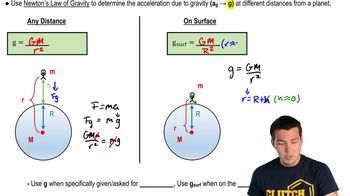
Acceleration due to gravity is the rate at which an object speeds up as it falls freely under the influence of gravity. On Earth, this is approximately 9.81 m/s². It varies depending on the celestial body, affecting how quickly objects fall.
Video consigliato:
Percorso guidato
05:20
Acceleration Due to Gravity

Free Fall Motion

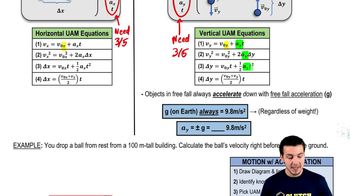
Free fall motion describes the movement of an object solely under the influence of gravity, without any air resistance. The time it takes for an object to reach the ground can be used to calculate the gravitational acceleration using kinematic equations.
Video consigliato:
Percorso guidato
08:36
Vertical Motion & Free Fall

Kinematic Equations

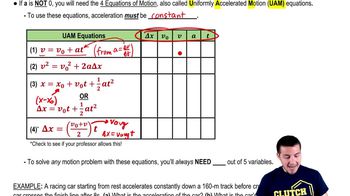
Kinematic equations relate the variables of motion: displacement, initial velocity, final velocity, acceleration, and time. For an object in free fall, these equations can determine the acceleration due to gravity by using the time of fall and initial conditions.
Video consigliato:
Percorso guidato
08:25
Kinematics Equations
Pratica correlata
Domanda del libro di testo

A large boulder is ejected vertically upward from a volcano with an initial speed of 40.040.0 m/s. Ignore air resistance. At what time after being ejected is the boulder moving at 20.020.0 m/s upward?

2187
views
Domanda del libro di testo

An egg is thrown nearly vertically upward from a point near the cornice of a tall building. The egg just misses the cornice on the way down and passes a point 30.030.0 m below its starting point 5.005.00 s after it leaves the thrower's hand. Ignore air resistance. What is the magnitude of its velocity at the highest point?

2394
views
Domanda del libro di testo

An egg is thrown nearly vertically upward from a point near the cornice of a tall building. The egg just misses the cornice on the way down and passes a point 30.030.0 m below its starting point 5.005.00 s after it leaves the thrower's hand. Ignore air resistance. How high does it rise above its starting point?

3192
views
Domanda del libro di testo

A large boulder is ejected vertically upward from a volcano with an initial speed of 40.040.0 m/s. Ignore air resistance. At what time is it moving at 20.020.0 m/s downward?

1692
views
Domanda del libro di testo

A large boulder is ejected vertically upward from a volcano with an initial speed of 40.040.0 m/s. Ignore air resistance. When is the displacement of the boulder from its initial position zero?

1897
views
Domanda del libro di testo

An egg is thrown nearly vertically upward from a point near the cornice of a tall building. The egg just misses the cornice on the way down and passes a point 30.030.0 m below its starting point 5.005.00 s after it leaves the thrower's hand. Ignore air resistance. What are the magnitude and direction of its acceleration at the highest point?

1735
views