Ch 02: Motion Along a Straight Line
Young & Freedman Calc - University Physics 15th Edition
Young & Freedman Calc15th EditionUniversity PhysicsISBN: 9780135159552Non è quello che usi tu?Cambia libro di testo
Capitolo 2, Problema 46a

A large boulder is ejected vertically upward from a volcano with an initial speed of 40.040.0 m/s. Ignore air resistance. At what time after being ejected is the boulder moving at 20.020.0 m/s upward?

Guida verificata passo dopo passo
1
Identify the known values: initial velocity \( v_0 = 40.0 \text{ m/s} \), final velocity \( v = 20.0 \text{ m/s} \), and acceleration due to gravity \( a = -9.8 \text{ m/s}^2 \) (negative because it acts downward).
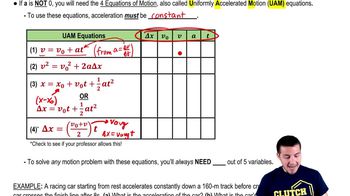
Use the kinematic equation that relates initial velocity, final velocity, acceleration, and time: \( v = v_0 + at \).
Substitute the known values into the equation: \( 20.0 = 40.0 + (-9.8)t \).
Rearrange the equation to solve for time \( t \): \( t = \frac{20.0 - 40.0}{-9.8} \).
Calculate the value of \( t \) using the rearranged equation to find the time at which the boulder is moving at 20.0 m/s upward.

Risposta video verificata per un problema simile:

Questa soluzione video è stata consigliata dai nostri tutor come utile per risolvere questo problema.
Durata del video:
1m

Concetti chiave

Ecco i concetti essenziali che devi comprendere per rispondere correttamente alla domanda.

Kinematics Equations

Kinematics equations describe the motion of objects under constant acceleration. For vertical motion, these equations relate initial velocity, final velocity, acceleration due to gravity, time, and displacement. In this problem, the equation v = u + at is used, where v is final velocity, u is initial velocity, a is acceleration (gravity), and t is time.
Video consigliato:
Percorso guidato
08:25
Kinematics Equations

Acceleration due to Gravity

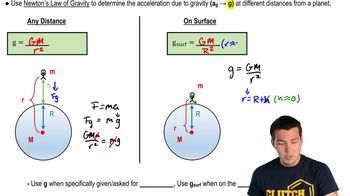
Gravity is a constant force that accelerates objects towards the Earth at approximately 9.81 m/s². In this scenario, the boulder is subject to this acceleration, which affects its velocity over time. Understanding gravity's role is crucial for calculating the time it takes for the boulder to reach a specific velocity.
Video consigliato:
Percorso guidato
05:20
Acceleration Due to Gravity

Initial and Final Velocity

Initial velocity is the speed at which an object starts its motion, while final velocity is the speed at a later time. In this problem, the boulder starts with an initial velocity of 40.0 m/s and we need to find the time when its velocity decreases to 20.0 m/s due to gravity's deceleration effect.
Video consigliato:
Percorso guidato
7:27
Escape Velocity
Pratica correlata
Domanda del libro di testo

A large boulder is ejected vertically upward from a volcano with an initial speed of 40.040.0 m/s. Ignore air resistance. When is the velocity of the boulder zero?

1711
views
Domanda del libro di testo

An egg is thrown nearly vertically upward from a point near the cornice of a tall building. The egg just misses the cornice on the way down and passes a point 30.030.0 m below its starting point 5.005.00 s after it leaves the thrower's hand. Ignore air resistance. What is the magnitude of its velocity at the highest point?

2394
views
Domanda del libro di testo

A large boulder is ejected vertically upward from a volcano with an initial speed of 40.040.0 m/s. Ignore air resistance. At what time is it moving at 20.020.0 m/s downward?

1692
views
Domanda del libro di testo

A large boulder is ejected vertically upward from a volcano with an initial speed of 40.040.0 m/s. Ignore air resistance. When is the displacement of the boulder from its initial position zero?

1897
views
Domanda del libro di testo

A 1515-kg rock is dropped from rest on the earth and reaches the ground in 1.751.75 s. When it is dropped from the same height on Saturn's satellite Enceladus, the rock reaches the ground in 18.618.6 s. What is the acceleration due to gravity on Enceladus?

2607
views
Domanda del libro di testo

An egg is thrown nearly vertically upward from a point near the cornice of a tall building. The egg just misses the cornice on the way down and passes a point 30.030.0 m below its starting point 5.005.00 s after it leaves the thrower's hand. Ignore air resistance. What are the magnitude and direction of its acceleration at the highest point?

1735
views