Ch 02: Motion Along a Straight Line
Young & Freedman Calc - University Physics 15th Edition
Young & Freedman Calc15th EditionUniversity PhysicsISBN: 9780135159552Non è quello che usi tu?Cambia libro di testo
Capitolo 2, Problema 49a

A rocket starts from rest and moves upward from the surface of the earth. For the first 10.010.0 s of its motion, the vertical acceleration of the rocket is given by ay=(2.80a_{y}=(2.80 m/s3)t)t, where the +y+y-direction is upward. What is the height of the rocket above the surface of the earth at t=10.0t = 10.0 s?

Guida verificata passo dopo passo
1
Identify the given information: The rocket starts from rest, meaning its initial velocity is 0 m/s. The vertical acceleration is given by \( a_y = 2.80 \text{ m/s}^3 \cdot t \), and we need to find the height at \( t = 10.0 \text{ s} \).
Understand the relationship between acceleration, velocity, and displacement. Since acceleration is a function of time, integrate the acceleration function \( a_y(t) = 2.80 \text{ m/s}^3 \cdot t \) with respect to time to find the velocity function \( v_y(t) \).
Perform the integration: \( v_y(t) = \int a_y(t) \, dt = \int 2.80 \text{ m/s}^3 \cdot t \, dt = 1.40 \text{ m/s}^3 \cdot t^2 + C \). Since the initial velocity is 0 m/s, \( C = 0 \), so \( v_y(t) = 1.40 \text{ m/s}^3 \cdot t^2 \).
Integrate the velocity function \( v_y(t) = 1.40 \text{ m/s}^3 \cdot t^2 \) to find the displacement function \( y(t) \). \( y(t) = \int v_y(t) \, dt = \int 1.40 \text{ m/s}^3 \cdot t^2 \, dt = \frac{1.40}{3} \text{ m/s}^3 \cdot t^3 + C \). Since the initial position is 0, \( C = 0 \), so \( y(t) = \frac{1.40}{3} \text{ m/s}^3 \cdot t^3 \).
Substitute \( t = 10.0 \text{ s} \) into the displacement function \( y(t) = \frac{1.40}{3} \text{ m/s}^3 \cdot t^3 \) to find the height of the rocket above the surface of the earth at \( t = 10.0 \text{ s} \).

Risposta video verificata per un problema simile:

Questa soluzione video è stata consigliata dai nostri tutor come utile per risolvere questo problema.
Durata del video:
2m

Concetti chiave

Ecco i concetti essenziali che devi comprendere per rispondere correttamente alla domanda.

Kinematics in One Dimension

Kinematics involves the study of motion without considering its causes. In one-dimensional motion, key equations relate displacement, velocity, acceleration, and time. For this problem, understanding how acceleration affects velocity and displacement over time is crucial to determine the rocket's height.
Video consigliato:
Percorso guidato
08:29
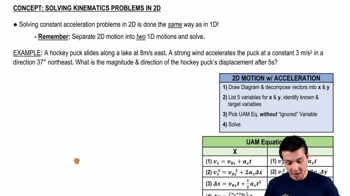
Kinematics in 2D

Integration in Physics

Integration is a mathematical tool used to find quantities like displacement from acceleration. Since acceleration is given as a function of time, integrating this function over the specified time interval provides the velocity, and further integration gives the displacement, which is the rocket's height at t = 10.0 s.
Video consigliato:
Percorso guidato
11:43
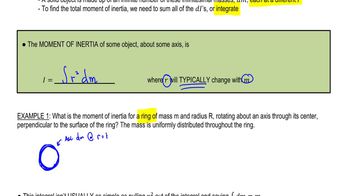
Finding Moment Of Inertia By Integrating

Variable Acceleration

Variable acceleration means acceleration changes with time, unlike constant acceleration scenarios. Here, the acceleration is a function of time, ay = (2.80 m/s³)t, requiring calculus to find velocity and displacement. Understanding how to handle variable acceleration is essential for solving the problem accurately.
Video consigliato:
Percorso guidato
05:28
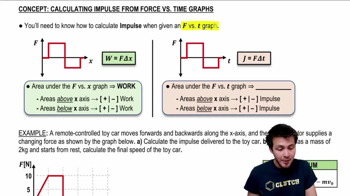
Impulse with Variable Forces
Pratica correlata
Domanda del libro di testo

A large boulder is ejected vertically upward from a volcano with an initial speed of 40.040.0 m/s. Ignore air resistance. When is the velocity of the boulder zero?

1711
views
Domanda del libro di testo

A small rocket burns 0.0500 kg of fuel per second, ejecting it as a gas with a velocity relative to the rocket of magnitude 1600 m/s. Would the rocket operate in outer space where there is no atmosphere? If so, how would you steer it? Could you brake it?

1508
views
Domanda del libro di testo

A large boulder is ejected vertically upward from a volcano with an initial speed of 40.040.0 m/s. Ignore air resistance. What are the magnitude and direction of the acceleration while the boulder is (i) moving upward? (ii) Moving downward? (iii) At the highest point?

1538
views
Domanda del libro di testo

A rocket starts from rest and moves upward from the surface of the earth. For the first 10.010.0 s of its motion, the vertical acceleration of the rocket is given by ay=(2.80a_{y}=(2.80 m/s3)t)t, where the +y+y-direction is upward. What is the speed of the rocket when it is 325325 m above the surface of the earth?

1936
views
Domanda del libro di testo

You throw a small rock straight up from the edge of a highway bridge that crosses a river. The rock passes you on its way down, 6.006.00 s after it was thrown. What is the speed of the rock just before it reaches the water 28.028.0 m below the point where the rock left your hand? Ignore air resistance.

7112
views
2
comments