Ch 02: Motion Along a Straight Line
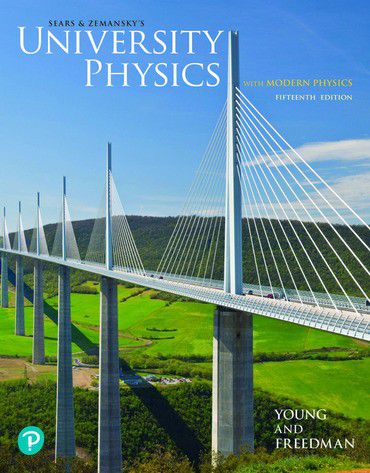
Young & Freedman Calc - University Physics 15th Edition
Young & Freedman Calc15th EditionUniversity PhysicsISBN: 9780135159552Non è quello che usi tu?Cambia libro di testo
Capitolo 2, Problema 49b

A rocket starts from rest and moves upward from the surface of the earth. For the first 10.010.0 s of its motion, the vertical acceleration of the rocket is given by ay=(2.80a_{y}=(2.80 m/s3)t)t, where the +y+y-direction is upward. What is the speed of the rocket when it is 325325 m above the surface of the earth?

Guida verificata passo dopo passo
1
Identify the given information: The rocket starts from rest, so the initial velocity (v0) is 0 m/s. The acceleration is given as a function of time: ay = (2.80 m/s^3)t. We need to find the speed of the rocket when it is 325 m above the surface.
Use the kinematic equation for position with variable acceleration: s = ∫v dt, where v = ∫a dt. First, find the velocity function by integrating the acceleration: v(t) = ∫(2.80 m/s^3)t dt.
Calculate the velocity function: v(t) = (2.80 m/s^3)(t^2)/2 + C. Since the rocket starts from rest, the constant C is 0. Therefore, v(t) = 1.40 m/s^3 * t^2.
Use the position function: s(t) = ∫v(t) dt = ∫(1.40 m/s^3 * t^2) dt. Integrate to find the position function: s(t) = (1.40 m/s^3)(t^3)/3 + C. Since the initial position is 0, C is 0, so s(t) = 0.467 m/s^3 * t^3.
Solve for the time when the rocket is 325 m above the surface: Set s(t) = 325 m and solve for t. Once t is found, substitute it back into the velocity function v(t) = 1.40 m/s^3 * t^2 to find the speed of the rocket at that height.

Risposta video verificata per un problema simile:

Questa soluzione video è stata consigliata dai nostri tutor come utile per risolvere questo problema.
Durata del video:
4m

Concetti chiave

Ecco i concetti essenziali che devi comprendere per rispondere correttamente alla domanda.

Kinematics Equations

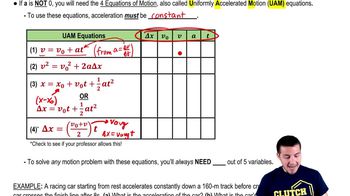
Kinematics equations describe the motion of objects without considering the forces that cause the motion. They relate displacement, velocity, acceleration, and time. In this problem, the kinematic equation v = u + at is crucial, where v is the final velocity, u is the initial velocity, a is the acceleration, and t is the time.
Video consigliato:
Percorso guidato
08:25
Kinematics Equations

Variable Acceleration

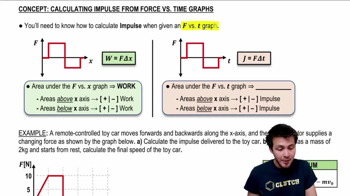
Variable acceleration occurs when the acceleration of an object changes with time. In this scenario, the rocket's acceleration is given as a function of time, ay = (2.80 m/s³)t. To find the velocity, we need to integrate this acceleration function with respect to time, considering the initial conditions.
Video consigliato:
Percorso guidato
05:28
Impulse with Variable Forces

Integration in Physics

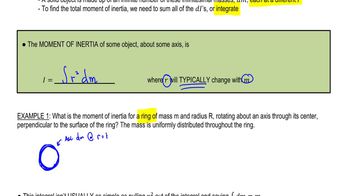
Integration is a mathematical process used to find quantities like displacement or velocity when given a rate of change, such as acceleration. For this problem, integrating the acceleration function ay = (2.80 m/s³)t with respect to time will yield the velocity function, which can then be evaluated to find the speed at a specific height.
Video consigliato:
Percorso guidato
11:43
Finding Moment Of Inertia By Integrating