Ch 02: Motion Along a Straight Line
Young & Freedman Calc - University Physics 15th Edition
Young & Freedman Calc15th EditionUniversity PhysicsISBN: 9780135159552Non è quello che usi tu?Cambia libro di testo
Capitolo 2, Problema 16

An astronaut has left the International Space Station to test a new space scooter. Her partner measures the following velocity changes, each taking place in a 1010-s interval. What are the magnitude, the algebraic sign, and the direction of the average acceleration in each interval? Assume that the positive direction is to the right.
(a) At the beginning of the interval, the astronaut is moving toward the right along the xx-axis at 15.015.0 m/s, and at the end of the interval she is moving toward the right at 5.05.0 m/s.
(b) At the beginning she is moving toward the left at 5.05.0 m/s, and at the end she is moving toward the left at 15.015.0 m/s.
(c) At the beginning she is moving toward the right at 15.015.0 m/s, and at the end she is moving toward the left at 15.015.0 m/s.

Guida verificata passo dopo passo
1
To find the average acceleration, use the formula: \( a_{avg} = \frac{\Delta v}{\Delta t} \), where \( \Delta v \) is the change in velocity and \( \Delta t \) is the time interval.
For interval (a), calculate \( \Delta v \) as the final velocity minus the initial velocity: \( \Delta v = 5.0 \text{ m/s} - 15.0 \text{ m/s} = -10.0 \text{ m/s} \). The time interval \( \Delta t \) is 10 s.
Substitute \( \Delta v = -10.0 \text{ m/s} \) and \( \Delta t = 10 \text{ s} \) into the average acceleration formula: \( a_{avg} = \frac{-10.0 \text{ m/s}}{10 \text{ s}} \). The negative sign indicates the acceleration is to the left.
For interval (b), calculate \( \Delta v \) as the final velocity minus the initial velocity: \( \Delta v = -15.0 \text{ m/s} - (-5.0 \text{ m/s}) = -10.0 \text{ m/s} \). The time interval \( \Delta t \) is 10 s.
Substitute \( \Delta v = -10.0 \text{ m/s} \) and \( \Delta t = 10 \text{ s} \) into the average acceleration formula: \( a_{avg} = \frac{-10.0 \text{ m/s}}{10 \text{ s}} \). The negative sign indicates the acceleration is to the left.

Risposta video verificata per un problema simile:

Questa soluzione video è stata consigliata dai nostri tutor come utile per risolvere questo problema.
Durata del video:
6m

Concetti chiave

Ecco i concetti essenziali che devi comprendere per rispondere correttamente alla domanda.

Average Acceleration

Average acceleration is defined as the change in velocity divided by the time over which the change occurs. It is a vector quantity, meaning it has both magnitude and direction. The formula is a_avg = (v_final - v_initial) / Δt, where v_final is the final velocity, v_initial is the initial velocity, and Δt is the time interval.
Video consigliato:
Percorso guidato
05:44
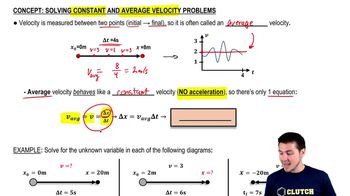
Solving Constant and Average Velocity Problems

Velocity and Direction

Velocity is a vector quantity that describes the speed of an object in a specific direction. In this problem, the direction is along the x-axis, with positive values indicating movement to the right and negative values indicating movement to the left. Understanding the direction is crucial for determining the sign of the velocity and acceleration.
Video consigliato:
Percorso guidato
7:27
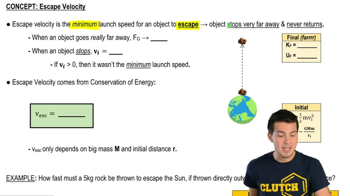
Escape Velocity

Sign Convention

In physics, sign convention is used to indicate direction. For this problem, the positive direction is defined as to the right. Therefore, a positive velocity or acceleration indicates movement or acceleration to the right, while a negative value indicates movement or acceleration to the left. This helps in determining the algebraic sign of the average acceleration.
Video consigliato:
Percorso guidato
08:55
Net Torque & Sign of Torque
Pratica correlata
Domanda del libro di testo

An antelope moving with constant acceleration covers the distance between two points 70.070.0 m apart in 6.006.00 s. Its speed as it passes the second point is 15.015.0 m/s. What is its acceleration?

3320
views
Domanda del libro di testo

A car's velocity as a function of time is given byvx(t)=α+βt2 v_x(t) = α + βt^2, where α=3.00α = 3.00 m/s and β=0.100β = 0.100 m/s3. Draw vxv_x-tt and axa_x-tt graphs for the car's motion between t=0 t = 0 and t=5.00t = 5.00 s.

2372
views
Domanda del libro di testo

A race car starts from rest and travels east along a straight and level track. For the first 5.05.0 s of the car's motion, the eastward component of the car's velocity is given by vx(t)=v_{x}(t)= (0.8600.860 m/s3)t2. What is the acceleration of the car when vx=12.0v_{x}=12.0 m/s?

4406
views
2
rank
Domanda del libro di testo

In the fastest measured tennis serve, the ball left the racquet at 73.1473.14 m/s. A served tennis ball is typically in contact with the racquet for 30.030.0 ms and starts from rest. Assume constant acceleration. What was the ball's acceleration during this serve?

3190
views
1
rank
Domanda del libro di testo

The fastest measured pitched baseball left the pitcher's hand at a speed of 45.045.0 m/s. If the pitcher was in contact with the ball over a distance of 1.501.50 m and produced constant acceleration, what acceleration did he give the ball?

2938
views
Domanda del libro di testo

A car's velocity as a function of time is given byvx(t)=α+βt2 v_x(t) = α + βt^2, where α=3.00α = 3.00 m/s and β=0.100β = 0.100 m/s3. Calculate the average acceleration for the time interval t=0t = 0 to t=5.00t = 5.00 s.

3631
views
1
rank