
Ch 03: Motion in Two or Three Dimensions
Young & Freedman Calc - University Physics 15th Edition
Young & Freedman Calc15th EditionUniversity PhysicsISBN: 9780135159552Non è quello che usi tu?Cambia libro di testo
Capitolo 3, Problema 21d

A man stands on the roof of a 15.0-m-tall building and throws a rock with a speed of 30.0 m/s at an angle of 33.0° above the horizontal. Ignore air resistance. Calculate Draw x-t, y-t, vx–t, and vy–t graphs for the motion.

Guida verificata passo dopo passo
1
Step 1: Begin by analyzing the problem. The rock is thrown from a height of 15.0 meters with an initial speed of 30.0 m/s at an angle of 33.0° above the horizontal. We need to consider the motion in both the horizontal (x) and vertical (y) directions separately.
Step 2: Calculate the initial velocity components. Use trigonometry to find the horizontal and vertical components of the initial velocity. The horizontal component (υx) is given by υx = υ * cos(θ), and the vertical component (υy) is given by υy = υ * sin(θ), where υ is the initial speed and θ is the angle of projection.
Step 3: Determine the equations of motion. For horizontal motion, the velocity remains constant since there is no air resistance, so x(t) = υx * t. For vertical motion, use the kinematic equation y(t) = y0 + υy * t - (1/2) * g * t^2, where y0 is the initial height and g is the acceleration due to gravity (approximately 9.81 m/s²).
Step 4: Plot the x-t and y-t graphs. The x-t graph will be a straight line indicating constant velocity, while the y-t graph will be a parabola indicating the effect of gravity on the vertical motion. The initial height and the time of flight will influence the shape of the y-t graph.
Step 5: Plot the υx-t and υy-t graphs. The υx-t graph will be a horizontal line since the horizontal velocity is constant. The υy-t graph will be a linear graph starting at the initial vertical velocity and decreasing linearly due to gravity, eventually becoming negative as the rock falls back down.

Risposta video verificata per un problema simile:

Questa soluzione video è stata consigliata dai nostri tutor come utile per risolvere questo problema.
Durata del video:
3m

Concetti chiave

Ecco i concetti essenziali che devi comprendere per rispondere correttamente alla domanda.

Projectile Motion

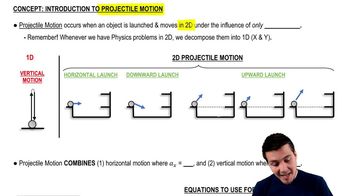
Projectile motion refers to the motion of an object thrown or projected into the air, subject to only the acceleration of gravity. It involves two components: horizontal and vertical motion, which are independent of each other. Understanding the initial velocity, angle of projection, and height is crucial for analyzing the trajectory and determining the object's position and velocity at any point in time.
Video consigliato:
Percorso guidato
04:44
Introduction to Projectile Motion

Kinematic Equations

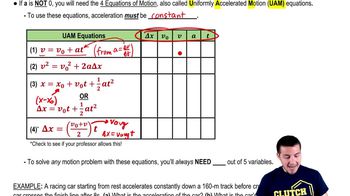
Kinematic equations describe the motion of objects in terms of displacement, velocity, acceleration, and time. For projectile motion, these equations help calculate the horizontal and vertical components of motion separately. They are essential for determining the position and velocity of the rock at any given time, which is necessary for plotting the x-t, y-t, υx–t, and υy–t graphs.
Video consigliato:
Percorso guidato
08:25
Kinematics Equations

Graphical Analysis of Motion

Graphical analysis involves plotting graphs to visually represent the motion of an object. The x-t and y-t graphs show how the horizontal and vertical positions change over time, while the υx–t and υy–t graphs depict the changes in horizontal and vertical velocities. These graphs provide insights into the motion's characteristics, such as constant horizontal velocity and changing vertical velocity due to gravity.
Video consigliato:
Percorso guidato
05:00
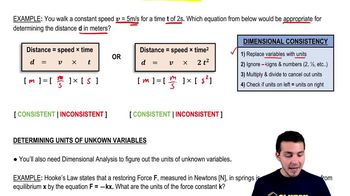
Dimensional Analysis
Pratica correlata
Domanda del libro di testo

In a carnival booth, you can win a stuffed giraffe if you toss a quarter into a small dish. The dish is on a shelf above the point where the quarter leaves your hand and is a horizontal distance of 2.1 m from this point (Fig. E3.19). If you toss the coin with a velocity of 6.4 m/s at an angle of 60° above the horizontal, the coin will land in the dish. Ignore air resistance. What is the height of the shelf above the point where the quarter leaves your hand?

1972
views
Domanda del libro di testo

The earth has a radius of 6380 km and turns around once on its axis in 24 h. If arad at the equator is greater than g, objects will fly off the earth's surface and into space. (We will see the reason for this in Chapter 5.) What would the period of the earth's rotation have to be for this to occur?

4555
views
Domanda del libro di testo

In a carnival booth, you can win a stuffed giraffe if you toss a quarter into a small dish. The dish is on a shelf above the point where the quarter leaves your hand and is a horizontal distance of 2.1 m from this point (Fig. E3.19). If you toss the coin with a velocity of 6.4 m/s at an angle of 60° above the horizontal, the coin will land in the dish. Ignore air resistance. What is the vertical component of the velocity of the quarter just before it lands in the dish?

4752
views
2
rank
Domanda del libro di testo

A shot putter releases the shot some distance above the level ground with a velocity of 12.0 m/s, 51.0° above the horizontal. The shot hits the ground 2.08 s later. Ignore air resistance. How far did she throw the shot horizontally?

2280
views
Domanda del libro di testo

A model of a helicopter rotor has four blades, each 3.40 m long from the central shaft to the blade tip. The model is rotated in a wind tunnel at 550 rev/min. What is the linear speed of the blade tip, in m/s?

4040
views
Domanda del libro di testo

The earth has a radius of 6380 km and turns around once on its axis in 24 h. What is the radial acceleration of an object at the earth's equator? Give your answer in m/s2 and as a fraction of g.

3288
views