Ch 03: Motion in Two or Three Dimensions
Young & Freedman Calc - University Physics 15th Edition
Young & Freedman Calc15th EditionUniversity PhysicsISBN: 9780135159552Non è quello che usi tu?Cambia libro di testo
Capitolo 3, Problema 25a

The earth has a radius of 6380 km and turns around once on its axis in 24 h. What is the radial acceleration of an object at the earth's equator? Give your answer in m/s2 and as a fraction of g.

Guida verificata passo dopo passo
1
First, convert the radius of the Earth from kilometers to meters. Since 1 km = 1000 m, the radius in meters is 6380 km * 1000 m/km = 6380000 m.
Next, calculate the angular velocity (ω) of the Earth. The Earth completes one full rotation in 24 hours, which is equivalent to 24 * 3600 seconds. The angular velocity is given by ω = 2π / T, where T is the period of rotation. So, ω = 2π / (24 * 3600) s.
The radial (centripetal) acceleration (a_r) at the Earth's equator can be calculated using the formula a_r = ω² * r, where r is the radius of the Earth. Substitute the values of ω and r to find a_r.
To express the radial acceleration as a fraction of g (acceleration due to gravity), use the value g = 9.81 m/s². Calculate the fraction by dividing the radial acceleration by g: fraction = a_r / g.
Ensure the units are consistent and check the calculations for accuracy. The final result will give you the radial acceleration in m/s² and as a fraction of g.

Risposta video verificata per un problema simile:

Questa soluzione video è stata consigliata dai nostri tutor come utile per risolvere questo problema.
Durata del video:
2m

Concetti chiave

Ecco i concetti essenziali che devi comprendere per rispondere correttamente alla domanda.

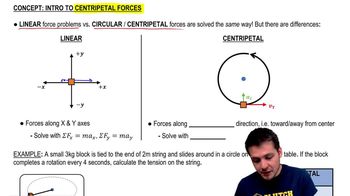
Centripetal Acceleration

Centripetal acceleration is the acceleration experienced by an object moving in a circular path, directed towards the center of the circle. It is calculated using the formula a_c = v^2/r, where v is the tangential velocity and r is the radius of the circular path. This concept is crucial for determining the radial acceleration of an object at the Earth's equator.
Video consigliato:
Percorso guidato
06:48
Intro to Centripetal Forces

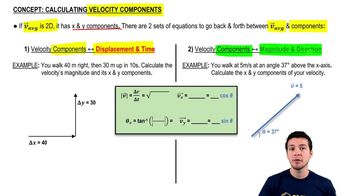
Tangential Velocity

Tangential velocity refers to the linear speed of an object moving along a circular path. It is given by the formula v = 2πr/T, where r is the radius of the circle and T is the period of rotation. For the Earth, this period is 24 hours, and understanding this concept helps in calculating the centripetal acceleration at the equator.
Video consigliato:
Percorso guidato
05:53
Calculating Velocity Components

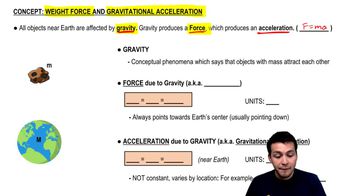
Gravitational Acceleration (g)

Gravitational acceleration, denoted as g, is the acceleration due to Earth's gravity, approximately 9.81 m/s². When calculating the radial acceleration as a fraction of g, it provides a comparative measure of how the centripetal acceleration at the equator relates to the standard gravitational pull experienced by objects on Earth's surface.
Video consigliato:
Percorso guidato
07:32
Weight Force & Gravitational Acceleration
Pratica correlata
Domanda del libro di testo

In a carnival booth, you can win a stuffed giraffe if you toss a quarter into a small dish. The dish is on a shelf above the point where the quarter leaves your hand and is a horizontal distance of 2.1 m from this point (Fig. E3.19). If you toss the coin with a velocity of 6.4 m/s at an angle of 60° above the horizontal, the coin will land in the dish. Ignore air resistance. What is the height of the shelf above the point where the quarter leaves your hand?

1972
views
Domanda del libro di testo

The earth has a radius of 6380 km and turns around once on its axis in 24 h. If arad at the equator is greater than g, objects will fly off the earth's surface and into space. (We will see the reason for this in Chapter 5.) What would the period of the earth's rotation have to be for this to occur?

4555
views
Domanda del libro di testo

In a carnival booth, you can win a stuffed giraffe if you toss a quarter into a small dish. The dish is on a shelf above the point where the quarter leaves your hand and is a horizontal distance of 2.1 m from this point (Fig. E3.19). If you toss the coin with a velocity of 6.4 m/s at an angle of 60° above the horizontal, the coin will land in the dish. Ignore air resistance. What is the vertical component of the velocity of the quarter just before it lands in the dish?

4752
views
2
rank
Domanda del libro di testo

A model of a helicopter rotor has four blades, each 3.40 m long from the central shaft to the blade tip. The model is rotated in a wind tunnel at 550 rev/min. What is the radial acceleration of the blade tip expressed as a multiple of g?

2074
views
Domanda del libro di testo

A model of a helicopter rotor has four blades, each 3.40 m long from the central shaft to the blade tip. The model is rotated in a wind tunnel at 550 rev/min. What is the linear speed of the blade tip, in m/s?

4040
views
Domanda del libro di testo

A man stands on the roof of a 15.0-m-tall building and throws a rock with a speed of 30.0 m/s at an angle of 33.0° above the horizontal. Ignore air resistance. Calculate Draw x-t, y-t, vx–t, and vy–t graphs for the motion.

3306
views
1
rank