A small car of mass kg is pushing a large truck of mass kg due east on a level road. The car exerts a horizontal force of N on the truck. What is the magnitude of the force that the truck exerts on the car?
Ch 04: Newton's Laws of Motion
Young & Freedman Calc15th EditionUniversity PhysicsISBN: 9780135159552Non è quello che usi tu?Cambia libro di testo
Capitolo 4, Problema 29b
A ball is hanging from a long string that is tied to the ceiling of a train car traveling eastward on horizontal tracks. An observer inside the train car sees the ball hang motionless. Draw a clearly labeled free-body diagram for the ball if the train is speeding up uniformly. Is the net force on the ball zero in either case? Explain.
Guida verificata passo dopo passo1
Step 1: Begin by identifying the forces acting on the ball. The ball is subject to two primary forces: (1) the gravitational force acting downward, which is the weight of the ball, and (2) the tension force in the string, which acts along the string and keeps the ball suspended.
Step 2: Consider the scenario where the train is speeding up uniformly. In this case, the train is accelerating eastward. Due to this acceleration, the ball will experience a pseudo-force (inertial force) directed westward relative to the train's frame of reference. This pseudo-force arises because the train is a non-inertial reference frame.
Step 3: Draw the free-body diagram for the ball. Represent the gravitational force as a downward arrow labeled \( F_g = m g \), where \( m \) is the mass of the ball and \( g \) is the acceleration due to gravity. Represent the tension force as an arrow along the string, angled slightly westward to counteract the pseudo-force. Label the pseudo-force as \( F_p = m a \), where \( a \) is the acceleration of the train.
Step 4: Analyze the net force on the ball. The ball is motionless relative to the train, meaning it is in equilibrium in the train's frame of reference. The tension force in the string has both vertical and horizontal components. The vertical component of the tension balances the gravitational force, and the horizontal component balances the pseudo-force. Thus, the net force on the ball is zero in the train's frame of reference.
Step 5: Conclude that the net force on the ball is not zero in the inertial (ground) frame of reference because the ball is accelerating eastward along with the train. However, in the train's non-inertial frame, the net force is zero because the pseudo-force balances the horizontal component of the tension.

Risposta video verificata per un problema simile:
Questa soluzione video è stata consigliata dai nostri tutor come utile per risolvere questo problema.
Durata del video:
2mConcetti chiave
Ecco i concetti essenziali che devi comprendere per rispondere correttamente alla domanda.
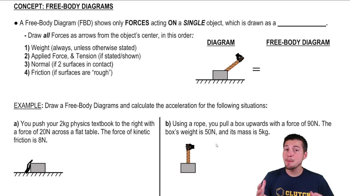
Free-Body Diagram
A free-body diagram is a graphical representation used to visualize the forces acting on an object. In this case, it would illustrate the gravitational force acting downward on the ball and the tension in the string acting upward. This diagram helps in analyzing the net force and understanding the motion of the object.
Video consigliato:
Percorso guidato
Free-Body Diagrams
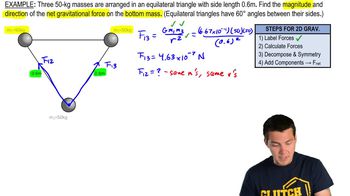
Net Force
The net force is the vector sum of all the forces acting on an object. It determines the object's acceleration according to Newton's second law (F=ma). If the net force is zero, the object remains in its current state of motion; if not, it will accelerate in the direction of the net force.
Video consigliato:
Percorso guidato
Finding Net Forces in 2D Gravitation
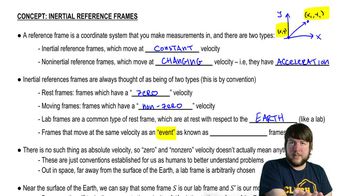
Inertial Reference Frame
An inertial reference frame is a frame of reference in which an object either remains at rest or moves at a constant velocity unless acted upon by a net external force. In the context of the train accelerating, the observer inside the train experiences a pseudo-force due to the acceleration, affecting the perceived forces on the ball.
Video consigliato:
Percorso guidato
Inertial Reference Frames
Pratica correlata
Domanda del libro di testo
4747
views
Domanda del libro di testo
Crates and sit at rest side by side on a frictionless horizontal surface. They have masses and , respectively. When a horizontal force is applied to crate , the two crates move off to the right. Draw clearly labeled free-body diagrams for crate and for crate . Indicate which pairs of forces, if any, are third-law action–reaction pairs.
2822
views
1
rank
Domanda del libro di testo
Boxes and are in contact on a horizontal, frictionless surface (Fig. E). Box has mass kg and box has mass kg. A horizontal force of N is exerted on box . What is the magnitude of the force that box exerts on box ?
9021
views
4
rank