Ch 04: Newton's Laws of Motion
Young & Freedman Calc - University Physics 15th Edition
Young & Freedman Calc15th EditionUniversity PhysicsISBN: 9780135159552Non è quello che usi tu?Cambia libro di testo
Capitolo 4, Problema 1

Two dogs pull horizontally on ropes attached to a post; the angle between the ropes is 60.0 60.0°. If Rover exerts a force of 270270 N and Fido exerts a force of 300300 N, find the magnitude of the resultant force and the angle it makes with Rover's rope.

Guida verificata passo dopo passo
1
Step 1: Represent the forces exerted by Rover and Fido as vectors. Rover's force vector has a magnitude of 270 N, and Fido's force vector has a magnitude of 300 N. The angle between the two vectors is given as 60.0°.
Step 2: Use the formula for the magnitude of the resultant force when two vectors are at an angle: \( F_{R} = \sqrt{F_{1}^2 + F_{2}^2 + 2F_{1}F_{2}\cos\theta} \), where \( F_{1} \) and \( F_{2} \) are the magnitudes of the forces, and \( \theta \) is the angle between them.
Step 3: Substitute the given values into the formula: \( F_{1} = 270 \, \text{N}, \, F_{2} = 300 \, \text{N}, \text{ and } \theta = 60.0° \). Calculate \( \cos\theta \) using \( \cos(60.0°) = 0.5 \).
Step 4: To find the angle \( \phi \) that the resultant force makes with Rover's rope, use the formula for the direction of the resultant vector: \( \tan\phi = \frac{F_{2}\sin\theta}{F_{1} + F_{2}\cos\theta} \). Substitute the values \( F_{1} = 270 \, \text{N}, \, F_{2} = 300 \, \text{N}, \text{ and } \theta = 60.0° \).
Step 5: Solve the equations step by step to find the magnitude of the resultant force \( F_{R} \) and the angle \( \phi \). Ensure proper handling of trigonometric functions and square roots during calculations.

Risposta video verificata per un problema simile:

Questa soluzione video è stata consigliata dai nostri tutor come utile per risolvere questo problema.
Durata del video:
9m

Concetti chiave

Ecco i concetti essenziali che devi comprendere per rispondere correttamente alla domanda.

Vector Addition

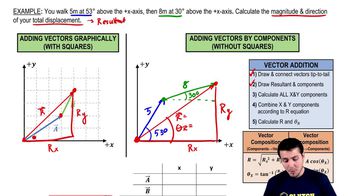
Vector addition is the process of combining two or more vectors to determine a resultant vector. In this scenario, the forces exerted by the dogs are vectors with both magnitude and direction. The resultant force can be found using the law of cosines or by breaking the vectors into their components and summing them.
Video consigliato:
Percorso guidato
07:30
Vector Addition By Components

Law of Cosines

The law of cosines relates the lengths of the sides of a triangle to the cosine of one of its angles. It is particularly useful in this problem to find the magnitude of the resultant force when two vectors are at an angle to each other. The formula is c² = a² + b² - 2ab*cos(θ), where θ is the angle between the two vectors.
Video consigliato:

Resultant Force Direction

The direction of the resultant force can be determined using trigonometric functions, specifically the sine and cosine functions. By calculating the angle that the resultant makes with one of the original vectors, we can use the inverse tangent function to find this angle. This is essential for understanding how the combined forces act in relation to the individual forces.
Video consigliato:
Percorso guidato
08:17
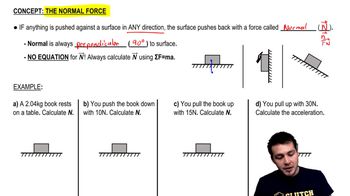
The Normal Force