Ch 21: Electric Charge and Electric Field
Young & Freedman Calc - University Physics 15th Edition
Young & Freedman Calc15th EditionUniversity PhysicsISBN: 9780135159552Non è quello che usi tu?Cambia libro di testo
Capitolo 21, Problema 26a

A +8.75+8.75-mC point charge is glued down on a horizontal frictionless table. It is tied to a −6.50-6.50-mC point charge by a light, nonconducting 2.502.50-cm wire. A uniform electric field of magnitude 1.85×1081.85\(\times\)10^8 N/CN/C is directed parallel to the wire, as shown in Fig. E21.3421.34. Find the tension in the wire.
Two point charges, -6.50 μC and 8.75 μC, connected by a 2.50 cm wire, with an electric field pointing right.

Guida verificata passo dopo passo
1
Identify the forces acting on the charges. The positive charge experiences a force due to the electric field and the negative charge experiences a force due to the electric field in the opposite direction.
Calculate the force on each charge due to the electric field using the formula: F = qE, where q is the charge and E is the electric field magnitude.
Determine the force between the two charges using Coulomb's law: F = k * |q1 * q2| / r^2, where k is Coulomb's constant, q1 and q2 are the charges, and r is the distance between them.
Consider the direction of the forces. The electric field force on the positive charge is in the direction of the field, while the force on the negative charge is opposite to the field direction. The Coulomb force is attractive, pulling the charges together.
Set up the equilibrium condition for the wire. The tension in the wire must balance the net force on each charge, which is the sum of the electric field force and the Coulomb force. Solve for the tension in the wire.

Risposta video verificata per un problema simile:

Questa soluzione video è stata consigliata dai nostri tutor come utile per risolvere questo problema.
Durata del video:
8m

Concetti chiave

Ecco i concetti essenziali che devi comprendere per rispondere correttamente alla domanda.

Coulomb's Law

Coulomb's Law describes the electrostatic force between two point charges. The force is directly proportional to the product of the magnitudes of the charges and inversely proportional to the square of the distance between them. This force is attractive if the charges are of opposite signs and repulsive if they are of the same sign.
Video consigliato:

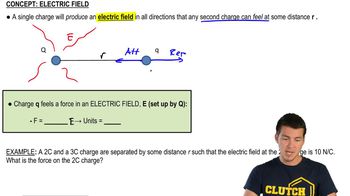
Electric Field

An electric field is a vector field around a charged object where a force would be exerted on other charges. The field's strength is measured in newtons per coulomb (N/C) and is defined as the force per unit charge. In this problem, the uniform electric field affects the charges, contributing to the tension in the wire.
Video consigliato:
Percorso guidato
03:16
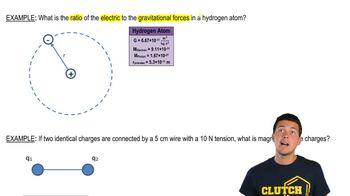
Intro to Electric Fields

Tension in a Wire

Tension in a wire is the force exerted along the wire, which in this scenario is due to the electrostatic forces between the charges and the external electric field. The tension must balance these forces to maintain equilibrium, and it can be calculated by considering the net force acting on the system of charges.
Video consigliato:
Percorso guidato
09:57
Magnetic Force on Current-Carrying Wire
Pratica correlata
Domanda del libro di testo

A proton is traveling horizontally to the right at 4.50×1064.50\(\times\)10^6 m/s. How much time does it take the proton to stop after entering the field?

1508
views

Domanda del libro di testo

A proton is traveling horizontally to the right at 4.50×1064.50\(\times\)10^6 m/s. Find the magnitude and direction of the weakest electric field that can bring the proton uniformly to rest over a distance of 3.203.20 cm.

3320
views
7
rank
Domanda del libro di testo

A −4.00-4.00-nC point charge is at the origin, and a second −5.00-5.00-nC point charge is on the xx-axis at x=0.800x = 0.800 m. Find the electric field (magnitude and direction) at each of the following points on the xx-axis: (i) x=0.200x = 0.200 m; (ii) x=1.20x = 1.20 m; (iii) x=−0.200x = -0.200 m.

3214
views
Domanda del libro di testo

A +8.75+8.75-mC point charge is glued down on a horizontal frictionless table. It is tied to a −6.50-6.50-mC point charge by a light, nonconducting 2.502.50-cm wire. A uniform electric field of magnitude 1.85×1081.85\(\times\)10^8 N/CN/C is directed parallel to the wire, as shown in Fig. E21.3421.34. What would the tension be if both charges were negative?

3310
views
Domanda del libro di testo

A proton is traveling horizontally to the right at 4.50×1064.50\(\times\)10^6 m/s. What minimum field (magnitude and direction) would be needed to stop an electron under the conditions of part (a)? Note: Part (a) asks for how much time does it take the proton to stop after entering the field.

1721
views
Domanda del libro di testo

A −4.00-4.00-nC point charge is at the origin, and a second −5.00-5.00-nC point charge is on the xx-axis at x=0.800x = 0.800 m. Find the net electric force that the two charges would exert on an electron placed at each point in part (a). Note: Part (a) asked to find the electric field (magnitude and direction) at each of the following points on the xx-axis: (i) x=0.200x = 0.200 m; (ii) x=1.20x = 1.20 m; (iii) x=−0.200x = -0.200 m.

4118
views