
Ch 21: Electric Charge and Electric Field
Young & Freedman Calc - University Physics 15th Edition
Young & Freedman Calc15th EditionUniversity PhysicsISBN: 9780135159552Non è quello che usi tu?Cambia libro di testo
Capitolo 21, Problema 23b

A proton is traveling horizontally to the right at 4.50×1064.50\(\times\)10^6 m/s. How much time does it take the proton to stop after entering the field?

Guida verificata passo dopo passo
1
Identify the initial velocity of the proton, which is given as \( v_i = 4.50 \times 10^6 \) m/s.
Recognize that the proton is entering a field that will exert a force on it, causing it to decelerate to a stop. The final velocity \( v_f \) will be 0 m/s.
Use the formula for acceleration \( a = \frac{F}{m} \), where \( F \) is the force exerted by the field and \( m \) is the mass of the proton. You will need to know the force exerted by the field to find the acceleration.
Apply the kinematic equation \( v_f = v_i + at \) to solve for the time \( t \). Rearrange the equation to \( t = \frac{v_f - v_i}{a} \).
Substitute the known values into the equation: \( v_f = 0 \) m/s, \( v_i = 4.50 \times 10^6 \) m/s, and \( a \) (calculated from the force and mass) to find the time \( t \) it takes for the proton to stop.

Risposta video verificata per un problema simile:

Questa soluzione video è stata consigliata dai nostri tutor come utile per risolvere questo problema.
Durata del video:
4m

Concetti chiave

Ecco i concetti essenziali che devi comprendere per rispondere correttamente alla domanda.

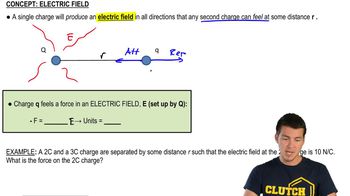
Electric Field

An electric field is a region around a charged particle where a force would be exerted on other charges. It is represented by field lines and is measured in newtons per coulomb (N/C). In this context, the electric field is responsible for exerting a force on the proton, causing it to decelerate.
Video consigliato:
Percorso guidato
03:16
Intro to Electric Fields

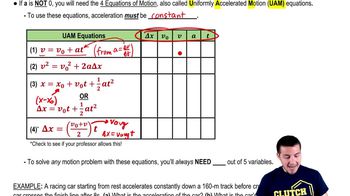
Kinematics

Kinematics is the branch of physics that deals with the motion of objects without considering the forces that cause the motion. It involves parameters such as velocity, acceleration, and time. To find the time it takes for the proton to stop, we use kinematic equations that relate these parameters.
Video consigliato:
Percorso guidato
08:25
Kinematics Equations

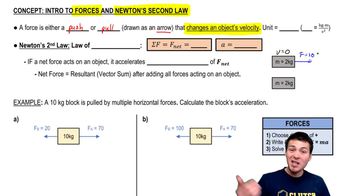
Newton's Second Law

Newton's Second Law states that the force acting on an object is equal to the mass of the object multiplied by its acceleration (F = ma). This law is crucial for determining the acceleration of the proton due to the electric field, which is needed to calculate the time taken for the proton to come to a stop.
Video consigliato:
Percorso guidato
06:54
Intro to Forces & Newton's Second Law
Pratica correlata
Domanda del libro di testo

A uniform electric field exists in the region between two oppositely charged plane parallel plates. A proton is released from rest at the surface of the positively charged plate and strikes the surface of the opposite plate, 1.601.60 cm distant from the first, in a time interval of 3.20×10−63.20\(\times\)10^{-6} s. Find the magnitude of the electric field.

3234
views
Domanda del libro di testo

A uniform electric field exists in the region between two oppositely charged plane parallel plates. A proton is released from rest at the surface of the positively charged plate and strikes the surface of the opposite plate, 1.601.60 cm distant from the first, in a time interval of 3.20×10−63.20\(\times\)10^{-6} s. Find the speed of the proton when it strikes the negatively charged plate.

1542
views
Domanda del libro di testo

A proton is traveling horizontally to the right at 4.50×1064.50\(\times\)10^6 m/s. Find the magnitude and direction of the weakest electric field that can bring the proton uniformly to rest over a distance of 3.203.20 cm.

3320
views
7
rank
Domanda del libro di testo

A +8.75+8.75-mC point charge is glued down on a horizontal frictionless table. It is tied to a −6.50-6.50-mC point charge by a light, nonconducting 2.502.50-cm wire. A uniform electric field of magnitude 1.85×1081.85\(\times\)10^8 N/CN/C is directed parallel to the wire, as shown in Fig. E21.3421.34. What would the tension be if both charges were negative?

3310
views
Domanda del libro di testo

A proton is traveling horizontally to the right at 4.50×1064.50\(\times\)10^6 m/s. What minimum field (magnitude and direction) would be needed to stop an electron under the conditions of part (a)? Note: Part (a) asks for how much time does it take the proton to stop after entering the field.

1721
views
Domanda del libro di testo

A +8.75+8.75-mC point charge is glued down on a horizontal frictionless table. It is tied to a −6.50-6.50-mC point charge by a light, nonconducting 2.502.50-cm wire. A uniform electric field of magnitude 1.85×1081.85\(\times\)10^8 N/CN/C is directed parallel to the wire, as shown in Fig. E21.3421.34. Find the tension in the wire.

2139
views
2
rank