

Ch 26: Direct-Current Circuits
Young & Freedman Calc - University Physics 15th Edition
Young & Freedman Calc15th EditionUniversity PhysicsISBN: 9780135159552Non è quello che usi tu?Cambia libro di testo
Capitolo 26, Problema 24

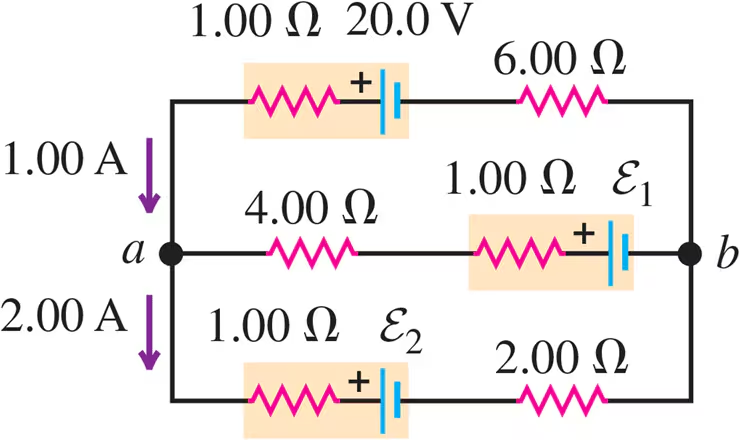
Find the emfs ε1ε_1 and ε2ε_2 in the circuit of Fig. E26.26, and find the potential difference of point bb relative to point aa.

Guida verificata passo dopo passo
1
Step 1: Identify the components in the circuit diagram, including resistors, batteries, and their respective emfs (ε_1 and ε_2). Note the direction of current flow and the polarity of each battery.
Step 2: Apply Kirchhoff's loop rule to the circuit. This rule states that the sum of the emfs in any closed loop is equal to the sum of the potential drops (IR) across the resistors in that loop. Write down the equations for each loop in the circuit.
Step 3: Solve the system of equations obtained from Kirchhoff's loop rule to find the values of ε_1 and ε_2. This may involve algebraic manipulation and substitution to isolate the emfs.
Step 4: To find the potential difference between points b and a, use the concept of potential difference, which is the work done per unit charge to move a charge between two points. Calculate the potential difference using the equation V = IR for the resistors between points a and b.
Step 5: Consider the direction of current flow and the polarity of the batteries when calculating the potential difference. Ensure that the signs are correctly assigned based on the direction of current and the orientation of the batteries.

Risposta video verificata per un problema simile:

Questa soluzione video è stata consigliata dai nostri tutor come utile per risolvere questo problema.
Durata del video:
10m

Concetti chiave

Ecco i concetti essenziali che devi comprendere per rispondere correttamente alla domanda.

Electromotive Force (EMF)

Electromotive force (EMF) is the energy provided by a cell or battery per coulomb of charge passing through it. It is the potential difference across the terminals of a source when no current is flowing. EMF is measured in volts and is a crucial factor in determining the behavior of electrical circuits.
Video consigliato:

Kirchhoff's Voltage Law

Kirchhoff's Voltage Law (KVL) states that the sum of the electrical potential differences (voltage) around any closed network is zero. This principle is essential for analyzing circuits, as it allows us to set up equations based on the loop rule to solve for unknown voltages or EMFs in the circuit.
Video consigliato:
Percorso guidato
04:08
Kirchhoff's Junction Rule

Potential Difference

Potential difference, also known as voltage, is the difference in electric potential between two points in a circuit. It represents the work done to move a unit charge from one point to another. Understanding potential difference is key to determining how energy is distributed in a circuit and is measured in volts.
Video consigliato:
Percorso guidato
07:04
Potential Difference Between Two Charges