

Ch 26: Direct-Current Circuits
Young & Freedman Calc - University Physics 15th Edition
Young & Freedman Calc15th EditionUniversity PhysicsISBN: 9780135159552Non è quello che usi tu?Cambia libro di testo
Capitolo 26, Problema 25b

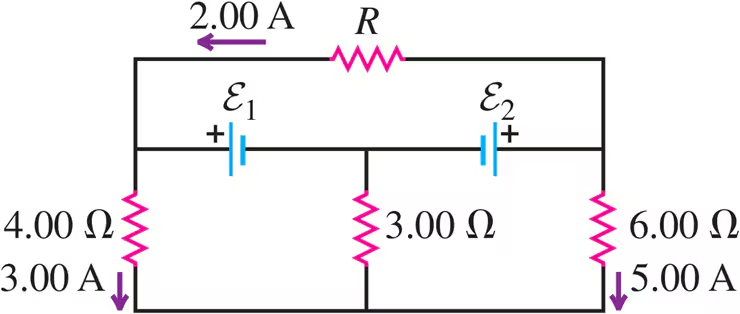
In the circuit shown in Fig. E26.27 find the unknown emfs ε1ε_1 and ε2ε_2.

Guida verificata passo dopo passo
1
Identify the components in the circuit: There are two batteries with unknown emfs (E₁ and E₂), three resistors with resistances of 8Ω, 8Ω, and 1Ω, and two currents given as 1.75A and 1.25A.
Apply Kirchhoff's loop rule to the left loop: The sum of the emfs and the voltage drops across the resistors should equal zero. The equation for the left loop is E₁ - 8Ω * 1.75A - 8Ω * 1.75A = 0.
Solve the equation from step 2 for E₁: Rearrange the equation to find the value of E₁ in terms of the given current and resistances.
Apply Kirchhoff's loop rule to the right loop: The sum of the emfs and the voltage drops across the resistors should equal zero. The equation for the right loop is E₂ - 1Ω * 1.25A - 8Ω * 1.25A = 0.
Solve the equation from step 4 for E₂: Rearrange the equation to find the value of E₂ in terms of the given current and resistances.

Risposta video verificata per un problema simile:

Questa soluzione video è stata consigliata dai nostri tutor come utile per risolvere questo problema.
Durata del video:
2m

Concetti chiave

Ecco i concetti essenziali che devi comprendere per rispondere correttamente alla domanda.

Kirchhoff's Loop Rule

Kirchhoff's Loop Rule states that the sum of the electromotive forces (emfs) and potential differences (voltage drops) around any closed loop in a circuit must equal zero. This principle is based on the conservation of energy, ensuring that all energy supplied by sources is used up by the resistive elements in the loop. It is essential for analyzing complex circuits with multiple loops and branches.
Video consigliato:
Percorso guidato
11:15
Intro to Kirchhoff's Loop Rule

Ohm's Law

Ohm's Law is a fundamental principle in electronics and physics, stating that the current (I) through a conductor between two points is directly proportional to the voltage (V) across the two points and inversely proportional to the resistance (R) of the conductor. It is expressed as V = IR, and is crucial for calculating voltage drops across resistors in a circuit, which is necessary for applying Kirchhoff's Loop Rule.
Video consigliato:
Percorso guidato
03:07
Resistance and Ohm's Law

Series and Parallel Circuits

In a series circuit, components are connected end-to-end, so the same current flows through each component, while the total voltage is the sum of the voltages across each component. In a parallel circuit, components are connected across the same two points, so the voltage across each component is the same, while the total current is the sum of the currents through each component. Understanding these configurations helps in analyzing the circuit's behavior and applying Kirchhoff's rules effectively.
Video consigliato:
Percorso guidato
09:51
Combining Capacitors in Series & Parallel