Ch 28: Sources of Magnetic Field
Young & Freedman Calc - University Physics 15th Edition
Young & Freedman Calc15th EditionUniversity PhysicsISBN: 9780135159552Non è quello che usi tu?Cambia libro di testo
Capitolo 28, Problema 39b

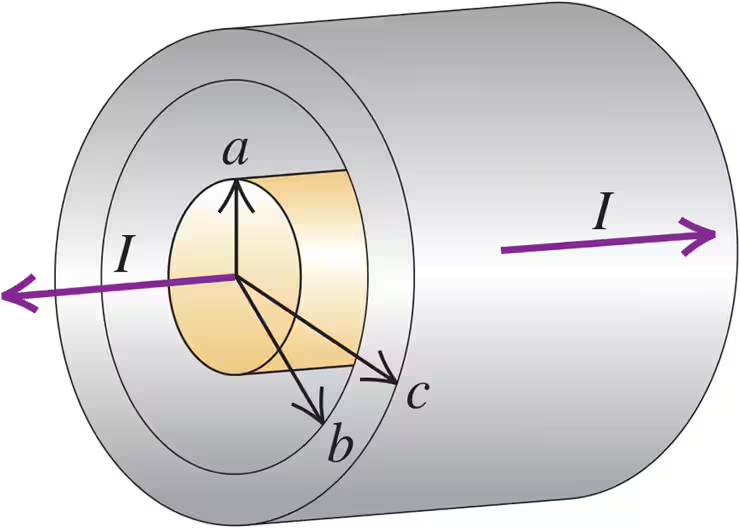
A solid conductor with radius a is supported by insulating disks on the axis of a conducting tube with inner radius b and outer radius c (Fig. E28.43). The central conductor and tube carry equal currents I in opposite directions. The currents are distributed uniformly over the cross sections of each conductor. Derive an expression for the magnitude of the magnetic field at points outside the tube (r > c).

Guida verificata passo dopo passo
1
Start by applying Ampère's Law, which relates the magnetic field around a closed loop to the current passing through the loop. The law is given by: ∮B·dl = μ₀I_enc, where B is the magnetic field, dl is a differential length element of the loop, μ₀ is the permeability of free space, and I_enc is the current enclosed by the loop.
Consider a circular Amperian loop of radius r, where r > c, centered on the axis of the conductors. Since the magnetic field is expected to be symmetric and tangential to the loop, the integral simplifies to B(2πr) = μ₀I_enc.
Determine the enclosed current I_enc. Since the currents in the central conductor and the tube are equal and opposite, the net enclosed current for r > c is zero. This is because the current in the central conductor is canceled by the current in the tube.
Substitute I_enc = 0 into the simplified Ampère's Law equation: B(2πr) = μ₀(0).
Solve for the magnetic field B. Since the right side of the equation is zero, the magnetic field B at points outside the tube (r > c) is zero. This result is consistent with the principle that the magnetic field outside a coaxial cable with equal and opposite currents is zero.

Risposta video verificata per un problema simile:

Questa soluzione video è stata consigliata dai nostri tutor come utile per risolvere questo problema.
Durata del video:
2m

Concetti chiave

Ecco i concetti essenziali che devi comprendere per rispondere correttamente alla domanda.

Ampere's Law

Ampere's Law relates the integrated magnetic field around a closed loop to the electric current passing through the loop. It is expressed as ∮B·dl = μ₀I_enc, where B is the magnetic field, dl is a differential element of the loop, μ₀ is the permeability of free space, and I_enc is the enclosed current. This law is crucial for calculating magnetic fields in symmetric situations, such as the one described in the problem.
Video consigliato:
Percorso guidato
05:21
Ampere's Law with Calculus

Superposition Principle

The superposition principle states that the net magnetic field created by multiple sources is the vector sum of the magnetic fields produced by each source independently. In this problem, the magnetic fields generated by the central conductor and the conducting tube must be considered separately and then combined to find the total magnetic field at a point outside the tube.
Video consigliato:
Percorso guidato
03:32
Superposition of Sinusoidal Wave Functions

Magnetic Field of a Long Straight Conductor

The magnetic field around a long straight conductor carrying a current I is given by B = (μ₀I)/(2πr), where r is the radial distance from the conductor. This formula is derived from Ampere's Law and is essential for understanding how the magnetic field behaves around the central conductor and the conducting tube in the problem, especially when considering points outside the tube.
Video consigliato:
Percorso guidato
12:33
Magnetic Field Produced by Straight Currents
Pratica correlata
Domanda del libro di testo

A closed curve encircles several conductors. The line integral ∮B⋅dl\(\oint\) B\(\cdot\) dl around this curve is 3.83×10⁻⁴ T m3.83\(\times\)10^{-4}\(\text{ T m}\). If you were to integrate around the curve in the opposite direction, what would be the value of the line integral? Explain.

1292
views

Domanda del libro di testo

As a new electrical technician, you are designing a large solenoid to produce a uniform 0.150 T magnetic field near the center of the solenoid. You have enough wire for 4000 circular turns. This solenoid must be 55.0 cm long and 2.80 cm in diameter. What current will you need to produce the necessary field?

1928
views
Domanda del libro di testo

A solenoid is designed to produce a magnetic field of 0.0270 T at its center. It has radius 1.40 cm and length 40.0 cm, and the wire can carry a maximum current of 12.0 A. What minimum number of turns per unit length must the solenoid have?

1511
views
Domanda del libro di testo

A 15.0 cm long solenoid with radius 0.750 cm is closely wound with 600 turns of wire. The current in the windings is 8.00 A. Compute the magnetic field at a point near the center of the solenoid.

1844
views
Domanda del libro di testo

Two long, parallel wires are separated by a distance of 0.400 m (Fig. E28.29). The currents I1 and I2 have the directions shown. Each current is doubled, so that I1 becomes 10.0 A and I2 becomes 4.00 A. Now what is the magnitude of the force that each wire exerts on a 1.20 m length of the other?

1449
views
Domanda del libro di testo

Two long, parallel wires are separated by a distance of 0.400 m (Fig. E28.29). The currents I1 and I2 have the directions shown. Calculate the magnitude of the force exerted by each wire on a 1.20-m length of the other. Is the force attractive or repulsive?

1775
views