Ch 31: Alternating Current
Young & Freedman Calc - University Physics 15th Edition
Young & Freedman Calc15th EditionUniversity PhysicsISBN: 9780135159552Non è quello che usi tu?Cambia libro di testo
Capitolo 31, Problema 4a

A capacitor is connected across an ac source that has voltage amplitude 60.0 V and frequency 80.0 Hz. What is the phase angle Φ for the source voltage relative to the current? Does the source voltage lag or lead the current?

Guida verificata passo dopo passo
1
Understand the relationship between voltage and current in an AC circuit with a capacitor. In such a circuit, the current leads the voltage by a phase angle due to the capacitive reactance.
Recall the formula for the phase angle \( \Phi \) in a capacitive circuit, which is given by \( \Phi = -\frac{\pi}{2} \). This indicates that the voltage lags the current by 90 degrees.
Recognize that the negative sign in the phase angle formula indicates that the voltage lags behind the current.
Since the phase angle \( \Phi \) is \( -\frac{\pi}{2} \), the source voltage lags the current by 90 degrees.
Conclude that in a purely capacitive AC circuit, the phase angle is always \( -\frac{\pi}{2} \), meaning the voltage lags the current by 90 degrees.

Risposta video verificata per un problema simile:

Questa soluzione video è stata consigliata dai nostri tutor come utile per risolvere questo problema.
Durata del video:
3m

Concetti chiave

Ecco i concetti essenziali che devi comprendere per rispondere correttamente alla domanda.

Capacitive Reactance

Capacitive reactance (Xc) is the opposition a capacitor offers to the flow of alternating current (AC). It is inversely proportional to the frequency (f) of the AC source and the capacitance (C) of the capacitor, given by the formula Xc = 1/(2πfC). This concept is crucial for understanding how the capacitor affects the phase relationship between voltage and current.
Video consigliato:
Percorso guidato
08:02
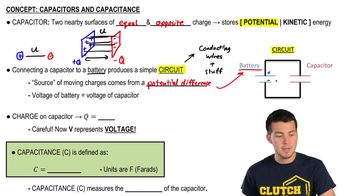
Capacitors & Capacitance (Intro)

Phase Angle in AC Circuits

The phase angle (Φ) in AC circuits indicates the difference in phase between the voltage across and the current through a component. For a purely capacitive circuit, the current leads the voltage by 90 degrees, meaning the phase angle is -90 degrees. This concept helps determine whether the voltage leads or lags the current in the circuit.
Video consigliato:
Percorso guidato
07:14
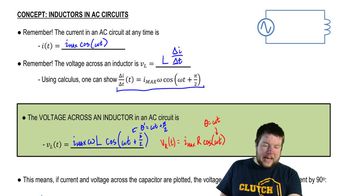
Inductors in AC Circuits

Voltage and Current Relationship in Capacitors

In capacitors connected to an AC source, the current leads the voltage because the capacitor charges and discharges, causing the current to reach its peak before the voltage does. This relationship is essential for understanding the behavior of capacitors in AC circuits and determining the phase angle between voltage and current.
Video consigliato:
Percorso guidato
07:14
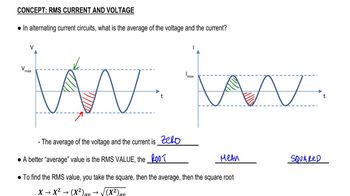
RMS Current and Voltage