Ch 31: Alternating Current
Young & Freedman Calc - University Physics 15th Edition
Young & Freedman Calc15th EditionUniversity PhysicsISBN: 9780135159552Non è quello che usi tu?Cambia libro di testo
Capitolo 31, Problema 1

You have a special light bulb with a very delicate wire filament. The wire will break if the current in it ever exceeds 1.50 A, even for an instant. What is the largest root-mean-square current you can run through this bulb?

Guida verificata passo dopo passo
1
Understand that the root-mean-square (RMS) current is a measure of the effective current value for alternating current (AC) circuits. It is related to the peak current by the formula: Irms=Ipeak/√2.
Identify that the peak current Ipeak is the maximum current that can flow through the filament without breaking it, which is given as 1.50 A.
Use the formula for RMS current: Irms=Ipeak/√2. Substitute the peak current value into the formula.
Calculate the RMS current by dividing the peak current by the square root of 2: Irms=1.50/√2.
Conclude that the largest RMS current you can run through the bulb is the result of the calculation from the previous step, ensuring the current does not exceed the filament's breaking point.

Risposta video verificata per un problema simile:

Questa soluzione video è stata consigliata dai nostri tutor come utile per risolvere questo problema.
Durata del video:
2m

Concetti chiave

Ecco i concetti essenziali che devi comprendere per rispondere correttamente alla domanda.

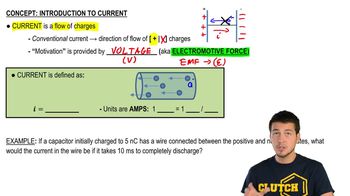
Current

Current is the flow of electric charge through a conductor, measured in amperes (A). It is crucial to understand the maximum current a device can handle to prevent damage. In this context, the filament can withstand up to 1.50 A, which is the threshold for safe operation.
Video consigliato:
Percorso guidato
05:38
Intro to Current

Root-Mean-Square (RMS) Current

RMS current is a measure of the effective value of an alternating current (AC), equivalent to a direct current (DC) that would deliver the same power. It is calculated as the square root of the average of the squares of instantaneous current values over a cycle. For safety, the RMS current must be less than or equal to the maximum allowable current.
Video consigliato:
Percorso guidato
05:21
Root-Mean-Square Speed of Ideal Gases

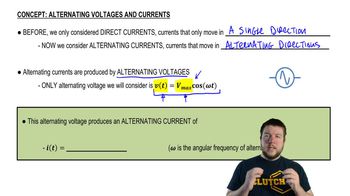
Alternating Current (AC)

Alternating current is a type of electrical current where the flow of electric charge periodically reverses direction. Understanding AC is essential for calculating RMS values, as AC currents vary over time, unlike direct currents which remain constant. This variation necessitates using RMS to assess the effective current safely.
Video consigliato:
Percorso guidato
07:49
Alternating Voltages and Currents