
Off to Europe! You plan to take your hair dryer to Europe, where the electrical outlets put out 240 V instead of the 120 V seen in the United States. The dryer puts out 1600 W at 120 V. (b) What current will your dryer draw from a European outlet? (c) What resistance will your dryer appear to have when operated at 240 V?
Ch 31: Alternating Current
Young & Freedman Calc15th EditionUniversity PhysicsISBN: 9780135159552Non è quello che usi tu?Cambia libro di testo
Capitolo 31, Problema 35a
A Step-Down Transformer. A transformer connected to a 120 V (rms) ac line is to supply 12.0 V (rms) to a portable electronic device. The load resistance in the secondary is 5.00 Ω. What should the ratio of primary to secondary turns of the transformer be?
Guida verificata passo dopo passo1
Understand the basic principle of a transformer: A transformer is a device that transfers electrical energy between two or more circuits through electromagnetic induction. It consists of primary and secondary coils. The voltage across these coils is related by the turns ratio.
Identify the given values: The primary voltage \( V_p \) is 120 V (rms), and the secondary voltage \( V_s \) is 12.0 V (rms). The load resistance \( R_s \) in the secondary is 5.00 \( \Omega \).
Use the formula for the turns ratio of a transformer: The turns ratio \( \frac{N_p}{N_s} \) is given by \( \frac{V_p}{V_s} \). This formula relates the primary and secondary voltages to the number of turns in the primary \( N_p \) and secondary \( N_s \) coils.
Substitute the given values into the formula: \( \frac{N_p}{N_s} = \frac{120}{12} \). This will give you the ratio of the number of turns in the primary coil to the number of turns in the secondary coil.
Interpret the result: The calculated turns ratio will tell you how many times more turns the primary coil should have compared to the secondary coil to achieve the desired voltage transformation.

Risposta video verificata per un problema simile:
Questa soluzione video è stata consigliata dai nostri tutor come utile per risolvere questo problema.
Durata del video:
2mConcetti chiave
Ecco i concetti essenziali che devi comprendere per rispondere correttamente alla domanda.
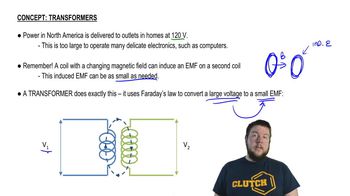
Transformer Basics
A transformer is an electrical device that transfers electrical energy between two or more circuits through electromagnetic induction. It consists of primary and secondary coils, and it can either step up or step down voltage levels. The voltage change is determined by the ratio of the number of turns in the primary coil to the number of turns in the secondary coil.
Video consigliato:
Percorso guidato
Transformers
Turn Ratio
The turn ratio of a transformer is the ratio of the number of turns in the primary coil to the number of turns in the secondary coil. This ratio determines how the input voltage is transformed into the output voltage. For a step-down transformer, the primary coil has more turns than the secondary coil, resulting in a lower output voltage compared to the input voltage.
Video consigliato:
Percorso guidato
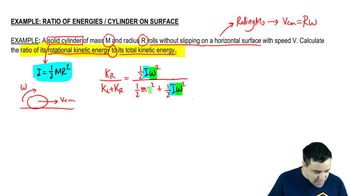
Ratio of energies of cylinder on surface
RMS Voltage
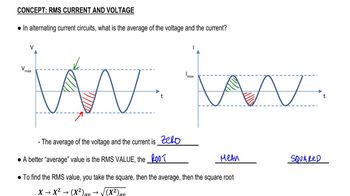
RMS (Root Mean Square) voltage is a measure of the effective value of an alternating current (AC) voltage. It represents the equivalent DC voltage that would deliver the same power to a load. In the context of transformers, RMS values are used to describe both the input and output voltages, ensuring that the power calculations are accurate and consistent.
Video consigliato:
Percorso guidato
RMS Current and Voltage
Pratica correlata
Domanda del libro di testo
1618
views
Domanda del libro di testo
Off to Europe! You plan to take your hair dryer to Europe, where the electrical outlets put out 240 V instead of the 120 V seen in the United States. The dryer puts out 1600 W at 120 V. What could you do to operate your dryer via the 240 V line in Europe?
1645
views
Domanda del libro di testo
A series ac circuit contains a 250-Ω resistor, a 15-mH inductor, a 3.5-μF capacitor, and an ac power source of voltage amplitude 45 V operating at an angular frequency of 360 rad/s.What is the power factor of this circuit?
1754
views
