
Ch 33: The Nature and Propagation of Light
Young & Freedman Calc - University Physics 15th Edition
Young & Freedman Calc15th EditionUniversity PhysicsISBN: 9780135159552Non è quello che usi tu?Cambia libro di testo
Capitolo 32, Problema 30b

Light of original intensity I0 passes through two ideal polarizing filters having their polarizing axes oriented as shown in Fig. E33.28. You want to adjust the angle f so that the intensity at point P is equal to I0/10. If the original light is linearly polarized in the same direction as the polarizing axis of the first polarizer the light reaches, what should Φ be?

Guida verificata passo dopo passo
1
Understand that when light passes through a polarizer, its intensity is reduced according to Malus's Law, which states that the intensity I after passing through a polarizer is given by: I=I_0⁢cos2Φ, where Φ is the angle between the light's polarization direction and the polarizer's axis.
Since the original light is linearly polarized in the same direction as the polarizing axis of the first polarizer, it will pass through the first polarizer without any reduction in intensity. Therefore, the intensity after the first polarizer remains I_0.
The light then passes through the second polarizer, which is oriented at an angle Φ with respect to the first polarizer. According to Malus's Law, the intensity at point P after the second polarizer is: I=I_0⁢cos2Φ.
Set the intensity at point P to be I_0/10 and solve for Φ: I_0/10=I_0⁢cos2Φ.
Divide both sides by I_0 and take the square root to find cosΦ: cosΦ=1/10. Finally, calculate Φ using the inverse cosine function.

Risposta video verificata per un problema simile:

Questa soluzione video è stata consigliata dai nostri tutor come utile per risolvere questo problema.
Durata del video:
2m

Concetti chiave

Ecco i concetti essenziali che devi comprendere per rispondere correttamente alla domanda.

Polarization of Light

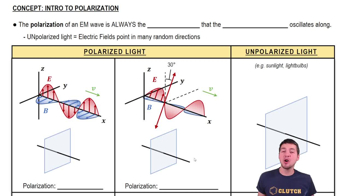
Polarization refers to the orientation of the oscillations of light waves. When light is polarized, its electric field oscillates in a specific direction. Polarizing filters allow light waves oscillating in a particular direction to pass through while blocking others, thus reducing the intensity of light based on the angle between the light's polarization and the filter's axis.
Video consigliato:
Percorso guidato
05:32
Introduction to Polarization

Malus's Law

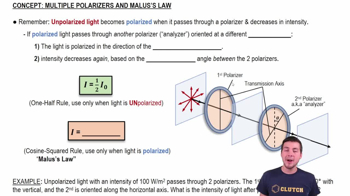
Malus's Law describes how the intensity of polarized light changes as it passes through a polarizing filter. The law states that the intensity I of light after passing through a polarizer is given by I = I0 * cos²(Φ), where I0 is the initial intensity and Φ is the angle between the light's polarization direction and the polarizer's axis. This principle is crucial for calculating the intensity of light after multiple polarizers.
Video consigliato:
Percorso guidato
09:47
Multiple Polarizers & Malus's Law

Angle of Polarization

The angle of polarization, Φ, is the angle between the polarization direction of incoming light and the axis of a polarizing filter. Adjusting this angle affects the intensity of light transmitted through the filter. In the given problem, finding the correct angle Φ is essential to achieve the desired intensity at point P, which involves using Malus's Law to solve for Φ when the intensity is I0/10.
Video consigliato:
Percorso guidato
05:32
Introduction to Polarization