Ch 37: Special Relativity
Young & Freedman Calc - University Physics 15th Edition
Young & Freedman Calc15th EditionUniversity PhysicsISBN: 9780135159552Non è quello che usi tu?Cambia libro di testo
Capitolo 36, Problema 26ac

Relativistic Baseball. Calculate the magnitude of the force required to give a 0.145 kg baseball an acceleration a = 1.00 m/s2 in the direction of the baseball's initial velocity when this velocity has a magnitude of (a) 10.0 m/s; (c) 0.990c.

Guida verificata passo dopo passo
1
Step 1: Begin by recalling Newton's second law of motion, which states that the force is equal to the rate of change of momentum: F = dp/dt. For relativistic cases, momentum is given by p = γmv, where γ = 1 / √(1 - v²/c²) is the Lorentz factor, m is the mass, and v is the velocity.
Step 2: For each velocity scenario, calculate the Lorentz factor γ using the formula γ = 1 / √(1 - v²/c²). Substitute the given velocities (10.0 m/s, 0.900c, and 0.990c) into the equation, where c is the speed of light (approximately 3.00 × 10⁸ m/s).
Step 3: Determine the relativistic mass using m_rel = γm, where m is the rest mass of the baseball (0.145 kg). This accounts for the increase in mass due to relativistic speeds.
Step 4: Use the relativistic form of Newton's second law, F = γma, to calculate the force for each scenario. Substitute the values of γ, m, and the given acceleration a = 1.00 m/s² into the equation.
Step 5: Ensure that the units are consistent throughout the calculations (e.g., kilograms for mass, meters per second for velocity, and meters per second squared for acceleration). The resulting force values will be in newtons (N).

Risposta video verificata per un problema simile:

Questa soluzione video è stata consigliata dai nostri tutor come utile per risolvere questo problema.
Durata del video:
10m

Concetti chiave

Ecco i concetti essenziali che devi comprendere per rispondere correttamente alla domanda.

Newton's Second Law of Motion

Newton's Second Law states that the force acting on an object is equal to the mass of the object multiplied by its acceleration (F = ma). This fundamental principle allows us to calculate the force required to accelerate an object, such as a baseball, under various conditions. Understanding this law is crucial for solving problems involving motion and force.
Video consigliato:
Percorso guidato
06:54
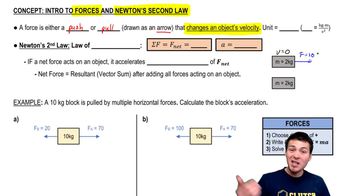
Intro to Forces & Newton's Second Law

Relativistic Effects

At speeds approaching the speed of light, relativistic effects become significant, altering the mass and behavior of objects. The relativistic mass increases as an object's velocity approaches the speed of light (c), which affects the force required to achieve a given acceleration. This concept is essential for understanding how forces behave at high velocities, such as 0.900c and 0.990c.
Video consigliato:
Percorso guidato
07:40
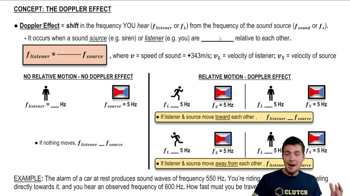
The Doppler Effect

Acceleration

Acceleration is defined as the rate of change of velocity of an object over time. It is a vector quantity, meaning it has both magnitude and direction. In this problem, the baseball is subjected to a specific acceleration of 1.00 m/s², which is crucial for determining the force needed to achieve this change in velocity, especially when considering the effects of relativistic speeds.
Video consigliato:
Percorso guidato
05:47
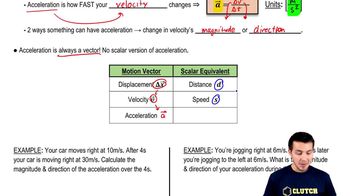
Intro to Acceleration
Pratica correlata
Domanda del libro di testo

A proton (rest mass 1.67×10−271.67\(\times\)10^{-27} kg) has total energy that is 4.004.00 times its rest energy. What are (a) the kinetic energy of the proton; (b) the magnitude of the momentum of the proton; (c) the speed of the proton?

2951
views
Domanda del libro di testo

A proton has momentum with magnitude p0 when its speed is 0.400c. In terms of p0, what is the magnitude of the proton's momentum when its speed is doubled to 0.800c?

1473
views
Domanda del libro di testo

Two particles are created in a high-energy accelerator and move off in opposite directions. The speed of one particle, as measured in the laboratory, is 0.650c, and the speed of each particle relative to the other is 0.950c. What is the speed of the second particle, as measured in the laboratory?

1560
views
Domanda del libro di testo

Tell It to the Judge. (a) How fast must you be approaching a red traffic light (λ = 675 nm) for it to appear yellow (λ = 575 nm)? Express your answer in terms of the speed of light. (b) If you used this as a reason not to get a ticket for running a red light, how much of a fine would you get for speeding? Assume that the fine is \$1.00 for each kilometer per hour that your speed exceeds the posted limit of 90 km/h.

940
views
Domanda del libro di testo

A force is applied to a particle along its direction of motion. At what speed is the magnitude of force required to produce a given acceleration twice as great as the force required to produce the same acceleration when the particle is at rest? Express your answer in terms of the speed of light.

1424
views
Domanda del libro di testo

A source of electromagnetic radiation is moving in a radial direction relative to you. The frequency you measure is 1.25 times the frequency measured in the rest frame of the source. What is the speed of the source relative to you? Is the source moving toward you or away from you?

1087
views