Ch 37: Special Relativity
Young & Freedman Calc - University Physics 15th Edition
Young & Freedman Calc15th EditionUniversity PhysicsISBN: 9780135159552Non è quello che usi tu?Cambia libro di testo
Capitolo 36, Problema 23

Tell It to the Judge. (a) How fast must you be approaching a red traffic light (λ = 675 nm) for it to appear yellow (λ = 575 nm)? Express your answer in terms of the speed of light. (b) If you used this as a reason not to get a ticket for running a red light, how much of a fine would you get for speeding? Assume that the fine is \$1.00 for each kilometer per hour that your speed exceeds the posted limit of 90 km/h.

Guida verificata passo dopo passo
1
Step 1: Understand the Doppler effect for light. The Doppler effect describes how the wavelength of light changes due to the relative motion between the source and the observer. For this problem, the observer (you) is moving toward the source (the red traffic light). The formula for the observed wavelength λ' is: λ'=λ0(1-vc), where λ₀ is the original wavelength, v is the velocity of the observer, and c is the speed of light.
Step 2: Rearrange the formula to solve for the velocity v. Substitute the given values for the wavelengths: λ₀ = 675 nm (red light) and λ' = 575 nm (yellow light). The rearranged formula is: v=c(λ0-λ'λ'). This will allow you to calculate the velocity as a fraction of the speed of light.
Step 3: Convert the velocity from the fraction of the speed of light to kilometers per hour (km/h). Since the speed of light c is approximately 3 × 10⁸ m/s, you can multiply the fraction by c and then convert the result to km/h using the conversion factor: 1 m/s = 3.6 km/h.
Step 4: Determine the excess speed over the posted limit. Subtract the posted speed limit of 90 km/h from the calculated velocity in km/h to find how much faster you are traveling than the limit.
Step 5: Calculate the fine. Multiply the excess speed (in km/h) by \$1.00 per km/h to determine the total fine for speeding. This will give you the monetary penalty based on your calculated speed.

Risposta video verificata per un problema simile:

Questa soluzione video è stata consigliata dai nostri tutor come utile per risolvere questo problema.
Durata del video:
11m

Concetti chiave

Ecco i concetti essenziali che devi comprendere per rispondere correttamente alla domanda.

Doppler Effect

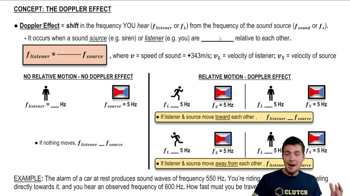
The Doppler Effect describes the change in frequency or wavelength of a wave in relation to an observer moving relative to the source of the wave. In this context, as a vehicle approaches a red traffic light, the light's wavelength shifts due to the vehicle's speed, causing it to appear yellow instead of red. This effect is crucial for understanding how motion affects the perception of light.
Video consigliato:
Percorso guidato
07:40
The Doppler Effect

Wavelength and Color Perception

Wavelength is a fundamental property of light that determines its color. The visible spectrum ranges from approximately 380 nm (violet) to 750 nm (red). In this scenario, the red light at 675 nm appears yellow at 575 nm due to the Doppler shift, illustrating how changes in wavelength can alter color perception based on the observer's speed.
Video consigliato:
Percorso guidato
05:42
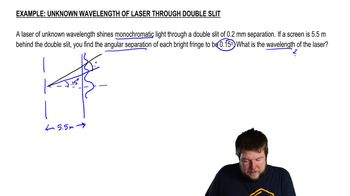
Unknown Wavelength of Laser through Double Slit

Speed and Fine Calculation

The calculation of fines for speeding is typically based on how much a driver's speed exceeds the posted limit. In this case, if the speed exceeds 90 km/h, the fine is $1.00 for each kilometer per hour over the limit. Understanding this calculation is essential for determining the financial consequences of exceeding speed limits, even when using the Doppler Effect as a defense.
Video consigliato:
Percorso guidato
07:59
Speed Distribution & Special Speeds of Ideal Gases
Pratica correlata
Domanda del libro di testo

A proton has momentum with magnitude p0 when its speed is 0.400c. In terms of p0, what is the magnitude of the proton's momentum when its speed is doubled to 0.800c?

1473
views
Domanda del libro di testo

A rocket ship flies past the earth at 91.0% of the speed of light. Inside, an astronaut who is undergoing a physical examination is having his height measured while he is lying down parallel to the direction in which the ship is moving. (a) If his height is measured to be 2.00 m by his doctor inside the ship, what height would a person watching this from the earth measure? (b) If the earth-based person had measured 2.00 m, what would the doctor in the spaceship have measured for the astronaut’s height? Is this a reasonable height?

1010
views
Domanda del libro di testo

Two particles are created in a high-energy accelerator and move off in opposite directions. The speed of one particle, as measured in the laboratory, is 0.650c, and the speed of each particle relative to the other is 0.950c. What is the speed of the second particle, as measured in the laboratory?

1560
views
Domanda del libro di testo

Relativistic Baseball. Calculate the magnitude of the force required to give a 0.145 kg baseball an acceleration a = 1.00 m/s2 in the direction of the baseball's initial velocity when this velocity has a magnitude of (a) 10.0 m/s; (c) 0.990c.

1349
views
Domanda del libro di testo

A source of electromagnetic radiation is moving in a radial direction relative to you. The frequency you measure is 1.25 times the frequency measured in the rest frame of the source. What is the speed of the source relative to you? Is the source moving toward you or away from you?

1087
views
Domanda del libro di testo

A pursuit spacecraft from the planet Tatooine is attempting to catch up with a Trade Federation cruiser. As measured by an observer on Tatooine, the cruiser is traveling away from the planet with a speed of 0.600c. The pursuit ship is traveling at a speed of 0.800c relative to Tatooine, in the same direction as the cruiser. (a) For the pursuit ship to catch the cruiser, should the velocity of the cruiser relative to the pursuit ship be directed toward or away from the pursuit ship? (b) What is the speed of the cruiser relative to the pursuit ship?

1147
views