 Indietro
Chapter 1: Trigonometric Functions – Angles, Angle Relationships, and Triangles
Guida di studio - Note intelligenti
 Appunti personalizzati basati sui tuoi materiali, ampliati con definizioni chiave, esempi e contesto.
Chapter 1: Trigonometric Functions
Section 1.1: Angles
This section introduces the foundational terminology and properties of angles, including their measurement, classification, and relationships.
Angle: Formed by two rays (or line segments) with a common endpoint called the vertex. Each ray is a side of the angle.
Initial Side and Terminal Side: The initial side is where the angle starts; the terminal side is where it ends after rotation.
Positive and Negative Angles: Counterclockwise rotation yields a positive angle; clockwise yields a negative angle.
Types of Angles:
Acute Angle:
Right Angle:
Obtuse Angle:
Straight Angle:
Complementary Angles: Two angles whose measures sum to .
Supplementary Angles: Two angles whose measures sum to .
Standard Position: An angle is in standard position if its vertex is at the origin and its initial side lies on the positive x-axis.
Quadrantal Angles: Angles whose terminal sides lie on the x- or y-axis (e.g., , , , ).
Coterminal Angles: Angles with the same initial and terminal sides but different measures; their measures differ by multiples of .
Example: Find the complement and supplement of a angle. Complement: Supplement:
Section 1.2: Angle Relationships and Similar Triangles
This section explores geometric properties of angles formed by intersecting lines and triangles, including the classification and properties of similar and congruent triangles.
Vertical Angles: Formed by two intersecting lines; they are always equal in measure.
Parallel Lines and a Transversal: When a transversal crosses parallel lines, several angle pairs are formed:
Name | Sketch | Rule |
|---|---|---|
Alternate Interior Angles | See diagram | Equal in measure |
Alternate Exterior Angles | See diagram | Equal in measure |
Interior Angles on Same Side | See diagram | Sum to |
Corresponding Angles | See diagram | Equal in measure |
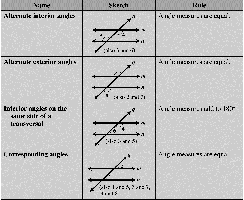
Angle Sum of a Triangle: The sum of the interior angles of any triangle is .
Similar Triangles: Triangles with the same shape but not necessarily the same size; corresponding angles are equal, and corresponding sides are proportional.
Congruent Triangles: Triangles with the same shape and size; all corresponding sides and angles are equal.
Example: Given two angles of a triangle, and , the third angle is .
Types of Triangles
Triangles can be classified by their angles or sides:
By Angles | By Sides |
|---|---|
All acute | All sides equal (Equilateral) |
One right angle | Two sides equal (Isosceles) |
One obtuse angle | No sides equal (Scalene) |
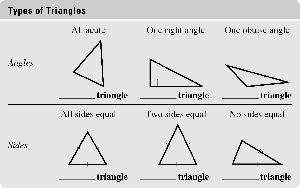
Example: Angle Measures in Parallel Lines
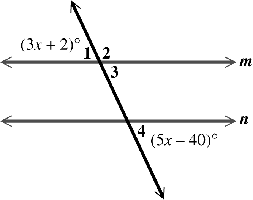
Given and are parallel, and angle measures are expressed in terms of , use the properties of corresponding, alternate interior, and exterior angles to solve for $x$ and the angle measures.
Example: Similar Triangles
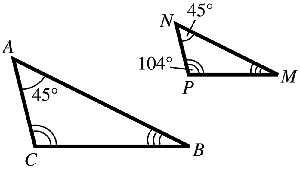
Given triangles and are similar, corresponding angles are equal. Use this property to find unknown angle measures.
Example: Finding Side Lengths in Similar Triangles
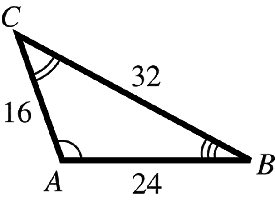
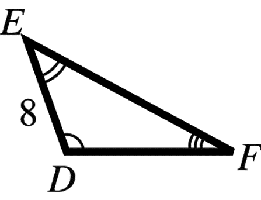
Given triangles and are similar, set up proportions between corresponding sides to solve for unknown lengths.
Section 1.3: The Pythagorean Theorem and the Distance Formula
This section introduces the Pythagorean Theorem, a fundamental result for right triangles, and the distance formula for points in the coordinate plane.
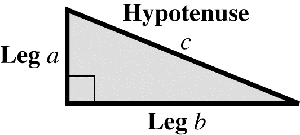
Pythagorean Theorem: In a right triangle with legs and , and hypotenuse :
Distance Formula: For points and in the plane:
Section 1.4: Trigonometric Functions and Their Properties
This section defines the six trigonometric functions, their relationships, and their properties in the coordinate plane.
Six Trigonometric Functions: For an angle in standard position, with a point on its terminal side and :
Quadrantal Angles: For , some trigonometric functions are undefined due to division by zero.
0 | 1 | 0 | Undefined | 1 | Undefined | |
1 | 0 | Undefined | 0 | Undefined | 1 | |
0 | -1 | 0 | Undefined | -1 | Undefined | |
-1 | 0 | Undefined | 0 | Undefined | -1 | |
0 | 1 | 0 | Undefined | 1 | Undefined |
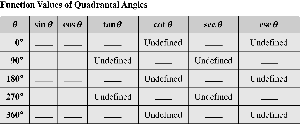
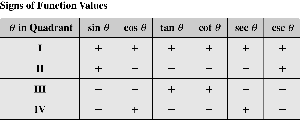
Signs of Trigonometric Functions in Quadrants
The sign of each trigonometric function depends on the quadrant in which the terminal side of the angle lies:
Quadrant | ||||||
|---|---|---|---|---|---|---|
I | + | + | + | + | + | + |
II | + | - | - | - | - | + |
III | - | - | + | + | - | - |
IV | - | + | - | - | + | - |
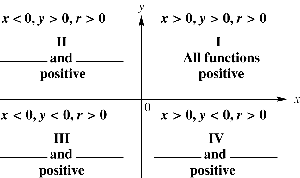
Quadrant Diagram
The coordinate plane is divided into four quadrants, each with specific sign conventions for , , and :
Ranges of Trigonometric Functions
Sine and Cosine: ,
Tangent and Cotangent: ,
Secant and Cosecant: ,
Reciprocal and Quotient Identities
Reciprocal Identities:
Quotient Identities:
Pythagorean Identities
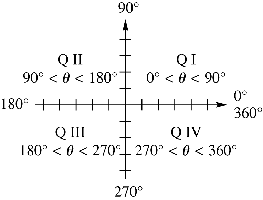
Quadrant Ranges and Reference Diagram
Additional info: The above notes include all major concepts, definitions, and properties from the provided materials, with relevant images and tables to reinforce understanding. Examples and formulas are expanded for clarity and exam preparation.
