 Indietro
Circles: Equations, Graphs, and Applications in the Coordinate Plane
Guida di studio - Note intelligenti
 Appunti personalizzati basati sui tuoi materiali, ampliati con definizioni chiave, esempi e contesto.
Chapter 2: Graphs
Section 4: Circles
This section explores the geometric and algebraic properties of circles in the coordinate plane. Students will learn how to write equations of circles, graph them, and convert between standard and general forms. Applications and historical context are also discussed.
Objectives
Write the standard form of the equation of a circle
Graph a circle in the coordinate plane
Work with the general form of the equation of a circle
Definition and Properties of a Circle
Definition of a Circle
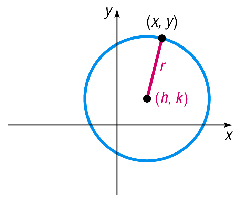
A circle is the set of all points in the xy-plane that are a fixed distance r (the radius) from a fixed point (h, k) (the center).
Center: The fixed point (h, k)
Radius: The fixed distance r
Standard Form of the Equation of a Circle
The standard form of the equation of a circle with center (h, k) and radius r is:
Every point (x, y) on the circle satisfies this equation.
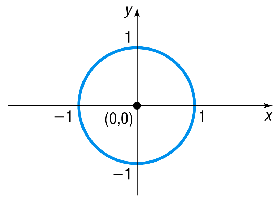
If the center is at the origin (0, 0), the equation simplifies to .
Example 1: Writing the Standard Form
Problem: Write the standard form of the equation of the circle with radius 5 and center (-3, 6).
Solution: Substitute h = -3, k = 6, r = 5 into the standard form:
Graphing Circles
To graph a circle, plot the center (h, k) and use the radius r to mark points at distance r from the center in all directions. Draw a smooth curve through these points.

Example 2: Graphing a Circle
Problem: Graph the circle with center (-2, 3) and radius 1.
Equation:
General Form of the Equation of a Circle
General Form
The general form of a circle's equation is:
To convert from general to standard form, complete the square for both x and y terms.
Algorithm: Converting Between Forms
Standard Form:
General Form:
Expand the squares and combine like terms to go from standard to general form.
To return to standard form, complete the square for x and y.
Example 4: Converting to Standard Form
Problem: Convert to standard form.
Group x and y terms:
Complete the square for each group:
Applications and Additional Examples
Finding the Equation of a Circle Given Center and a Point
Given the center (h, k) and a point (x_1, y_1) on the circle, the radius is the distance between these points:
Substitute r, h, and k into the standard form.
Example 7: Center and Point
Problem: Write the standard form of the equation of the circle with center (1, 0) and containing the point (-3, 2).
Find the radius:
Equation:
Example 8: Circle Tangent to a Line
Problem: Write the standard form of the equation of the circle with center (4, -2) and tangent to the line x = 1.
The radius is the horizontal distance from the center to the line:
Equation:
Example 9: Circle with Diameter Endpoints
Problem: Write the standard form of the equation of a circle with diameter endpoints (4, 3) and (0, 1).
Find the center (midpoint):
Find the radius (half the distance between endpoints):
Equation:
Historical Context: Aristotle and the Geocentric Model
Aristotle's Model of the Universe
In ancient Greek astronomy, Aristotle proposed a geocentric model where the Earth is at the center of the universe. Planets and stars were thought to be attached to rotating spheres, with all motions being circular and at constant speeds.
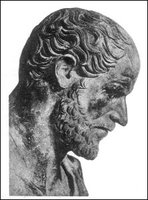
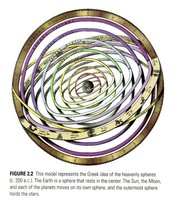
Additional info: This historical context illustrates the importance of circles in early scientific models and the development of mathematical astronomy.
Summary Table: Forms of the Equation of a Circle
Form | Equation | Key Features |
|---|---|---|
Standard Form | Center (h, k), radius r | |
General Form | Complete the square to find center and radius |
