 Indietro
Lines and Their Equations: Slope, Forms, and Graphs
Guida di studio - Note intelligenti
 Appunti personalizzati basati sui tuoi materiali, ampliati con definizioni chiave, esempi e contesto.
Chapter 1: Graphs
Section 1.3: Lines
This section introduces the concept of lines in the coordinate plane, focusing on the slope, various forms of linear equations, and the relationships between lines such as parallelism and perpendicularity. Understanding these foundational ideas is essential for analyzing and graphing linear relationships in precalculus.
Objective 1: Calculate and Interpret the Slope of a Line
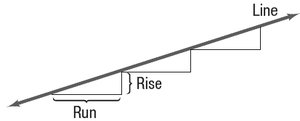
The slope of a line is a measure of its steepness, defined as the ratio of the vertical change (rise) to the horizontal change (run) between two points on the line. Slope is a key concept in understanding linear relationships.
Definition: The slope m between two points and is given by:
Interpretation:
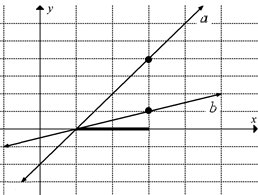
If the rise increases for the same run, the line becomes more steep.
If the rise decreases for the same run, the line becomes less steep.
If the run decreases for the same rise, the line becomes more steep.
If the run increases for the same rise, the line becomes less steep.
Vertical lines: The slope is undefined because the run is zero, resulting in division by zero.
Horizontal lines: The slope is zero because the rise is zero.
Average Rate of Change: For a line, the average rate of change is constant and equal to the slope.
Example: Given points and , the slope is .
Objective 2: Graph Lines Given a Point and the Slope
To graph a line when given a point and the slope, start at the given point and use the slope to determine another point. Draw a straight line through both points.
Step 1: Plot the given point .
Step 2: From this point, move according to the slope: rise units up/down and run units right/left.
Step 3: Draw the line through these points.
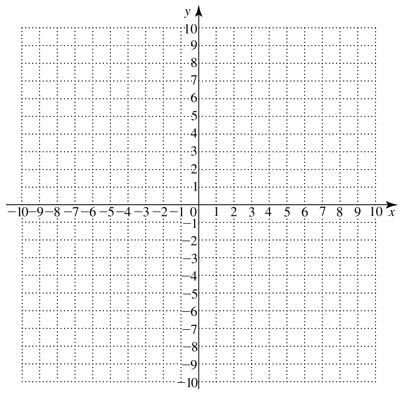
Example: Graph the line through with slope . From $(2, 3)$, move up 2 units and right 1 unit to plot a second point, then draw the line.
Objective 3: Find the Equation of a Vertical Line
A vertical line has an undefined slope and is represented by an equation of the form , where is the x-intercept. All points on this line have the same x-coordinate.
Equation:
Graph: A straight line parallel to the y-axis crossing the x-axis at .
Example: The equation is a vertical line passing through all points where $x = 4$.
Objective 4: Use the Point-Slope Form of a Line; Identify Horizontal Lines
The point-slope form of a line is useful when you know the slope and a point on the line. A horizontal line has a slope of zero and is represented by .
Point-Slope Form:
Horizontal Line:
Example: The line with slope passing through : .
Example: The horizontal line through : .
Objective 5: Use the Slope-Intercept Form of a Line
The slope-intercept form is the most common way to write the equation of a line, especially for graphing. It highlights the slope and the y-intercept.
Equation:
m: Slope of the line
b: y-intercept (where the line crosses the y-axis)
Example: The line with slope and y-intercept is .
Objective 6: Find the Equation of a Line Given Two Points
Given two distinct points, you can always find the equation of the line passing through them.
Step 1: Find the slope .
Step 2: Use the point-slope form with one of the points.
Step 3: Rearrange to slope-intercept or general form as needed.
Example: Through and : , so , or .
Objective 7: Graph Lines Written in General Form Using Intercepts
The general form of a line is . To graph such a line, find the x- and y-intercepts by setting and respectively.
General Form:
x-intercept: Set , solve for
y-intercept: Set , solve for
Example: For , x-intercept: , y-intercept: .
Objective 8: Find Equations of Parallel Lines
Parallel lines have the same slope but different y-intercepts (if nonvertical). Vertical lines are parallel if they have different x-intercepts.
Criteria: Two lines are parallel if and .
Vertical lines: and are parallel if .
Example: and are parallel.
Objective 9: Find Equations of Perpendicular Lines
Perpendicular lines intersect at a right angle (90°). For nonvertical lines, their slopes are negative reciprocals: .
Criteria: If a line has slope , a perpendicular line has slope .
Vertical and horizontal lines: Any vertical line is perpendicular to any horizontal line.
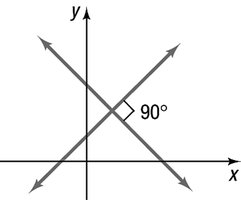
Example: The line is perpendicular to .
Graphical Examples: Perpendicular Lines and Viewing Windows
When graphing perpendicular lines, the appearance of the right angle can be distorted if the axes are not scaled equally. A square viewing window preserves the true angle.
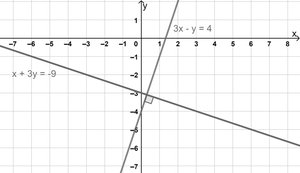
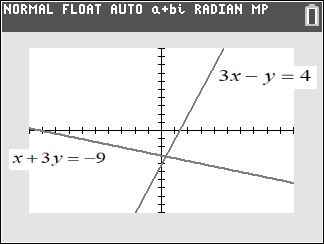
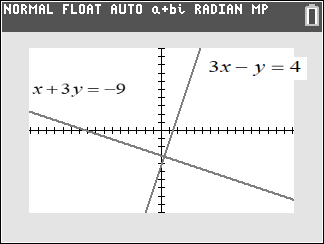
Additional info: Always use a square grid when verifying perpendicularity visually to avoid misleading interpretations.
