 Indietro
Properties and Graphing of Rational Functions
Guida di studio - Note intelligenti
 Appunti personalizzati basati sui tuoi materiali, ampliati con definizioni chiave, esempi e contesto.
Rational Functions
Definition and Domain
A rational function is any function that can be written as the ratio of two polynomials: , where and are polynomials and . The domain of a rational function is all real numbers except those for which the denominator equals zero.
Finding the Domain: Set the denominator equal to zero and solve for . Exclude these values from the domain.
Lowest Terms: A rational function is in lowest terms if and have no common factors. Always find the domain before reducing to lowest terms.
Intercepts
Intercepts are points where the graph crosses the axes.
X-intercepts: Set and solve for . These are the zeros of the numerator.
Y-intercepts: Set and solve for .
Asymptotes of Rational Functions
Vertical Asymptotes (VA)
Vertical asymptotes occur at the real zeros of the denominator, where the function becomes unbounded. The graph approaches but never crosses these lines.
VA Location: Set and solve for .
Multiplicity: If the zero has odd multiplicity, the graph approaches on one side and on the other. If even, it approaches the same infinity on both sides.
Horizontal Asymptotes (HA)
Horizontal asymptotes describe the end behavior of the function as .
If degree of numerator degree of denominator: is the HA.
If degree of numerator degree of denominator: , where and are leading coefficients.
If degree of numerator degree of denominator: No HA; may have an oblique (slant) asymptote.
Oblique (Slant) Asymptotes
Oblique asymptotes occur when the degree of the numerator is exactly one more than the degree of the denominator. Use polynomial long division to find the equation of the slant asymptote.
Equation: Divide by ; the quotient (without remainder) is the slant asymptote.
Graphing Rational Functions
Using Transformations
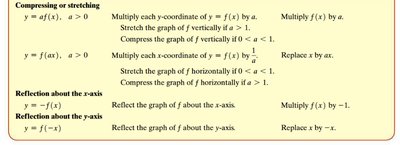
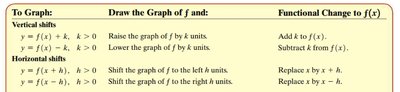
Transformations help graph rational functions by shifting, stretching, compressing, or reflecting the basic graph.
Vertical Shifts: raises the graph by units; lowers it by units.
Horizontal Shifts: shifts left by units; shifts right by units.
Vertical Stretch/Compression: stretches vertically if , compresses if .
Horizontal Stretch/Compression: compresses horizontally if , stretches if .
Reflections: reflects about the x-axis; reflects about the y-axis.
Graphing Example
To graph a rational function:
Find the domain.
Reduce to lowest terms.
Find x- and y-intercepts.
Find vertical, horizontal, and oblique asymptotes.
Plot key points and asymptotes.
Sketch the graph, noting behavior near asymptotes.
Special Cases: Holes
Holes in the Graph
A hole occurs when a factor cancels in both the numerator and denominator. The function is undefined at this point, but there is no vertical asymptote.
Location: Set the cancelled factor equal to zero and solve for .
Summary Table: Properties of Rational Functions
Property | How to Find | Notes |
|---|---|---|
Domain | Set denominator | Exclude these values |
X-intercept | Set numerator | Zeros of numerator |
Y-intercept | Set | Evaluate |
Vertical Asymptote | Set denominator | Real zeros only |
Horizontal Asymptote | Compare degrees | See rules above |
Oblique Asymptote | Long division | Degree numerator = degree denominator + 1 |
Hole | Common factor cancels | Undefined at this |
Additional info:
End behavior of rational functions is modeled by their asymptotes.
Multiplicity of zeros affects the graph's approach to vertical asymptotes.
Transformations are essential for graphing complex rational functions.
