 Indietro
Solving Systems of Equations: Substitution, Elimination, and Graphical Methods
Guida di studio - Note intelligenti
 Appunti personalizzati basati sui tuoi materiali, ampliati con definizioni chiave, esempi e contesto.
Prerequisites
Solving Systems of Equations
Systems of equations are collections of two or more equations with the same set of variables. Solving these systems is a foundational skill in precalculus, with applications in business, science, and engineering. The main goal is to find all ordered pairs (or triples, etc.) that satisfy every equation in the system.
System of Equations: A set of equations with the same variables.
Solution: An ordered pair (or triple, etc.) that makes all equations in the system true.
Consistent System: A system with at least one solution.
Inconsistent System: A system with no solution.
Method of Substitution
The substitution method involves solving one equation for one variable and substituting this expression into the other equation. This reduces the system to a single equation in one variable, which can then be solved algebraically.
Step 1: Solve one equation for one variable in terms of the other.
Step 2: Substitute this expression into the other equation.
Step 3: Solve for the remaining variable.
Step 4: Substitute back to find the other variable.
Example: Solve the system by substitution:
Given: and
Solve the first equation for :
Substitute into the second equation:
Simplify:
Find :
Solving Systems Graphically
Graphical solutions involve plotting each equation on the same coordinate axes and identifying the intersection point(s). The coordinates of the intersection(s) are the solutions to the system. This method is especially useful for visualizing the relationship between equations, including nonlinear systems.
Step 1: Solve each equation for (if possible).
Step 2: Graph both equations on the same axes.
Step 3: Identify the intersection point(s).
Example: Solve the system graphically:
Given: and a second equation (not fully specified in the excerpt, but implied to be a quadratic).
Graph both equations and use the intersection feature on a graphing calculator to find solutions.
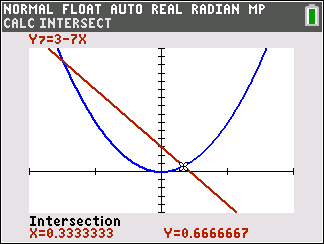
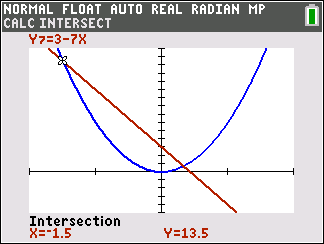
Additional info: The images show the intersection points of a line and a parabola, illustrating the graphical solution of a nonlinear system.
Method of Elimination
The elimination method involves adding or subtracting equations to eliminate one variable, making it possible to solve for the other. This method is particularly effective when the coefficients of one variable are opposites or can be made opposites by multiplication.
Step 1: Multiply one or both equations by suitable numbers so that the coefficients of one variable are opposites.
Step 2: Add or subtract the equations to eliminate one variable.
Step 3: Solve for the remaining variable.
Step 4: Substitute back to find the other variable.
Example: Solve the system using elimination:
Given: and
Multiply the first equation by 2:
Add to the second equation:
Substitute into either equation:
Special Cases: Infinitely Many Solutions
Sometimes, after elimination, all variables cancel and a true statement remains (e.g., ). This indicates that the system has infinitely many solutions; the equations are dependent and represent the same line.
Example: and
Multiply the first equation by 3:
Add to the second equation:
Conclusion: The system has infinitely many solutions.
Summary Table: Methods for Solving Systems of Equations
Method | When to Use | Key Steps |
|---|---|---|
Substitution | One equation is easily solved for one variable | Solve for one variable, substitute, solve for the other |
Elimination | Coefficients can be made equal or opposite | Add/subtract equations to eliminate a variable |
Graphical | Visualize solutions or solve nonlinear systems | Graph equations, find intersection points |
