 Indietro
Study Notes: Circles in the Cartesian Plane (Precalculus Chapter 1.4)
Guida di studio - Note intelligenti
 Appunti personalizzati basati sui tuoi materiali, ampliati con definizioni chiave, esempi e contesto.
Chapter 1: Graphs
Section 1.4: Circles
This section introduces the mathematical definition of a circle in the Cartesian plane, explores the standard and general forms of the equation of a circle, and demonstrates how to graph circles and find their intercepts. These concepts are foundational for understanding analytic geometry and are directly relevant to Precalculus.
Definition of a Circle
A circle is the set of all points (x, y) in the Cartesian plane that are a fixed distance r (the radius) from a fixed point (h, k) (the center).
Radius (r): The constant distance from the center to any point on the circle.
Center (h, k): The fixed point from which all points on the circle are equidistant.
Distance Formula: The distance between two points (x1, y1) and (x2, y2) is given by:
For a circle, this becomes:
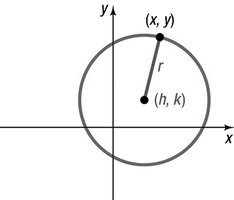
Standard Form of the Equation of a Circle
The standard form of the equation of a circle with center (h, k) and radius r is:
Center: (h, k)
Radius: r
Example: Write the standard form of the equation of the circle with radius 6 and center (4, –7):
Theorem: Circle at the Origin
If the center of the circle is at the origin (0, 0), the equation simplifies to:
Definition: Unit Circle
The unit circle is a circle with radius r = 1 and center at the origin (0, 0). Its equation is:
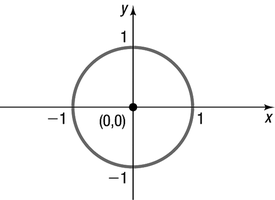
Graphing a Circle
To graph a circle given its equation in standard form:
Identify the center (h, k).
Determine the radius r.
Plot the center and draw all points at distance r from the center.
Example: Graph the equation .
Center: (4, –2)
Radius: 5
Finding the Intercepts of a Circle
To find the x-intercepts and y-intercepts of a circle:
Set y = 0 and solve for x to find x-intercepts.
Set x = 0 and solve for y to find y-intercepts.
Label the intercepts on the graph for clarity.
General Form of the Equation of a Circle
The general form of the equation of a circle is:
where A > 0. This form may represent a circle, a single point, or no graph at all, depending on the values of the coefficients.
If the equation can be rewritten in standard form, it represents a circle.
If the radius is zero, it represents a single point.
If the radius is imaginary (negative under the square root), there is no real graph.
Example: The equation is equivalent to (after expanding and simplifying).
Completing the Square
To convert the general form to standard form:
Group x and y terms.
Complete the square for both x and y.
Rewrite the equation in standard form to identify the center and radius.
Example: Convert to standard form:
Center: (4, –2)
Radius: 5
Summary Table: Forms of the Equation of a Circle
Form | Equation | Center | Radius |
|---|---|---|---|
Standard Form | (h, k) | r | |
Origin Form | (0, 0) | r | |
Unit Circle | (0, 0) | 1 | |
General Form | Completing the square required | Completing the square required |
Additional info: Completing the square is a key algebraic technique for converting the general form to standard form, allowing identification of the circle's center and radius.
