 Indietro
Neuroscience and Behavior: Foundations of Biological Psychology
Guida di studio - Note intelligenti
 Appunti personalizzati basati sui tuoi materiali, ampliati con definizioni chiave, esempi e contesto.
Neurons: The Basic Elements of Behavior
The Structure of the Neuron
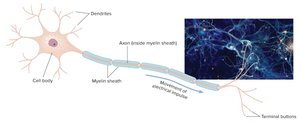
Neurons are the fundamental units of the nervous system, responsible for transmitting information throughout the body. Each neuron consists of a cell body, dendrites, an axon, and terminal buttons. Glial cells support neurons by providing nourishment, insulation, and repair.
Cell Body: Contains the nucleus and hereditary material.
Dendrites: Receive messages from other neurons.
Axon: Transmits messages away from the cell body to other neurons or body cells.
Myelin Sheath: Protective coating that increases the speed of electrical impulses.
Terminal Buttons: Send messages to other neurons.
Example: The myelin sheath is especially concentrated on axons that carry urgent information, such as those involved in reflexes.
How Neurons Fire
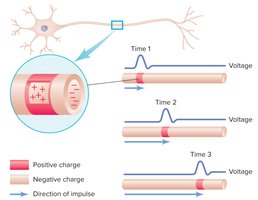
Neurons operate according to the all-or-none law, meaning they either fire completely or not at all. The firing process involves changes in electrical charge across the axon membrane.
Resting State: The neuron has a negative charge of about −70 millivolts.
Action Potential: When triggered, the charge becomes positive, traveling down the axon.
Refractory Period: After firing, the neuron briefly becomes more negative before returning to its resting state.
Equation: The change in membrane potential during an action potential can be represented as: where is the maximum positive voltage and is the resting potential.
Neural Communication: Synapses and Neurotransmitters
Where Neurons Meet: Bridging the Gap
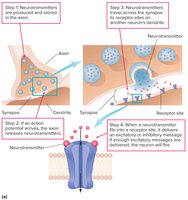
Neurons communicate at synapses, where the axon of one neuron meets the dendrite of another. Chemical messengers called neurotransmitters carry signals across the synaptic gap.
Synapse: The space between two neurons.
Neurotransmitters: Chemicals that transmit messages across the synapse.
Receptor Sites: Locations on the receiving neuron where neurotransmitters bind.
Excitatory Message: Increases likelihood of firing.
Inhibitory Message: Decreases likelihood of firing.
Reuptake: Neurotransmitters are reabsorbed by the sending neuron, ending the signal.
Example: SSRIs (Selective Serotonin Reuptake Inhibitors) are drugs that block reuptake, allowing serotonin to remain active longer and alleviating symptoms of depression.
The Nervous System: Organization and Function
Central and Peripheral Nervous Systems
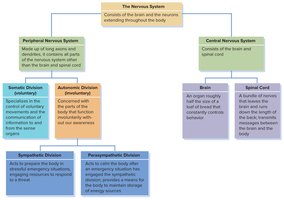
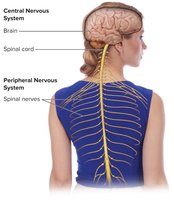
The nervous system is divided into the central nervous system (CNS) and peripheral nervous system (PNS). The CNS includes the brain and spinal cord, while the PNS connects the CNS to the rest of the body.
Central Nervous System (CNS): Brain and spinal cord; controls behavior and transmits messages.
Peripheral Nervous System (PNS): Nerves outside the CNS; includes somatic and autonomic divisions.
Somatic Division: Controls voluntary movements and sensory information.
Autonomic Division: Regulates involuntary functions (heart, glands, lungs).
Division | Main Function |
|---|---|
Somatic | Voluntary movement, sensory input |
Autonomic | Involuntary functions |
Sympathetic | Prepares body for stress (fight-or-flight) |
Parasympathetic | Calms body after stress |
Anatomy of the Nervous System
The CNS and PNS are physically distinct, with the CNS located in the brain and spinal cord, and the PNS branching out to the extremities.
Spinal Cord: Transmits messages and controls reflexes.
Spinal Nerves: Connect the CNS to the body.
Autonomic Nervous System: Sympathetic and Parasympathetic Divisions
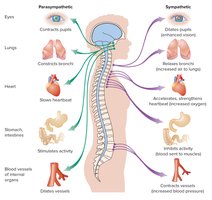
The autonomic nervous system regulates involuntary functions and is divided into sympathetic and parasympathetic branches.
Sympathetic Division: Activates body in stressful situations (increases heart rate, dilates pupils).
Parasympathetic Division: Calms the body after stress (slows heartbeat, contracts pupils).
Organ | Parasympathetic Effect | Sympathetic Effect |
|---|---|---|
Eyes | Contracts pupils | Dilates pupils |
Lungs | Constricts bronchi | Relaxes bronchi |
Heart | Slows heartbeat | Accelerates heartbeat |
Stomach/Intestines | Stimulates activity | Inhibits activity |
Blood Vessels | Dilates vessels | Constricts vessels |
The Endocrine System: Chemical Communication
Endocrine System and Hormones
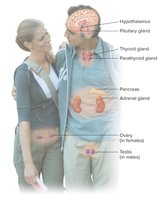
The endocrine system is a network of glands that release hormones into the bloodstream, regulating growth, metabolism, and behavior.
Hormones: Chemical messengers affecting body functions.
Pituitary Gland: The "master gland" controlling other endocrine glands.
Hypothalamus: Regulates the pituitary gland and maintains homeostasis.
The Brain: Structure and Function
Studying the Brain
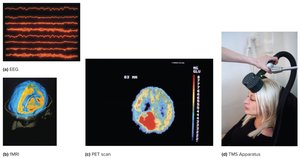
Researchers use various techniques to study brain structure and function, including EEG, fMRI, PET scans, and TMS.
EEG: Records electrical activity in the brain.
fMRI: Provides detailed images of brain activity.
PET: Shows biochemical activity.
TMS: Disrupts activity in specific brain regions to study function.
The Central Core: The "Old Brain"
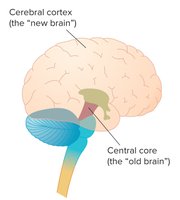
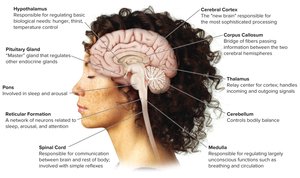
The central core, or "old brain," controls basic life functions and is shared with other vertebrates. It includes the medulla, pons, cerebellum, reticular formation, thalamus, and hypothalamus.
Medulla: Controls breathing and heartbeat.
Pons: Coordinates movement and regulates sleep.
Cerebellum: Maintains balance.
Reticular Formation: Regulates arousal and attention.
Thalamus: Relays sensory information.
Hypothalamus: Maintains homeostasis and regulates survival behaviors.
The Limbic System
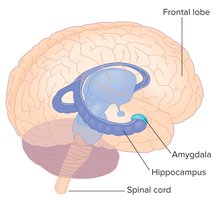
The limbic system is involved in emotions, self-preservation, learning, and memory. It includes the amygdala and hippocampus.
Amygdala: Controls aggression and emotional responses.
Hippocampus: Essential for learning and memory.
The Cerebral Cortex: The "New Brain"
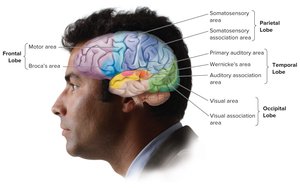
The cerebral cortex is responsible for higher-order functions such as thought, language, and perception. It is divided into four lobes: frontal, parietal, temporal, and occipital.
Frontal Lobe: Motor area, Broca's area (speech production).
Parietal Lobe: Somatosensory area (touch, pressure).
Temporal Lobe: Auditory area, Wernicke's area (language comprehension).
Occipital Lobe: Visual area.
Motor and Sensory Areas of the Cortex
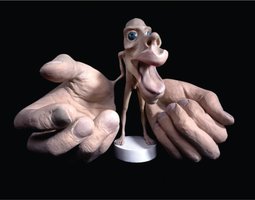
The motor area controls voluntary movement, while the sensory area processes information from the senses. The amount of cortical tissue dedicated to each body part reflects its sensitivity.
Somatosensory Area: Processes touch and pressure.
Auditory Area: Processes hearing.
Visual Area: Processes sight.
Association Areas and Neuroplasticity
Association areas are involved in higher mental processes. Neuroplasticity refers to the brain's ability to reorganize and form new connections throughout life.
Broca's Aphasia: Difficulty speaking.
Wernicke's Aphasia: Difficulty understanding speech.
Neurogenesis: Creation of new neurons in adulthood.
Specialization of the Hemispheres
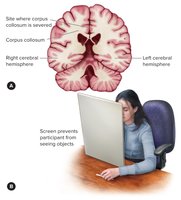
The brain is divided into left and right hemispheres, each specializing in different functions. The left hemisphere is dominant in verbal tasks, while the right is dominant in nonverbal tasks. The corpus callosum connects the two hemispheres.
Lateralization: Dominance of one hemisphere in specific functions.
Split-Brain: Corpus callosum is severed to treat epilepsy, revealing differences in hemispheric processing.
 Additional info: These notes provide foundational knowledge for biological psychology, covering neuron structure, neural communication, nervous system organization, endocrine system, and brain anatomy and function. This content is directly relevant to introductory psychology courses, especially chapters on biological psychology, sensation and perception, and cognition.
