 Indietro
PSYC 102: Introductory Psychology – Biological and Cognitive Focus (Course Overview & Study Guide)
Guida di studio - Note intelligenti
 Appunti personalizzati basati sui tuoi materiali, ampliati con definizioni chiave, esempi e contesto.
Course Introduction
Overview of Introductory Psychology
This course provides a foundational exploration of psychology, focusing on biological and cognitive aspects. Students will learn about the science of psychology, including the brain, behavior, memory, cognition, emotion, motivation, and learning. The course also introduces students to the history of psychology and scientific thinking.
Instructor: Jeremiah (Jeb) Edward Bohol, Ph.D., Clinical Psychologist
Class Format: In-person and remote, Tuesdays 7:00 pm – 9:45 pm
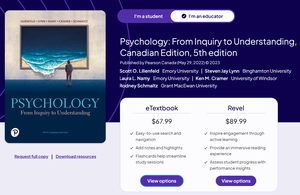
Textbook: Psychology: From Inquiry to Understanding, Canadian Edition, 5th edition
Course Structure & Evaluation
Assessment Methods
Students are evaluated through quizzes, midterms, research readings, and a final exam. Retake options are available with a reduced score.
Quiz: 5% (open book/notes, online)
Midterm 1: 20% (open book/notes, online)
Midterm 2: 30% (in-person, no notes)
Final Exam: 40% (in-person, no notes)
Research Reading: 5%
Retake Policy: Retake available for all assessments at 20% reduced total score
Grading Scale: A-level (80-100%), B-level (70-79%), C range (60-69%), NP (incomplete midterm/final)
Course Topics & Schedule
Weekly Outline
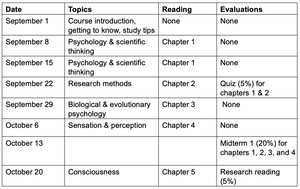
The course covers key areas of introductory psychology, aligned with standard chapter topics. Below is the tentative schedule:
Date | Topics | Reading | Evaluations |
|---|---|---|---|
September 1 | Course introduction, getting to know, study tips | None | None |
September 8 | Psychology & scientific thinking | Chapter 1 | None |
September 15 | Psychology & scientific thinking | Chapter 1 | None |
September 22 | Research methods | Chapter 2 | Quiz (5%) for chapters 1 & 2 |
September 29 | Biological & evolutionary psychology | Chapter 3 | None |
October 6 | Sensation & perception | Chapter 4 | None |
October 13 | Sensation & perception | Chapter 4 | Midterm 1 (20%) for chapters 1, 2, 3, and 4 |
October 20 | Consciousness | Chapter 5 | Research reading (5%) |
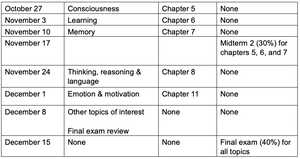
October 27 | Consciousness | Chapter 5 | None |
November 3 | Learning | Chapter 6 | None |
November 10 | Memory | Chapter 7 | None |
November 17 | Midterm 2 (30%) for chapters 5, 6, and 7 | Midterm 2 (30%) | |
November 24 | Thinking, reasoning & language | Chapter 8 | None |
December 1 | Emotion & motivation | Chapter 11 | None |
December 8 | Other topics of interest, Final exam review | None | None |
December 15 | Final exam (40%) for all topics | None | Final exam (40%) |
Key Course Policies
Academic Integrity & AI Use
Students are expected to avoid plagiarism, cheating, and other academic misdemeanors. Caution is advised when using artificial intelligence for assignments; always verify AI-generated content.
Academic Misdemeanor: Includes plagiarism, cheating, and improper conduct
AI Use: Double-check outcomes from AI tools
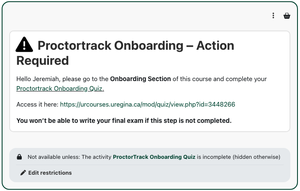
Proctortrack Onboarding
Completion of the Proctortrack Onboarding Quiz is required to write the final exam. Failure to complete this step will prevent exam participation.
Course Activities & Expectations
Group Activity
Students are encouraged to reflect on their learning goals, desired changes by semester's end, and share effective study tips.
Learning Goals: What do you expect to learn?
Desired Changes: What changes do you wish to see?
Study Tips: Share strategies for success
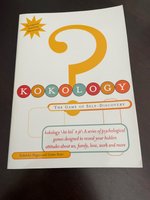
Sample Psychological Exercise: Kokology
Self-Discovery through Psychological Games
Kokology is a series of psychological games designed to reveal hidden attitudes about oneself, family, love, work, and more. The exercise involves imagining scenarios and interpreting responses to gain insight into stress, coping mechanisms, and personal relationships.
Scenario: Imagine exploring an old building in a forest, encountering various stimuli
Interpretation: Number of steps = stress level; sounds = coping with past experiences; reactions = problem-solving style; imagined person = confidant
Application: Useful for self-reflection and understanding psychological concepts
Important Dates
September 22: Quiz
October 13: Midterm 1
October 20: Research reading
November 17: Midterm 2
December 15: Final exam
Next Meeting Preview
Chapter 1: Brief History of Psychology & Scientific Thinking
The next class will introduce the history of psychology and the principles of scientific thinking, setting the foundation for understanding psychological research and practice.
History of Psychology: Key figures, movements, and developments
Scientific Thinking: Methods, critical analysis, and evidence-based practice
