 Indietro
Psychological Research: The Scientific Method and Research Strategies
Guida di studio - Note intelligenti
 Appunti personalizzati basati sui tuoi materiali, ampliati con definizioni chiave, esempi e contesto.
Psychological Research
The Scientific Method in Psychology
The scientific method is a systematic approach used by psychologists to acquire knowledge and understanding about behavior and mental processes. It ensures that research is objective, replicable, and based on empirical evidence.
Step 1: Identify Questions of Interest – Questions may arise from observed behaviors, phenomena requiring explanation, prior research findings, or curiosity and creativity.
Step 2: Formulate an Explanation – Develop a theory and a testable hypothesis to explain the observed phenomena.
Step 3: Carry Out Research – Devise operational definitions, select research methods, collect and analyze data.
Step 4: Communicate the Findings – Share results with the scientific community for evaluation and replication.
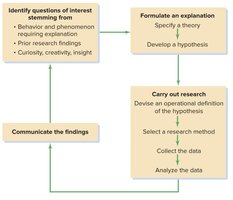
Additional info: The scientific method is iterative; findings often lead to new questions and further research.
Theories and Hypotheses
Theories are broad explanations and predictions concerning phenomena of interest. They provide a framework for organizing facts and guiding future research. For example, the diffusion of responsibility theory explains why individuals may be less likely to help in emergencies when others are present.
Hypothesis: A specific, testable prediction derived from a theory. For example, "The more people who witness an emergency, the less likely it is that help will be given."
Operational Definition: Translating a hypothesis into measurable, observable procedures.
Additional info: Hypotheses allow researchers to test theories and refine them based on empirical evidence.
Research Methods in Psychology
Types of Research Methods
Psychologists use various research methods to investigate behavior and mental processes. Each method has unique advantages and limitations.
Archival Research: Examines existing data (e.g., census records, databases). Advantage: Inexpensive. Disadvantage: Data may be incomplete or not suited to the hypothesis.
Naturalistic Observation: Observes behavior in its natural context without intervention. Advantage: Realistic data. Disadvantage: No control over variables.
Survey Research: Uses questionnaires or interviews to gather data from a representative sample. Advantage: Can generalize to larger populations if the sample is representative. Disadvantage: Potential for bias or inaccurate responses.
Case Study: In-depth analysis of an individual or small group. Advantage: Detailed insights. Disadvantage: Limited generalizability.
Correlational Research
Correlational research examines the relationship between two variables to determine if they are associated. The correlation coefficient (r) ranges from +1.0 (perfect positive) to -1.0 (perfect negative), with 0 indicating no relationship.
Positive correlation: Both variables increase or decrease together.
Negative correlation: One variable increases as the other decreases.
Limitation: Correlation does not imply causation.
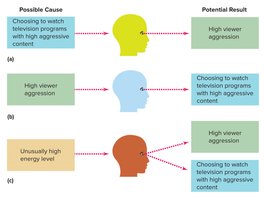
Example: Watching aggressive TV shows and aggressive behavior may be correlated, but causality cannot be determined without experimental research.
Experimental Research
Experimental research involves manipulating one variable (independent variable) to observe its effect on another variable (dependent variable), allowing for cause-and-effect conclusions.
Experimental group: Receives the treatment or manipulation.
Control group: Does not receive the treatment; serves as a baseline.
Random assignment: Participants are randomly assigned to groups to control for confounding variables.
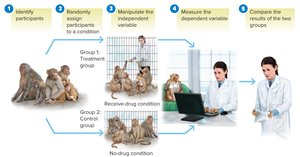
Example: Testing the effects of a drug on behavior by comparing a treatment group (receives drug) and a control group (no drug).
Variables in Experiments
Independent Variable (IV): The variable manipulated by the researcher.
Dependent Variable (DV): The variable measured to assess the effect of the IV.
Additional info: Proper experimental design is essential for valid results.
Significance and Replication
A significant outcome means the results are unlikely due to chance, as determined by statistical tests. Replication involves repeating studies to confirm findings, and meta-analysis combines results from multiple studies for overall conclusions.
Critical Issues in Psychological Research
Ethics in Research
Ethical guidelines protect research participants:
Protection from harm
Right to privacy
Voluntary participation
Informed consent and debriefing
Review by independent panels
Animal research is permitted under strict guidelines to minimize discomfort and justify procedures by their scientific value.
Threats to Experimental Validity
Experimental bias occurs when factors distort the relationship between variables. Placebos and double-blind procedures help control for bias from both experimenters and participants.
Application: Diffusion of Responsibility
Latané and Darley’s Experiment
The diffusion of responsibility theory was tested by Latané and Darley, who found that as the number of bystanders increased, the likelihood of helping behavior decreased.
Size of Group | Percentage Helping |
|---|---|
2 | 86% |
3 | 63% |
6 | 32% |
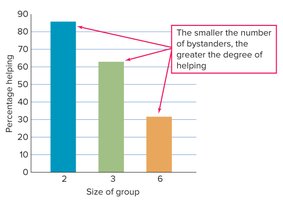
Example: In emergencies, individuals are less likely to help when more bystanders are present, supporting the diffusion of responsibility theory.
