 Indietro
Reading 5.1 Globalization and the elephant curve
Guida di studio - Note intelligenti
 Appunti personalizzati basati sui tuoi materiali, ampliati con definizioni chiave, esempi e contesto.
Globalization
Pros and Cons of Globalization
Globalization refers to the increasing interconnectedness of societies, economies, and cultures across the world. It has been shaped by political, economic, and technological changes since the late 20th century.
Post-1990, Liberal Consensus: Characterized by free trade, the end of the Cold War, the rise of liberal democracies, market economies, offshoring, and global trade agreements.
Contemporary Response: Includes tariffs, geopolitical divisions (e.g., China/Russia vs. US-led blocks), democratic backsliding, increased state involvement, nearshoring, and binational trade agreements.
Critics and Proponents: Proponents argue globalization promotes economic growth and cultural exchange. Critics highlight issues such as inequality, loss of local cultures, and exploitation.
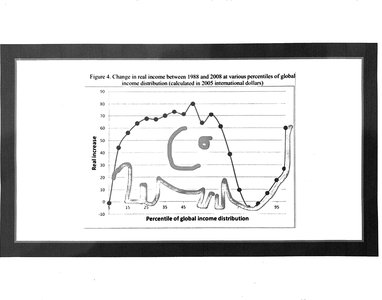
Example: The "Elephant Chart" is often used to illustrate how different income groups have benefited from globalization.
The Elephant Chart
The Elephant Chart visually represents changes in global income distribution, showing which groups have benefited most from globalization.
Interpretation: The chart shows that middle-income groups in emerging economies saw significant income growth, while the lower and middle classes in developed countries experienced stagnation. The global top 1% captured a large share of income growth.
Application: Sociologists use this chart to analyze economic inequality and the effects of globalization on different social classes.
Example: A proponent might argue the chart shows rising prosperity in developing countries, while a critic might highlight stagnation among Western middle classes.
Sectoral Transformation (Economic Restructuring)
Economic Sectors and Restructuring
Economic restructuring refers to changes in the dominant sectors of an economy, often driven by globalization, technological change, and policy shifts.
Economic Sectors: Primary (agriculture, mining), Secondary (manufacturing), Tertiary (services), Quaternary (information, research).
Sectoral Change: Societies shift from primary to secondary and tertiary sectors as they develop. This affects employment, income distribution, and social structure.
Supply Chains: Modern supply chains are global, with production and distribution spanning multiple countries.
Example: The shift from manufacturing to service economies in the US and Western Europe.
Income Distribution and Inequality
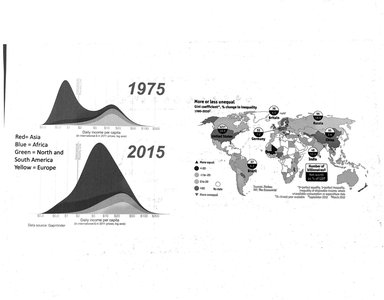
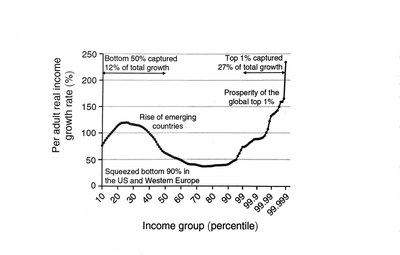
Income distribution is a key indicator of social stratification and economic health. Sociologists study how income is shared among different groups and how this changes over time.
Growth Rates: The bottom 50% captured only 12% of total growth, while the top 1% captured 27%.
Emerging Countries: Saw significant income growth, contributing to global economic restructuring.
Stagnation: The bottom 90% in the US and Western Europe experienced stagnation.
Formula: Income growth rate can be represented as .
Extreme Poverty by World Region
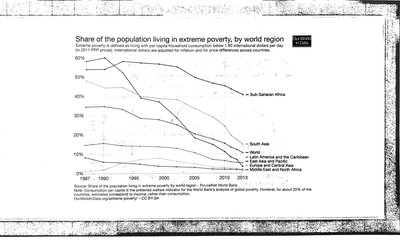
Extreme poverty is defined as living on less than $1.90 per day. Sociologists examine how poverty rates change across regions and over time.
Trends: Sub-Saharan Africa has the highest rates of extreme poverty, but rates have declined globally since 1990.
Regional Differences: South Asia, Latin America, and East Asia have seen significant reductions in poverty.
Application: Understanding poverty trends helps explain global inequality and the impact of economic restructuring.
Cultural Geography
Key Terms and Concepts
Cultural geography studies how culture, society, and space interact. Sociologists use these concepts to analyze social patterns and cultural change.
Cultural Imperialism: The dominance of one culture over others, often through media, trade, or political influence.
Universalizing vs. Ethnic Cultures: Universalizing cultures seek global adoption (e.g., Christianity), while ethnic cultures are tied to specific groups.
Secularism: The separation of religion from public life and government.
Globalization: The spread of ideas, products, and people across borders, affecting cultural practices.
Other Terms: Cultural syncretism (blending of cultures), gender, globalization, world system, etc.
Example: The spread of fast food chains as a form of cultural imperialism.
Additional info: These concepts are foundational for understanding how societies change and interact in a globalized world.
