Indietro
Socialization and the Development of the Self: Key Concepts in Sociology
Guida di studio - Note intelligenti
 Appunti personalizzati basati sui tuoi materiali, ampliati con definizioni chiave, esempi e contesto.
Socialization and Human Development
Epigenetics and Human Development
Human development is shaped by both biological and social factors. Epigenetics demonstrates that gene expression is not solely determined by DNA; instead, it is actively influenced by behavioral and social environments. This means that genes and the environment interact continuously, shaping individual outcomes.
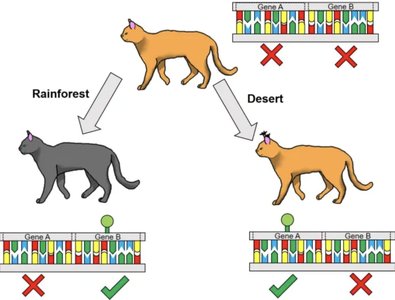
Example: An animal raised in a rainforest may express different genes than one raised in a desert, even if their DNA is identical. This illustrates how environmental context can influence biological outcomes.
The Importance of Socialization
The Tragedy of Isolation
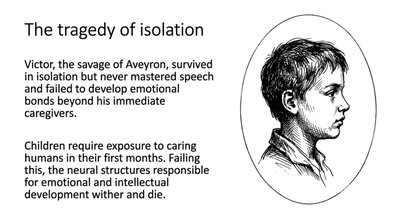
Socialization is essential for emotional and intellectual development. The case of Victor, the "savage of Aveyron," highlights the consequences of extreme isolation. Without early exposure to caring humans, children may survive physically but fail to develop language and emotional bonds, as the neural structures for these capacities wither without social input.
Defining Socialization
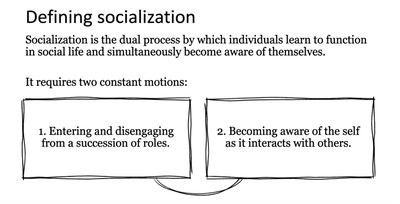
Socialization is the dual process by which individuals learn to function in social life and become aware of themselves. It involves two ongoing motions:
Entering and disengaging from a succession of roles
Becoming aware of the self as it interacts with others
The Emergence of the Self
Freud and the Social Construction of Self
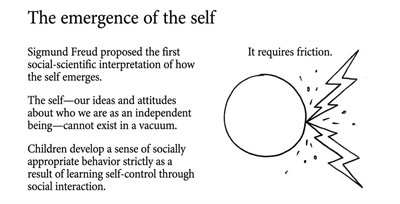
Sigmund Freud provided the first social-scientific interpretation of how the self emerges. The self—our ideas and attitudes about who we are—cannot exist in isolation. Children develop socially appropriate behavior by learning self-control through social interaction, which requires friction and engagement with others.
The Looking-Glass Self (Charles Horton Cooley)
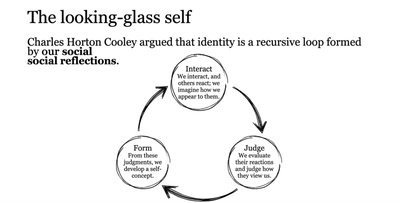
Cooley argued that identity is formed through a recursive loop of social reflection. The process involves:
Interacting: We interact and imagine how we appear to others.
Judging: We evaluate their reactions and judge how they view us.
Forming: From these judgments, we develop a self-concept.
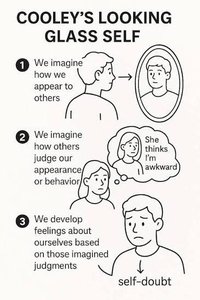
Example: If a person believes others see them as awkward, they may develop self-doubt based on this imagined judgment.
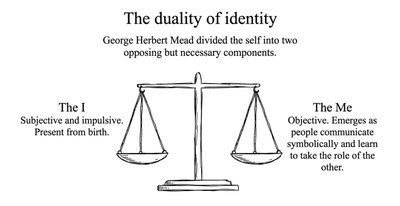
The Duality of Identity (George Herbert Mead)
Mead divided the self into two components:
The I: Subjective and impulsive, present from birth.
The Me: Objective, emerges as people learn to take the role of the other through communication and social interaction.
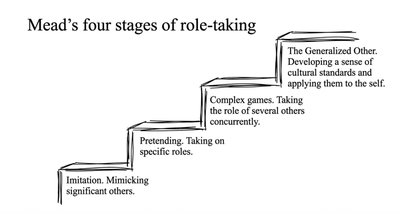
Mead’s Four Stages of Role-Taking
Mead described the development of the self through four stages:
Imitation: Mimicking significant others.
Pretending: Taking on specific roles.
Complex games: Taking the role of several others concurrently.
The Generalized Other: Developing a sense of cultural standards and applying them to oneself.
Theoretical Perspectives on Socialization
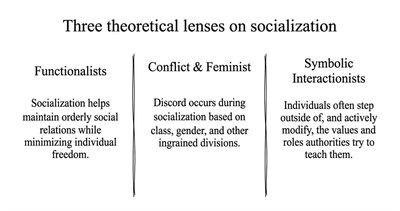
Three Theoretical Lenses
Functionalists | Conflict & Feminist | Symbolic Interactionists |
|---|---|---|
Socialization helps maintain orderly social relations while minimizing individual freedom. | Discord occurs during socialization based on class, gender, and other ingrained divisions. | Individuals often step outside of, and actively modify, the values and roles authorities try to teach them. |
Agents of Socialization
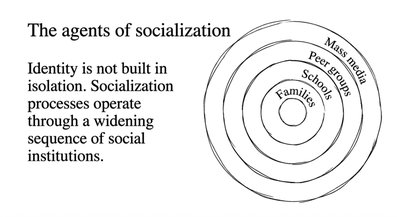
Major Agents
Identity is shaped through a sequence of social institutions, including:
Families
Schools
Peer groups
Mass media
Primary Socialization
The family is the most important agent of primary socialization, where children master basic skills required to function in society. The family’s influence endures throughout life.
Secondary Socialization and the Hidden Curriculum
Schools become responsible for secondary socialization after childhood. Beyond academics, schools enforce a hidden curriculum—teaching obedience to authority and conformity to cultural norms.
The Self-Fulfilling Prophecy
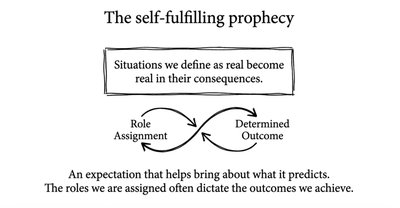
A self-fulfilling prophecy occurs when expectations lead to behaviors that cause those expectations to come true. The roles assigned to individuals often dictate the outcomes they achieve.
Peer Groups and Social Status
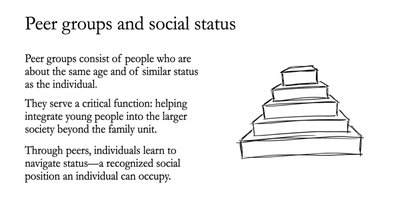
Peer groups, composed of individuals of similar age and status, help integrate young people into society and teach them how to navigate social status—a recognized social position.
The Mass Media
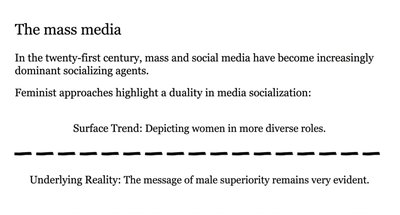
Mass and social media are increasingly dominant socializing agents. Feminist perspectives note a duality: while media depict women in more diverse roles, underlying messages of male superiority persist.
Socialization and Society
The Intersection of Biography and History
Individual potential is shaped by the historical context in which one lives. Success and failure are not solely matters of individual will but are influenced by historical and macroeconomic circumstances beyond personal control.

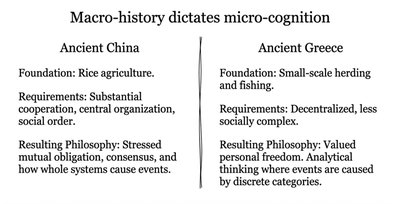
Macro-History Dictates Micro-Cognition
Ancient China | Ancient Greece |
|---|---|
Foundation: Rice agriculture Requirements: Substantial cooperation, central organization, social order Resulting Philosophy: Stressed mutual obligation, consensus, and holistic thinking. | Foundation: Small-scale herding and fishing Requirements: Decentralized, less socially complex Resulting Philosophy: Valued personal freedom, analytical thinking, and discrete categories. |
Resocialization and Adult Socialization
Resocialization and Total Institutions
Resocialization occurs when powerful agents deliberately cause rapid changes in people's values, roles, and self-conception, often within total institutions (e.g., prisons, military, residential schools). A historical example is the forced resocialization of Indigenous children in residential schools.
Anticipatory Socialization
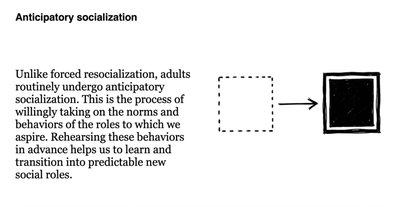
Unlike forced resocialization, anticipatory socialization is the process by which adults willingly adopt the norms and behaviors of roles they aspire to. Practicing these behaviors in advance helps individuals transition into new social roles.

The Flexible Adult Self
Socialization continues throughout adulthood. The modern self is highly flexible, shaped by globalization, the ability to reinvent oneself, and continuous social interaction via the Internet.