 Indietro
Space and Society: Movement and the Making of Space
Guida di studio - Note intelligenti
 Appunti personalizzati basati sui tuoi materiali, ampliati con definizioni chiave, esempi e contesto.
Space and Society
Movement and the Making of Space
Understanding the relationship between space and society is central to sociology. Space is not merely an empty backdrop for social action; rather, it is actively produced and shaped by human movement, social relations, and historical processes. This section explores key sociological theories about the social production of space and the role of movement in shaping geographic realities.
Henri Lefebvre's Spatial Triad: Lefebvre argued that space is always socially produced. His model distinguishes between space as perceived (physical and material), conceived (planned and imagined), and lived (experienced in everyday life). Space gains meaning through human activity and, in turn, shapes the conditions for social life.
Doreen Massey's Relational Space: Massey conceptualized geographic space as inherently relational. Space is not fixed or static; it is continually transformed by social connections, power relations, and flows of people, goods, and ideas. Non-human processes, such as climate change, also influence our relationship to space.
Colonialism and Spatiality (Achille Mbembe): Colonial processes have fundamentally shaped the spatial organization of postcolonial societies. Colonial borders often persist, and colonized peoples were integrated into imperial economies and worldviews, positioning the global south as peripheral.
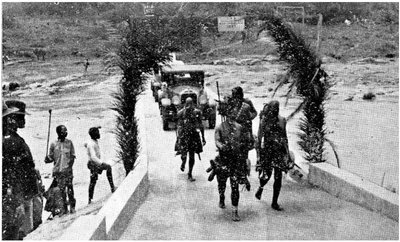
Example: The construction of a bridge across the Mfolozi River in 1938 (northern KwaZulu-Natal) illustrates how infrastructure projects physically and symbolically reshape space. The bridge connected rural areas to colonial administrative centers, facilitating new flows of people, goods, and ideas, and altering local mental geographies.
Movement, Mobility, and Power
Movement is deeply implicated in the making of space. The flows of people, goods, money, and ideas are central to understanding how geographic spaces are produced and transformed. However, these flows are not neutral; they are shaped by power relations and can reinforce inequalities.
Facilitating Mobility: Infrastructure such as bridges enables new forms of movement, connecting previously separated areas and populations. For example, the bridge over the Mfolozi River allowed colonial administrators to access rural territories and provided local communities with improved access to resources like hospitals.
Multiplicity and Social Relations: The opening ceremony of the bridge revealed the intersection of multiple cultures and social groups—local Zulu communities, colonial administrators, missionaries, and others—demonstrating Massey's idea of space as a social relation.
Extroversion and Mental Geography: Improved mobility reorients how people perceive and relate to space, connecting them to broader colonial and global geographies (a process Massey calls extroversion).
Power and Unequal Flows: While some flows (e.g., money, data) move rapidly through digital networks, others (e.g., people, goods) encounter friction and barriers. These differences reflect and reinforce social inequalities.
Additional info: Theories of space and movement are foundational for understanding urbanization, migration, and the impact of globalization on local communities. Sociologists analyze how infrastructure, policy, and historical legacies shape the lived experiences of space and mobility.
