 Indietro
Study Guide: Research Methods in Sociology
Guida di studio - Note intelligenti
 Appunti personalizzati basati sui tuoi materiali, ampliati con definizioni chiave, esempi e contesto.
Research Methods in Sociology
Introduction to Sociological Research
Sociological research is essential for understanding social phenomena and human behaviour. This chapter explores the scientific and unscientific approaches to inquiry, the distinction between qualitative and quantitative methods, and the ethical considerations guiding sociological research.
Levels of Experience
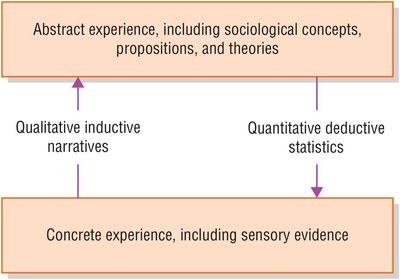
Experience shapes our perception of reality and our ability to recognize patterns. Sociologists distinguish between two levels of experience:
Concrete Experience: Gained through sensory input such as seeing, touching, tasting, smelling, and hearing.
Abstract Experience: Occurs in the mind and involves concepts and propositions.
Concepts: Abstract terms used to organize concrete experience.
Propositions: Ideas that result from finding relationships between concepts.
Scientific versus Unscientific Thinking
Biases can influence our observations and lead to incorrect conclusions. Scientific thinking aims to minimize bias and error.
Bias: The tendency to favour one person, thing, or idea over another.
Casual Observation: Ordinary inquiry performed in daily life.
Tradition: Knowledge passed down, which may or may not be valid.
Authority: Accepting information from experts or authoritative sources.
Pseudoscience: Claims that sound scientific but do not meet scientific standards.
Common Errors in Inquiry
Overgeneralization: Treating exceptions as the rule.
Selective Observation: Ignoring evidence that challenges beliefs.
Illogical Reasoning: Expecting events to recur without reasonable cause.
Consequences of Unscientific Thinking
Unscientific thinking can have serious consequences, such as the spread of misinformation and harmful practices (e.g., false COVID-19 treatments, conspiracy theories, climate-change denial).
Objectivity and Social Position
Objectivity is assessed by the consistency of observations among independent observers. Social position influences perspective:
Insiders: Have detailed experiences and insights.
Outsiders: Offer different perspectives.
Positivist and Interpretivist Traditions
Two major traditions guide sociological research:
Positivist Tradition: Views social realities as objective and best studied through quantitative methods (e.g., surveys, statistics). Originated with Auguste Comte.
Interpretivist Tradition: Views social realities as subjectively constructed and best studied through qualitative methods (e.g., interviews, participant observation).
Quantitative and Qualitative Research Traditions
Quantitative Methods: Emphasize deductive reasoning, starting with general ideas and testing them on specific cases.
Qualitative Methods: Emphasize inductive reasoning, starting with concrete cases and identifying general patterns and themes.
The Research Act
Qualitative Research Steps
Identify a research interest based on concrete experiences.
Collect evidence from similar cases.
Analyze evidence for patterns and themes.
Interpret patterns in context.
Quantitative Research Steps
Identify a theoretical idea of interest.
Translate the idea into a testable hypothesis.
Collect and analyze data.
Accept or reject the hypothesis based on data analysis.
Ethical Considerations in Sociological Research
Ethics are central to sociological research. Key principles include:
Voluntary Participation: Participants must choose to participate freely.
Harm Minimization: Researchers must minimize potential harm.
Right to Privacy: Protecting participant privacy.
Authenticity: Ensuring research accurately reflects social realities.
Informed Consent: Participants acknowledge risks and participate voluntarily.
Anonymity: Researchers cannot identify subjects based on evidence.
Confidentiality: Researchers agree not to disclose identities.
Debriefing: Interviewing participants after a study to clarify and address any issues.
Research Involving Indigenous Peoples: Requires community consultation and engagement with Indigenous organizations and leaders.
Quantitative Approaches
Operationalization
Operationalization: Translating concepts into variables and propositions into hypotheses.
Variable: A measure of a concept with multiple values.
Hypothesis: A testable form of a proposition.
Experimentation
Experiment: Controlled situation to isolate causes and measure effects.
Independent Variable: Presumed cause.
Dependent Variable: Presumed effect.
Randomization: Assigning subjects to groups by chance.
Experimental Group: Exposed to the independent variable.
Control Group: Not exposed to the independent variable.
Validity and Reliability
Validity: Degree to which results reflect reality.
Reliability: Consistency of measurement procedures.
Surveys and Sampling
Surveys: Ask questions about knowledge, attitudes, or behaviour.
Sample: Selected part of the population for analysis.
Population: Entire group of interest.
Probability Sample: Every member has a known, nonzero chance of selection.
Establishing Causality
Three criteria: Relationship test, sequencing, non-spuriousness.
Control Variable: Identifies context of relationship between variables.
Spuriousness: Change in a control variable causes change in both independent and dependent variables, erasing their association.
Official Statistics
Official Statistics: Data collected by government agencies (e.g., census, unemployment records).
Advantages: Inexpensive, easy to analyze.
Disadvantages: May not fit researcher interests, can be biased or incomplete.
Qualitative Approaches
Qualitative Methods: Seek subjective understanding using inductive approach.
Focus on how people interpret social experience.
Sampling in Qualitative Research
Purposive Sampling: Researcher uses judgment to locate members of interest.
Snowball Sampling: Existing participants suggest additional subjects.
Participant Observation
Researchers take part in the group being studied and observe systematically.
Ethnography: Goal is to experience and understand community membership.
Researcher’s Role and Reactivity
Degree of involvement affects data collection.
Reactivity: Presence of researcher may cause subjects to act artificially.
Gaining Access and Key Informants
Access depends on openness of group and trust of gatekeeper.
Key Informants: Community members who provide credible information.
Qualitative Interviewing
Structured Interviews: Follow protocols for predetermined subjects.
Unstructured/Semi-Structured Interviews: Open-ended formats for respondent-driven answers.
Exploratory Research: Formulates theories, suited for sensitive topics.
Focus Group: Group interviews guided by a moderator.
Authenticity: Criterion for qualitative research quality, capturing social realities as experienced by insiders.
Mixed Methods
Combining qualitative and quantitative methods in a single study.
Social Desirability Bias: Respondents answer to appear favourable.
Digital Sociology and Big Data
Digital Sociology: Uses digital technology as both tool and subject of research.
Nonreactive Methods: Study social life without affecting behaviour.
Big Data: Large datasets from digital sources.
Advantages: Reduces social desirability bias, accessible, often free, eliminates sampling bias, reveals online behaviour.
Disadvantages: Not representative, may contain "dirty data," ethical issues, privacy breaches, potential harm.
The Importance of Subjectivity
Subjective experiences can enhance objective sociological knowledge. Feminism, for example, brought attention to issues previously considered non-sociological, demonstrating that "the personal is political."
Comparison of Quantitative and Qualitative Methods
Aspect | Quantitative Methods | Qualitative Methods |
|---|---|---|
Approach | Deductive | Inductive |
Data | Numbers, statistics | Words, narratives |
Goal | Objectivity, generalization | Subjectivity, interpretation |
Sampling | Probability sampling | Purposive/snowball sampling |
Validity/Reliability | Measured by consistency and accuracy | Measured by authenticity |
