Skip to main content
Introductory Statistics
Il mio corso
Impara
Preparazione agli esami
AI Tutor
Guide di studio
Soluzioni per libri di testo
Flashcard
Esplora
Prova l'app
Il mio corso
Impara
Preparazione agli esami
AI Tutor
Guide di studio
Soluzioni per libri di testo
Flashcard
Esplora
Prova l'app
Indietro
Multiple Comparisons: Bonferoni Test definitions
Puoi toccare per girare la carta.
One-way ANOVA
Puoi toccare per girare la carta.
👆
One-way ANOVA
Statistical method for comparing means across three or more groups using variance analysis from group and error sources.
Avanzamenti del tracciato
I pulsanti di controllo sono stati cambiati in modalità "navigazione".
1/15
Flashcard correlate
Pratica correlata
Video consigliati
Multiple Comparisons: Bonferoni Test quiz
Multiple Comparisons: Bonferoni Test
15 Termini
Multiple Comparisons: Bonferoni Test
14. ANOVA
5 Problemi
Argomento
Two-Way ANOVA
14. ANOVA
5 Problemi
Argomento
Justin
14. ANOVA - Part 1 of 2
4 Argomenti
12 Problemi
Capitolo
Ally
14. ANOVA - Part 2 of 2
1 Argomento
3 Problemi
Capitolo
Justin
VideoThumbView.guidedCourse
08:11
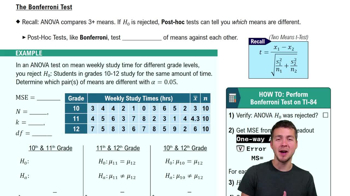
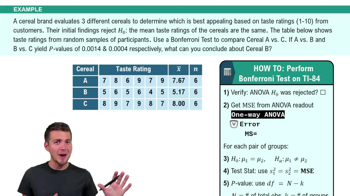
The Bonferroni Test Example 1
173
views
3
rank
VideoThumbView.guidedCourse
09:54
The Bonferroni Test
220
views
2
rank
1
comments
Termini in questo insieme (15)
Nascondere definizioni
One-way ANOVA
Statistical method for comparing means across three or more groups using variance analysis from group and error sources.
Null Hypothesis
Assumption that all group means are equal, serving as the baseline for statistical testing in variance analysis.
Post Hoc Test
Procedure applied after rejecting the baseline assumption to identify which group means differ significantly.
Bonferroni Test
Pairwise comparison method that adjusts error rates by multiplying p-values or dividing significance level by the number of comparisons.
Mean Square Error
Value from variance analysis representing within-group variability, used in calculating test statistics for comparisons.
Sample Size
Count of observations in each group, influencing calculations for test statistics and degrees of freedom.
Degrees of Freedom
Number derived from total observations minus groups, used in determining statistical significance and p-values.
Pairwise Comparison
Analysis of differences between every possible pair of group means to pinpoint significant disparities.
T Score
Statistic calculated from sample means, variability, and sizes, indicating the magnitude of difference between groups.
P Value
Probability measure indicating the likelihood of observing a result as extreme as the test statistic under the baseline assumption.
Adjusted P Value
Probability measure modified to account for multiple comparisons, controlling the overall error rate in the experiment.
Significance Level
Threshold for determining statistical significance, often set at 0.05, compared against adjusted probability measures.
Bonferroni Correction
Technique for controlling experiment-wide error by multiplying probability measures or dividing the threshold by the number of comparisons.
Combinatorial Function
Mathematical operation used to calculate the number of possible pairs among groups for comparison purposes.
Alternative Hypothesis
Statement asserting that at least one group mean differs, guiding the direction of statistical testing after baseline rejection.
 IndietroIndietro
 08:11
08:11