Skip to main content
Introductory Statistics
Il mio corso
Impara
Preparazione agli esami
AI Tutor
Guide di studio
Soluzioni per libri di testo
Flashcard
Esplora
Prova l'app
Il mio corso
Impara
Preparazione agli esami
AI Tutor
Guide di studio
Soluzioni per libri di testo
Flashcard
Esplora
Prova l'app
Indietro
Multiple Comparisons: Bonferoni Test quiz
Puoi toccare per girare la carta.
What is the purpose of a post hoc test like the Bonferroni test after a one-way ANOVA?
Puoi toccare per girare la carta.
👆
What is the purpose of a post hoc test like the Bonferroni test after a one-way ANOVA?
It identifies which specific means are different after rejecting the null hypothesis in a one-way ANOVA.
Avanzamenti del tracciato
I pulsanti di controllo sono stati cambiati in modalità "navigazione".
1/15
Flashcard correlate
Pratica correlata
Video consigliati
Multiple Comparisons: Bonferoni Test definitions
Multiple Comparisons: Bonferoni Test
15 Termini
Multiple Comparisons: Bonferoni Test
14. ANOVA
5 Problemi
Argomento
Two-Way ANOVA
14. ANOVA
5 Problemi
Argomento
Justin
14. ANOVA - Part 1 of 2
4 Argomenti
12 Problemi
Capitolo
Ally
14. ANOVA - Part 2 of 2
1 Argomento
3 Problemi
Capitolo
Justin
VideoThumbView.guidedCourse
08:11
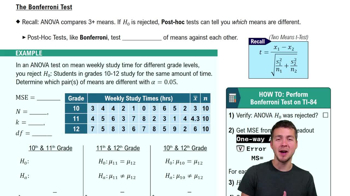
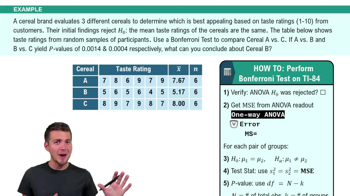
The Bonferroni Test Example 1
173
views
3
rank
VideoThumbView.guidedCourse
09:54
The Bonferroni Test
220
views
2
rank
1
comments
Termini in questo insieme (15)
Nascondere definizioni
What is the purpose of a post hoc test like the Bonferroni test after a one-way ANOVA?
It identifies which specific means are different after rejecting the null hypothesis in a one-way ANOVA.
When should you use a Bonferroni test in the context of ANOVA?
You use it after rejecting the null hypothesis in ANOVA to determine which pairs of means are significantly different.
What key value from the ANOVA output is used in the Bonferroni test calculations?
The mean square error (MSE) from the ANOVA output is used as the variance within groups.
How do you determine the number of pairwise comparisons in a Bonferroni test?
Use the combination formula nCr, where n is the number of groups and r is 2, to find the number of pairs.
What is the null hypothesis for each pairwise comparison in a Bonferroni test?
The null hypothesis is that the two group means being compared are equal.
How is the t-score calculated for each pair in the Bonferroni test?
Subtract the two sample means and divide by the square root of the MSE times the sum of the reciprocals of the sample sizes.
What do you do with the p-value obtained from each t-score in the Bonferroni test?
Multiply the original p-value by the number of pairwise comparisons to get the adjusted p-value.
How do you determine if a pairwise difference is statistically significant in the Bonferroni test?
Compare the adjusted p-value to the significance level α; if it is less than α, the difference is significant.
What is the effect of the Bonferroni correction on the likelihood of Type I error?
It reduces the experiment-wide Type I error rate by making it harder to find significant differences.
What alternative adjustment can be made instead of multiplying the p-value in the Bonferroni test?
You can divide the significance level α by the number of pairs instead of adjusting the p-value.
Why is the Bonferroni test considered tedious?
Because it requires performing multiple t-tests for each pair of means and adjusting each p-value.
What is the degrees of freedom used in the t-distribution for the Bonferroni test?
The degrees of freedom is the total sample size minus the number of groups, as given in the ANOVA error section.
What happens if the adjusted p-value is greater than α in a Bonferroni test?
You fail to reject the null hypothesis and conclude there is no significant difference between those means.
What does it mean if the adjusted p-value is less than α in a Bonferroni test?
You reject the null hypothesis and conclude that the two means are significantly different.
Why do we use the Bonferroni correction when making multiple comparisons?
Because making multiple comparisons increases the chance of Type I error, so the correction controls the overall error rate.
 IndietroIndietro
 08:11
08:11