Indietro
Chapter 5: Probability – Comprehensive Study Notes
Guida di studio - Note intelligenti
 Appunti personalizzati basati sui tuoi materiali, ampliati con definizioni chiave, esempi e contesto.
Probability
Introduction to Probability
Probability is a measure of how likely an event is to occur. It deals with experiments that yield random short-term results, or outcomes, yet reveal long-term predictability. Probability describes the long-term proportion with which a certain outcome will occur in situations with short-term uncertainty. It is used in games of chance, insurance, investment, and weather forecasting, and forms the basis of inferential statistics.
Probability Experiment: Any process that can be repeated in which the results are uncertain.
Sample Space (S): The collection of all possible outcomes of a probability experiment.
Event: Any collection of outcomes from a probability experiment. Events may consist of one or more outcomes.
Simple Event: An event with only one outcome, often denoted as ei.
Example: Consider the probability experiment of having two children. The possible outcomes are: boy-boy, boy-girl, girl-boy, girl-girl. The sample space is S = {BB, BG, GB, GG}. The event E = "have one boy" includes BG and GB.
The Law of Large Numbers
The Law of Large Numbers states that as the number of trials of a probability experiment increases, the proportion with which a certain outcome is observed gets closer to the probability of the outcome. This is not to be confused with the Law of Averages, which is a misconception.

Key Point: Each trial is independent; the likelihood of an outcome does not change based on previous results.
Probability Rules
Basic Probability Rules
Rule 1: The probability of any event E, P(E), must be between 0 and 1:
Rule 2: The sum of the probabilities of all outcomes in the sample space must equal 1:
Probability Model: Lists possible outcomes and their probabilities, satisfying Rules 1 and 2.
Impossible Event: Probability is 0.
Certain Event: Probability is 1.
Unusual Event: An event with a low probability of occurring.
Calculating Probabilities
There are three methods for calculating the probability of an outcome:
Empirical (Relative Frequency) Probability
Classical Probability
Subjective Probability
Empirical Probabilities (Relative Frequency)
The probability of an event E is approximately the number of times event E is observed divided by the number of repetitions of the experiment.
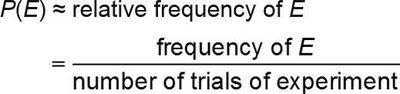
Example: Toss a coin 1450 times. If heads appears 718 times, then .
Empirical Probability Model Example
Suppose a survey records seatbelt use among college students:
Response | Frequency |
|---|---|
Never | 118 |
Rarely | 249 |
Sometimes | 345 |
Most of the time | 716 |
Always | 3093 |
To estimate the probability that a student sometimes wears a seatbelt:
Classical Probabilities
The classical method does not require an experiment; it uses counting techniques and theoretical values. It requires equally likely outcomes.
If an experiment has n equally likely outcomes and m ways that event E can occur, then:
Example: Rolling a die: Probability of an even number =
Subjective Probabilities
Subjective probability is based on personal judgment, often used when empirical or classical methods are not feasible. Example: An economist predicts a 20% chance of recession next year.
The Addition Rule and Complements
Addition Rule for Disjoint (Mutually Exclusive) Events
Two events are disjoint if they have no outcomes in common. For disjoint events E and F:
Example: Probability of drawing a yellow or blue M&M.
General Addition Rule
For events that are not disjoint:
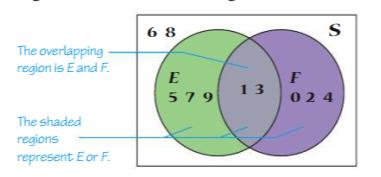
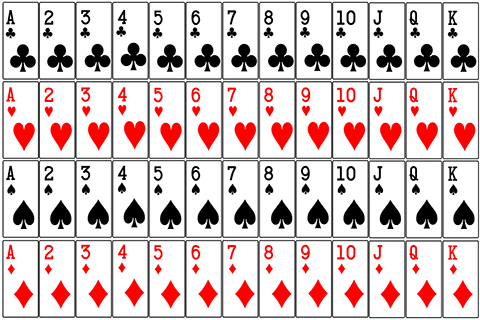
Example: Probability of drawing a 3 or a heart from a deck of cards.
The Complement Rule
The complement of event E, denoted EC, is all outcomes not in E. The probability of the complement is:
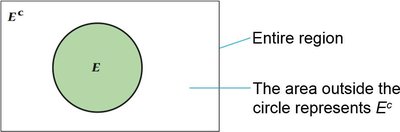
Example: If 31.6% of households own a dog, the probability that a household does not own a dog is .
Independence and the Multiplication Rule
Multiplication Rule for Independent Events
Two events E and F are independent if the occurrence of E does not affect the probability of F. For independent events:
Example: Probability that two randomly selected 60-year-old females survive the year:
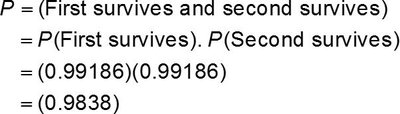
Multiplication Rule for n Independent Events
If E1, E2, ..., En are independent:
Conditional Probability and the Multiplication Rule
Multiplication Rule for Dependent Events
When the occurrence of one event changes the probability of another, the events are dependent. The probability of both occurring is:
Conditional Probability
Conditional probability is the probability that event F occurs given that event E has occurred. It is written as P(F|E):

Example: If 110 out of 212 female job applicants have a graduate degree,
Counting Techniques
Multiplication Rule of Counting
If a task consists of a sequence of choices, the total number of ways to make the selections is the product of the number of choices at each stage.
Example: If there are 3 manufacturers, 4 colors, and 2 tip types for pens, the store carries different pens.
Permutations
Permutations are ordered arrangements where order matters and no item is selected more than once. The number of permutations of n items is n! (factorial).
Example: Scheduling 6 classes in 6 periods: possible schedules.

Permutations of n Distinct Objects Taken r at a Time
Combinations
Combinations are collections where order does not matter and no item is selected more than once. The number of combinations is:
Permutations with Nondistinct Items
When some items are identical, the number of distinguishable permutations is:
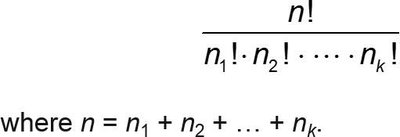
Example: Arranging 10 flags: 5 white, 3 blue, 2 red.
Summary of Counting Rules
Concept | Formula |
|---|---|
Multiplication Rule of Counting | |
Factorial | |
Combination | |
Permutation | or |
Permutations with Nondistinct Items |
Putting It All Together: Which Method Do I Use?
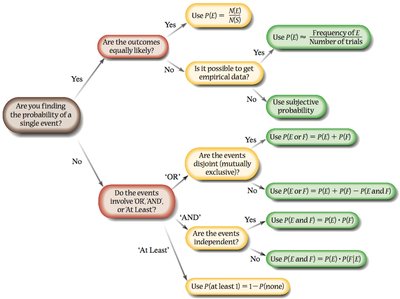
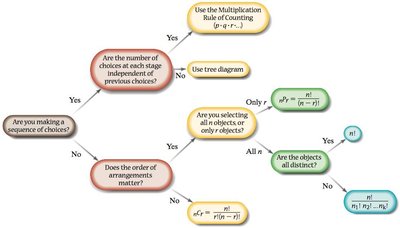
Use the following flowcharts to determine which probability or counting rule to use based on the nature of the events and the data available.