 Indietro
Experimental Designs and Data Collection in Introductory Statistics
Guida di studio - Note intelligenti
 Appunti personalizzati basati sui tuoi materiali, ampliati con definizioni chiave, esempi e contesto.
Experimental Designs
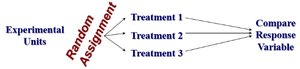
Completely Randomized Design
A completely randomized design is an experimental design in which all experimental units are assigned to treatments completely at random. This method helps to evenly distribute uncontrollable and unforeseen factors among the treatment groups, thereby reducing bias and increasing the validity of the results.
Randomization: Treatments are assigned to experimental units using a random process.
Purpose: To ensure that differences in the response variable are due to the treatments and not to other factors.
Example: Assigning 30 plants randomly to three different fertilizer treatments.
Block Design
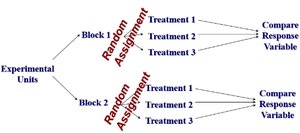
A block design involves grouping similar experimental units (blocks) together based on a characteristic that is expected to affect the response to the treatments. Randomization is then performed within each block. This design reduces variation within treatment groups and increases the accuracy of comparisons among treatments.
Blocking: Experimental units are first divided into homogeneous groups (blocks).
Randomization: Treatments are randomly assigned within each block.
Purpose: To control for known sources of variation among experimental units.
Example: Grouping dogs by breed size before randomly assigning them to different dog foods.
Matched Pairs Design
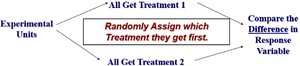
A matched pairs design is used when experimental units can be paired based on a variable, or when each subject receives both treatments in a random order. This design allows for direct comparison of treatments within pairs or within the same subject, reducing variability due to individual differences.
Pairing: Subjects are paired based on similarity, or each subject receives all treatments.
Randomization: The order of treatments is randomly assigned within each pair or subject.
Purpose: To control for variability between subjects.
Example: Each student uses both study techniques in a random order, and their retention scores are compared.
Examples of Experimental Designs
Example 1: Migraine Headache Study
Design: The study uses a block design by grouping participants based on their initial treatment (pain reliever or placebo) and then assigning half of each group to drink ice water.
Blinding: The study may be single-blind if participants do not know whether they are receiving the pain reliever or placebo.
Example 2: Dog Food Study
Design: Block design by breed size (small, medium, large), with random assignment of food type within each block.
Blinding: Single-blind as the food is sent in unmarked bags.
Example 3: Fertilizer and Tomato Plants
Design: Completely randomized design as plants are randomly assigned to fertilizer groups.
Blinding: Double-blind if the person measuring plant height does not know which fertilizer was used.
Example 4: Study Techniques and Student Retention
Design: Matched pairs design as each student experiences both study techniques in random order.
Blinding: Not specified, but possible if students do not know the hypothesis.
Example 5: Hamstring Injury Rehabilitation
Random Assignment: Ensures that differences in recovery time are due to the exercise program and not other factors.
Control Group: Including a group with no special exercise program would allow for comparison to standard recovery.
Blinding: Could be used if athletes do not know which program is expected to be more effective.
Statistical Significance: The difference in means should be tested using appropriate statistical methods (e.g., t-test) to determine if it is significant.
Collecting Data
Sampling Methods
Proper data collection is essential for making valid inferences about a population. Several sampling methods are commonly used in statistics:
Simple Random Sample: Every member of the population has an equal chance of being selected.
Stratified Random Sample: The population is divided into homogeneous groups (strata), and a random sample is taken from each stratum.
Cluster Sample: The population is divided into clusters, some clusters are randomly selected, and all members of selected clusters are surveyed.
Example: City Park Survey
Variable of Interest: Whether residents support the construction of walking trails (parameter: proportion of supporters in City X).
Strata: Residents could be divided by neighborhood or age group. For a cluster sample, randomly select entire neighborhoods and survey all residents within them. Potential bias: clusters may not be representative of the whole city.
Generalization: Results can be generalized to all residents of City X if the sample is random and representative.
Stratified Sample: Divide residents into strata (e.g., by age group), then randomly select a proportional number from each group to total 400 residents.
Example: Concrete Driveway Experiment
Type of Study: Experiment, because the developer actively assigns treatments (fiber or no fiber) to driveways.
Experimental Units: The 60 driveways.
Treatments: Concrete with fibers and concrete without fibers.
Response Variable: Severity of cracks (measured on a scale from 0 to 10).
Random Assignment: Use a random number generator or draw lots to assign 30 driveways to each treatment group.
Benefit of Random Assignment: Reduces the effect of confounding variables (e.g., driveway location, soil type) and allows for causal conclusions.
Identifying Key Elements in Experimental Design
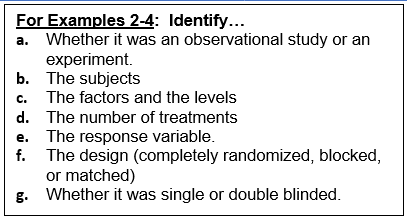
When analyzing an experiment, it is important to identify the following elements:
Element | Description |
|---|---|
Type of Study | Observational or Experimental |
Subjects | Who or what is being studied |
Factors and Levels | Independent variables and their categories |
Number of Treatments | How many different treatments are compared |
Response Variable | What is measured as the outcome |
Design | Completely randomized, blocked, or matched pairs |
Blinding | Single or double-blind |
Additional info: Statistical significance is typically assessed using hypothesis tests (e.g., t-test for means), and randomization is crucial for valid inference in experiments. Blinding helps reduce bias from participants or researchers knowing the treatment assignments.
