Ch. 3 - Probability
Larson - Elementary Statistics: Picturing the World 8th Edition
Larson8th EditionElementary Statistics: Picturing the WorldISBN: 9780137493470Non è quello che usi tu?Cambia libro di testo
Capitolo 3, Problema 3.2.1

3. What does the notation P(B|A) mean?

Guida verificata passo dopo passo
1
The notation P(B|A) represents the conditional probability of event B occurring given that event A has already occurred.
To calculate P(B|A), use the formula: P(B|A) = P(A ∩ B)P(A), where P(A ∩ B) is the probability of both events A and B occurring, and P(A) is the probability of event A occurring.
Ensure that P(A) > 0, as the conditional probability is undefined if P(A) = 0.
This concept is useful in scenarios where the occurrence of one event influences the likelihood of another event.
For example, in a deck of cards, if event A is 'drawing a red card' and event B is 'drawing a heart,' P(B|A) would represent the probability of drawing a heart given that the card drawn is red.

Risposta video verificata per un problema simile:

Questa soluzione video è stata consigliata dai nostri tutor come utile per risolvere questo problema.
Durata del video:
2m

Concetti chiave

Ecco i concetti essenziali che devi comprendere per rispondere correttamente alla domanda.

Conditional Probability

Conditional probability refers to the likelihood of an event occurring given that another event has already occurred. It is denoted as P(B|A), which reads as 'the probability of B given A.' This concept is fundamental in statistics and probability theory, as it helps in understanding how the occurrence of one event can influence the probability of another.
Video consigliato:
Percorso guidato
5:37
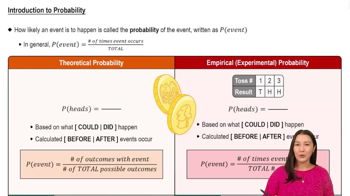
Introduction to Probability

Events A and B

In the notation P(B|A), A and B represent two distinct events within a probability space. Event A is the condition or the event that has already occurred, while event B is the event whose probability we are trying to determine under the condition of A. Understanding the relationship between these events is crucial for calculating conditional probabilities accurately.
Video consigliato:
Percorso guidato
05:54
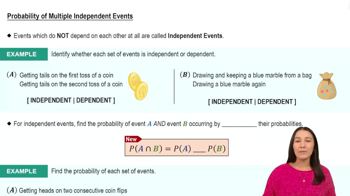
Probability of Multiple Independent Events

Bayes' Theorem

Bayes' Theorem is a fundamental principle in probability that relates conditional probabilities of events. It provides a way to update the probability of an event based on new evidence or information. The theorem is often expressed as P(A|B) = [P(B|A) * P(A)] / P(B), illustrating how P(B|A) can be used to infer the probability of A given B, thereby highlighting the interconnectedness of events in probability.
Pratica correlata
Domanda del libro di testo

29. Explain, in your own words, why in the Addition Rule for P(A or B or C), P(A and B and C) is added at the end of the formula.

292
views

Domanda del libro di testo

23. Footrace There are 72 runners in a 10-kilometer race. How many ways can the runners finish first, second, and third?

116
views
Domanda del libro di testo

"Identifying Simple Events In Exercises 33-36, determine the number of outcomes in the event. Then decide whether the event is a simple event or not. Explain your reasoning.

36. You randomly select one card from a standard deck of 52 playing cards. Event B is selecting the ace of spades."

62
views
Domanda del libro di testo

Odds The chances of winning are often written in terms of odds rather than probabilities. The odds of winning is the ratio of the number of successful outcomes to the number of unsuccessful outcomes. The odds of losing is the ratio of the number of unsuccessful outcomes to the number of successful outcomes. For example, when the number of successful outcomes is 2 and the number of unsuccessful outcomes is 3, the odds of winning are 2 : 3 (read "2 to 3"). In Exercises 91-96, use this information about odds.

92. The probability of winning an instant prize game is 1/10. The odds of winning a different instant prize game are 1 : 10. You want the best chance of winning. Which game should you play? Explain your reasoning.

61
views
Domanda del libro di testo

Finding Classical Probabilities In Exercises 41-46, a probability experiment consists of rolling a 12-sided die numbered 1 to 12. Find the probability of the event.

46. Event F: rolling a number divisible by 5

120
views
Domanda del libro di testo

True or False? In Exercises 3-6, determine whether the statement is true or false. If it is false,

explain why.

4. When two events are independent, they are also mutually exclusive.

150
views