Ch. 3 - Probability
Larson - Elementary Statistics: Picturing the World 8th Edition
Larson8th EditionElementary Statistics: Picturing the WorldISBN: 9780137493470Non è quello che usi tu?Cambia libro di testo
Capitolo 3, Problema 3.4.23

23. Footrace There are 72 runners in a 10-kilometer race. How many ways can the runners finish first, second, and third?

Guida verificata passo dopo passo
1
Step 1: Recognize that this is a permutation problem because the order in which the runners finish (first, second, and third) matters.
Step 2: Use the formula for permutations, which is P(n, r) = n! / (n - r)!, where n is the total number of items (runners) and r is the number of positions to fill (first, second, and third).
Step 3: Substitute the given values into the formula: n = 72 (total runners) and r = 3 (positions to fill). The formula becomes P(72, 3) = 72! / (72 - 3)!.
Step 4: Simplify the denominator: (72 - 3)! = 69!, so the formula becomes P(72, 3) = 72 × 71 × 70 (since the factorial terms beyond 69! cancel out).
Step 5: Multiply the remaining terms (72 × 71 × 70) to find the total number of ways the runners can finish first, second, and third.

Risposta video verificata per un problema simile:

Questa soluzione video è stata consigliata dai nostri tutor come utile per risolvere questo problema.
Durata del video:
2m

Concetti chiave

Ecco i concetti essenziali che devi comprendere per rispondere correttamente alla domanda.

Permutations

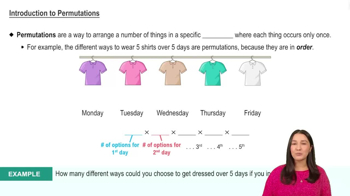
Permutations refer to the different arrangements of a set of items where the order matters. In this context, we are interested in the arrangements of the top three finishers among 72 runners. The formula for permutations is given by n! / (n - r)!, where n is the total number of items, and r is the number of items to arrange.
Video consigliato:
Percorso guidato
07:11
Introduction to Permutations

Factorial

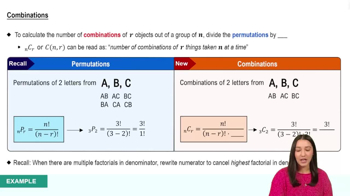
A factorial, denoted as n!, is the product of all positive integers up to n. It is a fundamental concept in combinatorics used to calculate permutations and combinations. For example, 5! equals 5 × 4 × 3 × 2 × 1 = 120. Understanding factorials is essential for solving problems involving arrangements and selections.
Video consigliato:

Combinatorial Counting

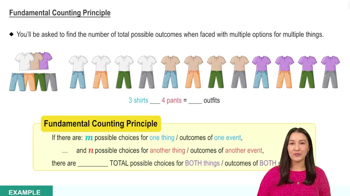
Combinatorial counting involves determining the number of ways to choose or arrange items from a larger set. In this problem, we need to count the specific arrangements of the top three finishers from the total of 72 runners. This concept is crucial for solving problems in probability and statistics, especially when dealing with competitions or selections.
Video consigliato:
Percorso guidato
04:04
Fundamental Counting Principle
Pratica correlata
Domanda del libro di testo

80. Unusual Events Can any of the events in Exercises 75-78 be considered unusual? Explain.

134
views

Domanda del libro di testo

In Exercises 7-14, perform the indicated calculation.

12. (10C7)/(14C7)

132
views
Domanda del libro di testo

29. Explain, in your own words, why in the Addition Rule for P(A or B or C), P(A and B and C) is added at the end of the formula.

292
views
Domanda del libro di testo

"Identifying Simple Events In Exercises 33-36, determine the number of outcomes in the event. Then decide whether the event is a simple event or not. Explain your reasoning.

36. You randomly select one card from a standard deck of 52 playing cards. Event B is selecting the ace of spades."

62
views
Domanda del libro di testo

3. What does the notation P(B|A) mean?

278
views
Domanda del libro di testo

Odds The chances of winning are often written in terms of odds rather than probabilities. The odds of winning is the ratio of the number of successful outcomes to the number of unsuccessful outcomes. The odds of losing is the ratio of the number of unsuccessful outcomes to the number of successful outcomes. For example, when the number of successful outcomes is 2 and the number of unsuccessful outcomes is 3, the odds of winning are 2 : 3 (read "2 to 3"). In Exercises 91-96, use this information about odds.

92. The probability of winning an instant prize game is 1/10. The odds of winning a different instant prize game are 1 : 10. You want the best chance of winning. Which game should you play? Explain your reasoning.

61
views