Ch. 3 - Probability
Larson - Elementary Statistics: Picturing the World 8th Edition
Larson8th EditionElementary Statistics: Picturing the WorldISBN: 9780137493470Non è quello che usi tu?Cambia libro di testo
Capitolo 3, Problema 3.RE.39

39. You are given that P(A) = 0.15 and P(B) = 0.40. Do you have enough information to find P(A or B)? Explain.

Guida verificata passo dopo passo
1
Step 1: Recall the formula for the probability of the union of two events, P(A or B), which is given by P(A ∪ B) = P(A) + P(B) - P(A ∩ B). This formula accounts for the overlap between events A and B to avoid double-counting.
Step 2: Substitute the given values into the formula. You are provided P(A) = 0.15 and P(B) = 0.40. However, the formula also requires the value of P(A ∩ B), the probability that both events A and B occur simultaneously.
Step 3: Assess whether P(A ∩ B) is provided or can be inferred. In this problem, P(A ∩ B) is not given, and there is no information about whether events A and B are independent or dependent. Without P(A ∩ B), you cannot calculate P(A or B) precisely.
Step 4: If events A and B were independent, you could calculate P(A ∩ B) using the formula P(A ∩ B) = P(A) × P(B). However, independence is not stated in the problem, so you cannot assume it.
Step 5: Conclude that you do not have enough information to find P(A or B) because the value of P(A ∩ B) is missing, and the relationship between events A and B (independent or dependent) is not specified.

Risposta video verificata per un problema simile:

Questa soluzione video è stata consigliata dai nostri tutor come utile per risolvere questo problema.
Durata del video:
1m

Concetti chiave

Ecco i concetti essenziali che devi comprendere per rispondere correttamente alla domanda.

Probability of Events

Probability is a measure of the likelihood that an event will occur, expressed as a number between 0 and 1. In this context, P(A) and P(B) represent the probabilities of events A and B occurring, respectively. Understanding how to interpret these probabilities is essential for analyzing the relationship between the events.
Video consigliato:
Percorso guidato
05:54
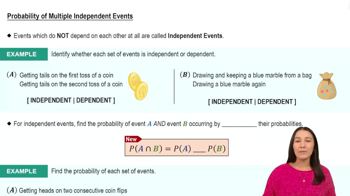
Probability of Multiple Independent Events

Union of Events

The union of two events, denoted as P(A or B), represents the probability that at least one of the events occurs. To calculate this, we typically use the formula P(A or B) = P(A) + P(B) - P(A and B). However, without knowing P(A and B), we cannot determine P(A or B) accurately.
Video consigliato:
Percorso guidato
05:54
Probability of Multiple Independent Events

Independence of Events

Events A and B are independent if the occurrence of one does not affect the probability of the other. If A and B are independent, we can calculate P(A and B) as P(A) * P(B). However, the question does not provide information about their independence, which is crucial for determining P(A or B) without additional data.
Video consigliato:
Percorso guidato
05:54
Probability of Multiple Independent Events
Pratica correlata
Domanda del libro di testo

In Exercises 19-22, determine whether the events are independent or dependent. Explain your reasoning.

22. Getting high grades and being awarded an academic scholarship

136
views

Domanda del libro di testo

In Exercises 25 and 26, determine whether the events are mutually exclusive. Explain your reasoning.

25. Event A: Randomly select a red jelly bean from a jar.

Event B: Randomly select a yellow jelly bean from the jar.

116
views
Domanda del libro di testo

In Exercises 7-12, classify the statement as an example of classical probability, empirical probability, or subjective probability. Explain your reasoning.

8. The probability of randomly selecting five cards of the same suit from a standard deck of 52 playing cards is about 0.002.

97
views
Domanda del libro di testo

In Exercises 19-22, determine whether the events are independent or dependent. Explain your reasoning.

19. Tossing a coin four times and getting four heads, and then tossing it a fifth time and getting a head

144
views
Domanda del libro di testo

In Exercises 29-32, find the probability.

31. A 12-sided die, numbered 1 to 12, is rolled. Find the probability that the roll results in an odd number or a number less than 4.

81
views
Domanda del libro di testo

In Exercises 35–38, the bar graph shows the results of a survey in which 8806 undergraduate students were asked how many hours they spend on studying and other academic activities outside of class in a typical week. (Source: American College Health Association)

" style="" width="480">

37. Find the probability of randomly selecting an undergraduate who does not study from 6 to 10 hours per week.

113
views