Ch. 3 - Probability
Larson - Elementary Statistics: Picturing the World 8th Edition
Larson8th EditionElementary Statistics: Picturing the WorldISBN: 9780137493470Non è quello che usi tu?Cambia libro di testo
Capitolo 3, Problema 3.RE.8

In Exercises 7-12, classify the statement as an example of classical probability, empirical probability, or subjective probability. Explain your reasoning.
8. The probability of randomly selecting five cards of the same suit from a standard deck of 52 playing cards is about 0.002.

Guida verificata passo dopo passo
1
Step 1: Understand the three types of probability classifications: Classical probability is based on theoretical reasoning and assumes equally likely outcomes. Empirical probability is based on observed data or experiments. Subjective probability is based on personal judgment or opinion.
Step 2: Analyze the given statement. The problem mentions the probability of randomly selecting five cards of the same suit from a standard deck of 52 playing cards, which is calculated as approximately 0.002.
Step 3: Determine the method used to calculate this probability. Since the probability is derived from theoretical calculations based on the rules of card combinations and the structure of a standard deck, it aligns with classical probability.
Step 4: Explain the reasoning. Classical probability applies here because the calculation is based on the assumption of equally likely outcomes (all cards in the deck have an equal chance of being selected) and uses combinatorial mathematics to determine the likelihood.
Step 5: Conclude the classification. The statement is an example of classical probability because it relies on theoretical principles rather than experimental data or personal judgment.

Risposta video verificata per un problema simile:

Questa soluzione video è stata consigliata dai nostri tutor come utile per risolvere questo problema.
Durata del video:
3m

Concetti chiave

Ecco i concetti essenziali che devi comprendere per rispondere correttamente alla domanda.

Classical Probability

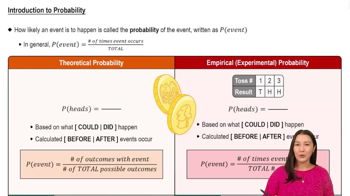
Classical probability is based on the assumption that all outcomes in a sample space are equally likely. It is calculated by taking the number of favorable outcomes and dividing it by the total number of possible outcomes. For example, when drawing cards from a deck, the probability of drawing a specific suit can be determined by the ratio of the number of cards in that suit to the total number of cards.
Video consigliato:
Percorso guidato
5:37
Introduction to Probability

Empirical Probability

Empirical probability, also known as experimental probability, is derived from actual experiments or historical data rather than theoretical calculations. It is calculated by observing the frequency of an event occurring in a series of trials and dividing it by the total number of trials. This type of probability is useful when theoretical models are difficult to apply or when real-world data is available.
Video consigliato:
Percorso guidato
5:37
Introduction to Probability

Subjective Probability

Subjective probability is based on personal judgment, intuition, or experience rather than on exact calculations or empirical data. It reflects an individual's belief about the likelihood of an event occurring, which can vary from person to person. This type of probability is often used in situations where there is little data available, and decisions must be made based on personal insights or expert opinions.
Video consigliato:
Percorso guidato
5:37
Introduction to Probability