Ch. 3 - Probability
Larson - Elementary Statistics: Picturing the World 8th Edition
Larson8th EditionElementary Statistics: Picturing the WorldISBN: 9780137493470Non è quello che usi tu?Cambia libro di testo
Capitolo 3, Problema 3.2.35

"According to Bayes’ Theorem, the probability of event A , given that event B has occurred, is
P(A|B) = P(A) * P(B|A)P(A) * P(B|A) + P(A') * P(B|A').
In Exercises 33–38, use Bayes’ Theorem to find P(A|B).
35. P(A) = 0.25, P(A') = 0.75, P(B|A) = 0.3 , and P(B|A') = 0.5 "

Guida verificata passo dopo passo
1
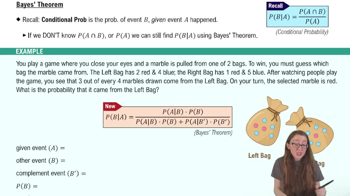
Step 1: Recall Bayes' Theorem formula: P(A|B) = (P(A) * P(B|A)) / (P(A) * P(B|A) + P(A') * P(B|A')). This formula helps calculate the conditional probability of event A given that event B has occurred.
Step 2: Identify the given values from the problem: P(A) = 0.25, P(A') = 0.75, P(B|A) = 0.3, and P(B|A') = 0.5.
Step 3: Substitute the given values into the numerator of the formula: P(A) * P(B|A) = 0.25 * 0.3.
Step 4: Substitute the given values into the denominator of the formula: P(A) * P(B|A) + P(A') * P(B|A') = (0.25 * 0.3) + (0.75 * 0.5).
Step 5: Simplify the numerator and denominator expressions separately, then divide the numerator by the denominator to find P(A|B).

Risposta video verificata per un problema simile:

Questa soluzione video è stata consigliata dai nostri tutor come utile per risolvere questo problema.
Durata del video:
4m

Concetti chiave

Ecco i concetti essenziali che devi comprendere per rispondere correttamente alla domanda.

Bayes' Theorem

Bayes' Theorem is a fundamental principle in probability theory that describes how to update the probability of a hypothesis based on new evidence. It states that the probability of event A given event B (P(A|B)) can be calculated using the formula P(A|B) = P(A) * P(B|A) / (P(A) * P(B|A) + P(A') * P(B|A')). This theorem is particularly useful in scenarios where prior knowledge about the events is available.
Video consigliato:

Conditional Probability

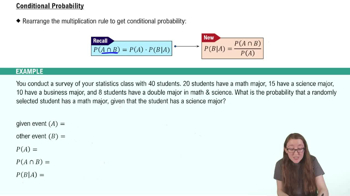
Conditional probability is the measure of the probability of an event occurring given that another event has already occurred. It is denoted as P(A|B), which represents the probability of event A occurring under the condition that event B is true. Understanding conditional probability is crucial for applying Bayes' Theorem, as it allows us to assess how the occurrence of one event influences the likelihood of another.
Video consigliato:
Percorso guidato
03:53
Conditional Probability Rule

Prior and Posterior Probabilities

In the context of Bayes' Theorem, prior probability refers to the initial assessment of the likelihood of an event before new evidence is considered (P(A)), while posterior probability is the updated probability after taking into account the new evidence (P(A|B)). The distinction between these two types of probabilities is essential for understanding how new information can change our beliefs about the likelihood of events.
Video consigliato:
Percorso guidato
5:37
Introduction to Probability