
Ch. 3 - Probability
Larson - Elementary Statistics: Picturing the World 8th Edition
Larson8th EditionElementary Statistics: Picturing the WorldISBN: 9780137493470Non è quello che usi tu?Cambia libro di testo
Capitolo 3, Problema 3.4.3

True or False? In Exercises 3-6, determine whether the statement is true or false. If it is false, rewrite it as a true statement.
3. A combination is an ordered arrangement of objects.

Guida verificata passo dopo passo
1
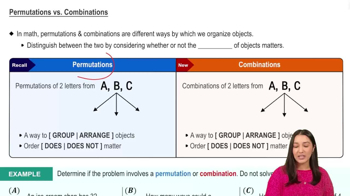
Understand the definition of a combination: A combination is a selection of objects where the order does not matter. This is a key distinction from a permutation, where the order does matter.
Analyze the given statement: 'A combination is an ordered arrangement of objects.'
Compare the definition of a combination with the statement. Since a combination does not consider order, the statement is false.
Rewrite the statement to make it true: 'A combination is an arrangement of objects where the order does not matter.'
Conclude that the corrected statement aligns with the definition of a combination, ensuring clarity and accuracy.

Risposta video verificata per un problema simile:

Questa soluzione video è stata consigliata dai nostri tutor come utile per risolvere questo problema.
Durata del video:
1m

Concetti chiave

Ecco i concetti essenziali che devi comprendere per rispondere correttamente alla domanda.

Combination vs. Permutation

A combination refers to a selection of items from a larger set where the order does not matter, while a permutation involves an arrangement of items where the order is significant. Understanding this distinction is crucial for accurately interpreting statements about arrangements and selections in statistics.
Video consigliato:
Percorso guidato
03:18
Permutations vs. Combinations

Ordered Arrangement

An ordered arrangement implies that the sequence of items is important, meaning that different sequences of the same items are considered distinct. This concept is fundamental in distinguishing between combinations and permutations, as it directly affects how we count and analyze different groupings of data.
Video consigliato:
Percorso guidato
06:37
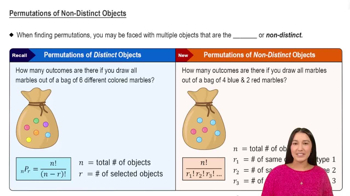
Permutations of Non-Distinct Objects

True/False Statements in Mathematics

In mathematics, determining the truth value of a statement often involves understanding definitions and properties of terms used. In this case, recognizing that a combination is not an ordered arrangement allows us to assess the statement's validity and, if false, to reformulate it correctly.
Video consigliato:
Percorso guidato
06:21
Step 1: Write Hypotheses
Pratica correlata
Domanda del libro di testo

"According to Bayes’ Theorem, the probability of event A , given that event B has occurred, is

P(A|B) = P(A) * P(B|A)P(A) * P(B|A) + P(A') * P(B|A').

In Exercises 33–38, use Bayes’ Theorem to find P(A|B).

35. P(A) = 0.25, P(A') = 0.75, P(B|A) = 0.3 , and P(B|A') = 0.5 "

104
views
Domanda del libro di testo

1. When two events are mutually exclusive, why is P(A and B) = 0?

264
views
Domanda del libro di testo

Cards In Exercises 59-62, you are dealt a hand of five cards from a standard deck of 52 playing cards.

62. Find the probability of being dealt three of a kind (the other two cards are different from each other).

146
views
Domanda del libro di testo

Classifying Events Based on Studies In Exercises 15-18, identify the two events described in the study. Do the results indicate that the events are independent or dependent? Explain your reasoning.

17. A study found that there is no relationship between playing violent video games and aggressive or bullying behavior in teenagers. (Source: The Royal Society Publishing)

75
views
Domanda del libro di testo

Boy or Girl? In Exercises 71-74, a couple plans to have three children. Each child is equally likely to be a boy or a girl.

74. What is the probability that at least one child is a boy?

111
views
Domanda del libro di testo

Matching Probabilities In Exercises 11-16, match the event with its probability.

a. 0.95

b. 0.005

c. 0.25

d. 0

e. 0.375

f. 0.5

14. A game show contestant must randomly select a door. One door doubles her money while the other three doors leave her with no winnings. What is the probability she selects the

door that doubles her money?

77
views