Ch. 3 - Probability
Larson - Elementary Statistics: Picturing the World 8th Edition
Larson8th EditionElementary Statistics: Picturing the WorldISBN: 9780137493470Non è quello che usi tu?Cambia libro di testo
Capitolo 3, Problema 3.1.74

Boy or Girl? In Exercises 71-74, a couple plans to have three children. Each child is equally likely to be a boy or a girl.
74. What is the probability that at least one child is a boy?

Guida verificata passo dopo passo
1
Step 1: Understand the problem. The couple plans to have three children, and each child is equally likely to be a boy or a girl. We are tasked with finding the probability that at least one child is a boy.
Step 2: Use the complement rule. Instead of directly calculating the probability of 'at least one boy,' calculate the probability of the complement event, which is 'no boys' (all children are girls), and subtract it from 1. This is because P(at least one boy) = 1 - P(no boys).
Step 3: Calculate the probability of the complement event (all children are girls). Since each child is equally likely to be a boy or a girl, the probability of a girl for one child is 0.5. For three children, the probability of all being girls is the product of their individual probabilities: P(all girls) = 0.5 × 0.5 × 0.5.
Step 4: Subtract the complement probability from 1 to find the desired probability. Use the formula P(at least one boy) = 1 - P(all girls).
Step 5: Simplify the expression to get the final probability. Ensure that the result is expressed as a fraction, decimal, or percentage, depending on the context of the problem.

Risposta video verificata per un problema simile:

Questa soluzione video è stata consigliata dai nostri tutor come utile per risolvere questo problema.
Durata del video:
2m

Concetti chiave

Ecco i concetti essenziali che devi comprendere per rispondere correttamente alla domanda.

Probability

Probability is a measure of the likelihood that a particular event will occur, expressed as a number between 0 and 1. In this context, it helps us quantify the chances of having at least one boy among three children, where each child has an equal chance of being a boy or a girl.
Video consigliato:
Percorso guidato
5:37
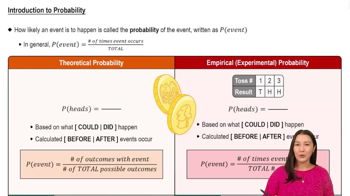
Introduction to Probability

Complement Rule

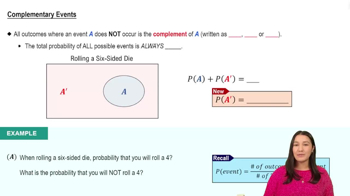
The Complement Rule states that the probability of an event occurring is equal to 1 minus the probability of it not occurring. For this question, instead of directly calculating the probability of having at least one boy, we can find the probability of having no boys (all girls) and subtract it from 1.
Video consigliato:
Percorso guidato
4:23
Complementary Events

Binomial Distribution

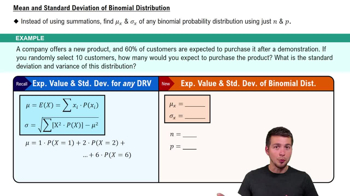
The Binomial Distribution models the number of successes in a fixed number of independent Bernoulli trials, each with the same probability of success. In this scenario, the number of boys in three children can be modeled using this distribution, where 'success' is defined as having a boy.
Video consigliato:
Percorso guidato
03:28
Mean & Standard Deviation of Binomial Distribution
Pratica correlata
Domanda del libro di testo

1. When two events are mutually exclusive, why is P(A and B) = 0?

264
views

Domanda del libro di testo

True or False? In Exercises 3-6, determine whether the statement is true or false. If it is false, rewrite it as a true statement.

3. A combination is an ordered arrangement of objects.

101
views
Domanda del libro di testo

Cards In Exercises 59-62, you are dealt a hand of five cards from a standard deck of 52 playing cards.

62. Find the probability of being dealt three of a kind (the other two cards are different from each other).

146
views
Domanda del libro di testo

Matching Probabilities In Exercises 11-16, match the event with its probability.

a. 0.95

b. 0.005

c. 0.25

d. 0

e. 0.375

f. 0.5

14. A game show contestant must randomly select a door. One door doubles her money while the other three doors leave her with no winnings. What is the probability she selects the

door that doubles her money?

77
views
Domanda del libro di testo

Recognizing Mutually Exclusive Events In Exercises 9–12, determine whether the events are mutually exclusive. Explain your reasoning.

10. Event A: Randomly select a student with a birthday in April.

Event B: Randomly select a student with a birthday in May.

144
views
Domanda del libro di testo

Classifying Types of Probability In Exercises 53-58, classify the statement as an example of classical probability, empirical probability, or subjective probability. Explain your reasoning.

55. An analyst feels that the probability of a team winning an upcoming game is 60%.

114
views