
Ch. 3 - Probability
Larson - Elementary Statistics: Picturing the World 8th Edition
Larson8th EditionElementary Statistics: Picturing the WorldISBN: 9780137493470Non è quello che usi tu?Cambia libro di testo
Capitolo 3, Problema 3.1.23

Finding the Probability of an Event In Exercises 21-24, the probability that an event will not happen is given. Find the probability that the event will happen. 
23. P(E')=3/4

Guida verificata passo dopo passo
1
Step 1: Understand the problem. The probability of the complement of an event, denoted as P(E'), is given as 3/4. You are tasked with finding the probability of the event itself, denoted as P(E).
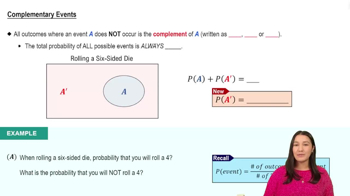
Step 2: Recall the relationship between the probability of an event and its complement. The sum of the probabilities of an event and its complement is always equal to 1. Mathematically, this is expressed as: P(E) + P(E') = 1.
Step 3: Substitute the given value of P(E') into the equation. Replace P(E') with 3/4 in the formula: P(E) + 3/4 = 1.
Step 4: Solve for P(E). Rearrange the equation to isolate P(E) on one side: P(E) = 1 - 3/4.
Step 5: Simplify the expression to find the probability of the event happening. Perform the subtraction: P(E) = 1 - 3/4. This will give you the final probability value.

Risposta video verificata per un problema simile:

Questa soluzione video è stata consigliata dai nostri tutor come utile per risolvere questo problema.
Durata del video:
1m

Concetti chiave

Ecco i concetti essenziali che devi comprendere per rispondere correttamente alla domanda.

Probability of an Event

Probability is a measure of the likelihood that a specific event will occur, expressed as a number between 0 and 1. An event with a probability of 0 means it will not happen, while a probability of 1 indicates certainty. Understanding how to calculate the probability of an event is fundamental in statistics, as it allows for predictions and informed decision-making.
Video consigliato:
Percorso guidato
05:54
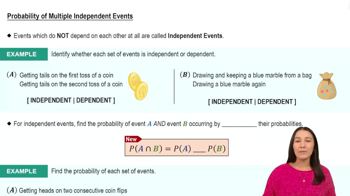
Probability of Multiple Independent Events

Complementary Events

Complementary events are two outcomes of a single event where one event occurs if and only if the other does not. For any event E, the probability of its complement E' (the event not happening) plus the probability of E must equal 1. This relationship is crucial for calculating probabilities, as it allows us to find the probability of an event by subtracting the probability of its complement from 1.
Video consigliato:
Percorso guidato
4:23
Complementary Events

Calculating Probability from Complements

To find the probability of an event occurring when given the probability of it not occurring, you can use the formula P(E) = 1 - P(E'). In the context of the question, if P(E') = 3/4, then P(E) can be calculated as 1 - 3/4, which equals 1/4. This method is a straightforward approach to solving probability problems involving complementary events.
Video consigliato:
Percorso guidato
06:31
Z-Scores From Given Probability - TI-84 (CE) Calculator
Pratica correlata
Domanda del libro di testo

According to Bayes’ Theorem, the probability of event A , given that event B has occurred, is

P(A|B) = P(A) * P(B|A)P(A) * P(B|A) + P(A') * P(B|A').

In Exercises 33–38, use Bayes’ Theorem to find P(A|B).

33. P(A) = 2/3, P(A') = 1/3, P(B|A) = 1/5 , and P(B|A') = 1/2

238
views
Domanda del libro di testo

Using a Tree Diagram In Exercises 67-70, a probability experiment consists of rolling a six-sided die and spinning the spinner shown at the left. The spinner is equally likely to land on each color. Use a tree diagram to find the probability of the event. Then explain whether the event can be considered unusual.

68. Event B: rolling an odd number and the spinner landing on green

87
views
Domanda del libro di testo

"True or False? In Exercises 5 and 6, determine whether the statement is true or false. If it is false, rewrite it as a true statement.

5. If two events are independent, then P(A|B) = P(B)."

37
views
Domanda del libro di testo

Finding Classical Probabilities In Exercises 41-46, a probability experiment consists of rolling a 12-sided die numbered 1 to 12. Find the probability of the event.

43. Event C: rolling a number greater than 4

164
views
Domanda del libro di testo

Cards In Exercises 59-62, you are dealt a hand of five cards from a standard deck of 52 playing cards.

59. Find the probability of being dealt two clubs and one of each of the other three suits.

116
views
Domanda del libro di testo

"According to Bayes’ Theorem, the probability of event A , given that event B has occurred, is

P(A|B) = P(A) * P(B|A)P(A) * P(B|A) + P(A') * P(B|A').

In Exercises 33–38, use Bayes’ Theorem to find P(A|B).

36. P(A) = 0.62, P(A') = 0.38, P(B|A) = 0.41 , and P(B|A') = 0.17 "

104
views