Ch. 3 - Probability
Larson - Elementary Statistics: Picturing the World 8th Edition
Larson8th EditionElementary Statistics: Picturing the WorldISBN: 9780137493470Non è quello che usi tu?Cambia libro di testo
Capitolo 3, Problema 3.1.68

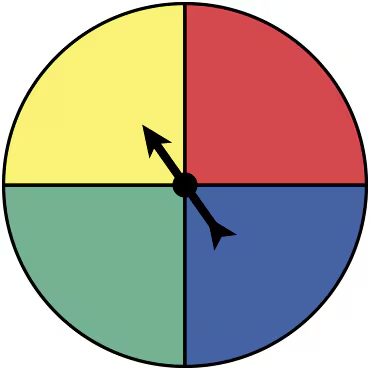
Using a Tree Diagram In Exercises 67-70, a probability experiment consists of rolling a six-sided die and spinning the spinner shown at the left. The spinner is equally likely to land on each color. Use a tree diagram to find the probability of the event. Then explain whether the event can be considered unusual.
68. Event B: rolling an odd number and the spinner landing on green
A circular spinner divided into four equal sections colored yellow, red, green, and blue, with an arrow pointing to yellow.

Guida verificata passo dopo passo
1
Step 1: Understand the problem. The experiment involves rolling a six-sided die and spinning a spinner with four equally likely colors: yellow, red, green, and blue. Event B is defined as rolling an odd number and the spinner landing on green.
Step 2: Identify the outcomes for rolling the die. A six-sided die has outcomes {1, 2, 3, 4, 5, 6}. Odd numbers are {1, 3, 5}, so there are 3 favorable outcomes for rolling an odd number.
Step 3: Identify the outcomes for the spinner. The spinner has 4 equally likely outcomes: yellow, red, green, and blue. The favorable outcome for Event B is the spinner landing on green, which is 1 out of 4 outcomes.
Step 4: Use a tree diagram to represent the combined outcomes. For each roll of the die (1, 2, 3, 4, 5, 6), draw branches for each spinner outcome (yellow, red, green, blue). Highlight the branches where the die roll is odd (1, 3, 5) and the spinner lands on green.
Step 5: Calculate the probability of Event B. Multiply the probability of rolling an odd number (3/6) by the probability of the spinner landing on green (1/4). This gives the probability of Event B. To determine if the event is unusual, compare the probability to a threshold (e.g., less than 0.05 is considered unusual).

Risposta video verificata per un problema simile:

Questa soluzione video è stata consigliata dai nostri tutor come utile per risolvere questo problema.
Durata del video:
2m

Concetti chiave

Ecco i concetti essenziali che devi comprendere per rispondere correttamente alla domanda.

Tree Diagram

A tree diagram is a visual representation used to illustrate all possible outcomes of a probability experiment. Each branch represents a possible outcome from a decision or event, allowing for a systematic way to calculate probabilities. In this case, the tree diagram will show the outcomes of rolling a die and spinning a spinner, helping to visualize the combined events.
Video consigliato:
Percorso guidato
5:14
Probability of Mutually Exclusive Events

Probability of Events

Probability quantifies the likelihood of an event occurring, expressed as a number between 0 and 1. For the given experiment, the probability of rolling an odd number (1, 3, or 5) and landing on green can be calculated by identifying the favorable outcomes over the total possible outcomes. Understanding how to calculate these probabilities is essential for determining whether the event is unusual.
Video consigliato:
Percorso guidato
05:54
Probability of Multiple Independent Events

Unusual Events

An event is considered unusual if its probability is significantly low, typically defined as less than 5%. In this context, after calculating the probability of rolling an odd number and landing on green, one must assess whether this probability falls below the threshold to classify the event as unusual. This concept helps in understanding the significance of certain outcomes in probability.
Video consigliato:
Percorso guidato
05:54
Probability of Multiple Independent Events
Pratica correlata
Domanda del libro di testo

56. Defective Disks A pack of 100 recordable DVDs contains 5 defective disks. You select four disks. What is the probability of selecting at least three non defective disks?

83
views

Domanda del libro di testo

Identifying Simple Events In Exercises 33-36, determine the number of outcomes in the event. Then decide whether the event is a simple event or not. Explain your reasoning.

34. A spreadsheet is used to randomly generate a number from 1 to 4000. Event B is generating a number less than 500.

112
views
Domanda del libro di testo

"True or False? In Exercises 5 and 6, determine whether the statement is true or false. If it is false, rewrite it as a true statement.

5. If two events are independent, then P(A|B) = P(B)."

37
views
Domanda del libro di testo

Finding Classical Probabilities In Exercises 41-46, a probability experiment consists of rolling a 12-sided die numbered 1 to 12. Find the probability of the event.

43. Event C: rolling a number greater than 4

164
views
Domanda del libro di testo

Finding the Probability of an Event In Exercises 21-24, the probability that an event will not happen is given. Find the probability that the event will happen. 

23. P(E')=3/4

256
views
Domanda del libro di testo

"According to Bayes’ Theorem, the probability of event A , given that event B has occurred, is

P(A|B) = P(A) * P(B|A)P(A) * P(B|A) + P(A') * P(B|A').

In Exercises 33–38, use Bayes’ Theorem to find P(A|B).

36. P(A) = 0.62, P(A') = 0.38, P(B|A) = 0.41 , and P(B|A') = 0.17 "

104
views