
Ch. 3 - Probability
Larson - Elementary Statistics: Picturing the World 8th Edition
Larson8th EditionElementary Statistics: Picturing the WorldISBN: 9780137493470Non è quello che usi tu?Cambia libro di testo
Capitolo 3, Problema 3.4.6

True or False? In Exercises 3-6, determine whether the statement is true or false. If it is false, rewrite it as a true statement.
6. 7C5=7C2

Guida verificata passo dopo passo
1
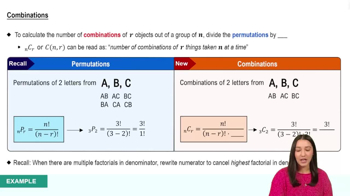
Step 1: Recall the formula for combinations, which is used to calculate the number of ways to choose r items from a set of n items. The formula is: C(n,r)=n!r!(n-r)!.
Step 2: Apply the formula to calculate C75. Substitute n = 7 and r = 5 into the formula: 7!5!(7-5)!.
Step 3: Simplify the denominator of the formula for C75. The denominator becomes 5!(2!), since 7-5=2.
Step 4: Similarly, calculate C72 using the same formula. Substitute n = 7 and r = 2 into the formula: 7!2!(7-2)!.
Step 5: Observe that the calculations for C75 and C72 are equivalent because of the symmetry property of combinations: Cnr=Cn(n-r). Conclude that the statement is true.

Risposta video verificata per un problema simile:

Questa soluzione video è stata consigliata dai nostri tutor come utile per risolvere questo problema.
Durata del video:
1m

Concetti chiave

Ecco i concetti essenziali che devi comprendere per rispondere correttamente alla domanda.

Combinatorial Notation

Combinatorial notation, often represented as nCr or C(n, r), denotes the number of ways to choose r elements from a set of n elements without regard to the order of selection. It is calculated using the formula nCr = n! / (r!(n-r)!), where '!' denotes factorial, the product of all positive integers up to that number.
Video consigliato:
Percorso guidato
06:33
Introduction to Confidence Intervals

Factorial

A factorial, denoted as n!, is the product of all positive integers from 1 to n. For example, 5! = 5 × 4 × 3 × 2 × 1 = 120. Factorials are fundamental in combinatorics, particularly in calculating combinations and permutations, as they help determine the total arrangements or selections possible.
Video consigliato:

Properties of Combinations

One important property of combinations is that C(n, r) = C(n, n-r). This means that choosing r elements from n is equivalent to leaving out n-r elements. This property is crucial for simplifying combinatorial expressions and understanding relationships between different combinations.
Video consigliato:
Pratica correlata
Domanda del libro di testo

Finding New Music In Exercises 45–48, use the pie chart, which shows the results of a survey of 513 music listeners who were asked about their primary source for new music. (Source: The Sound of AI)

<IMAGE>

47. You choose nine music listeners at random. What is the probability that none of them say their primary source for new music is friends or social media?

71
views
Domanda del libro di testo

Using the Fundamental Counting Principle In Exercises 37-40, use the Fundamental Counting Principle.

40. True or False Quiz Assuming that no questions are left unanswered, in how many ways can a six-question true or false quiz be answered?

165
views
Domanda del libro di testo

"According to Bayes’ Theorem, the probability of event A , given that event B has occurred, is

P(A|B) = P(A) * P(B|A)P(A) * P(B|A) + P(A') * P(B|A').

In Exercises 33–38, use Bayes’ Theorem to find P(A|B).

34. P(A) = 3/8, P(A') = 5/8, P(B|A) = 2/3 , and P(B|A') = 3/5 "

109
views
Domanda del libro di testo

True or False? In Exercises 5 and 6, determine whether the statement is true or false. If it is false, rewrite it as a true statement.

6. If events A and B are dependent, then P(A and B) = P(A) · P(B).

73
views
Domanda del libro di testo

1. When you calculate the number of permutations of n distinct objects taken r at a time, what are you counting? Give an example.

221
views
Domanda del libro di testo

16. Can Defects Of the cans produced by a company, 96% do not have a puncture, 93% do not have a smashed edge, and 89.3% have neither a puncture nor a smashed edge. Find

the probability that a randomly selected can does not have a puncture or a smashed edge.

88
views