
Ch. 3 - Probability
Larson - Elementary Statistics: Picturing the World 8th Edition
Larson8th EditionElementary Statistics: Picturing the WorldISBN: 9780137493470Non è quello che usi tu?Cambia libro di testo
Capitolo 3, Problema 3.2.6

True or False? In Exercises 5 and 6, determine whether the statement is true or false. If it is false, rewrite it as a true statement.
6. If events A and B are dependent, then P(A and B) = P(A) · P(B).

Guida verificata passo dopo passo
1
Step 1: Begin by understanding the concept of dependent and independent events. Dependent events are those where the occurrence of one event affects the probability of the other. Independent events, on the other hand, do not influence each other.
Step 2: Recall the formula for the probability of the intersection of two events (A and B). For independent events, the formula is P(A and B) = P(A) · P(B). However, for dependent events, this formula does not hold because the probability of B depends on A.
Step 3: For dependent events, the correct formula is P(A and B) = P(A) · P(B|A), where P(B|A) is the conditional probability of B given that A has occurred.
Step 4: Compare the given statement, 'If events A and B are dependent, then P(A and B) = P(A) · P(B)', with the correct formula for dependent events. Notice that the statement is false because it uses the formula for independent events instead of the correct formula for dependent events.
Step 5: Rewrite the statement as a true statement: 'If events A and B are dependent, then P(A and B) = P(A) · P(B|A).' This correctly reflects the relationship between dependent events.

Risposta video verificata per un problema simile:

Questa soluzione video è stata consigliata dai nostri tutor come utile per risolvere questo problema.
Durata del video:
57s

Concetti chiave

Ecco i concetti essenziali che devi comprendere per rispondere correttamente alla domanda.

Dependent Events

Dependent events are two or more events where the occurrence of one event affects the probability of the other event(s). For example, drawing a card from a deck without replacement means the outcome of the first draw influences the probabilities of subsequent draws.
Video consigliato:
Percorso guidato
05:54
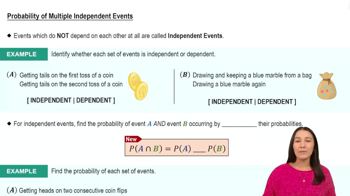
Probability of Multiple Independent Events

Joint Probability

Joint probability refers to the probability of two events occurring simultaneously. For dependent events A and B, the joint probability is calculated differently than for independent events, as it takes into account the influence of one event on the other.
Video consigliato:
Percorso guidato
5:37
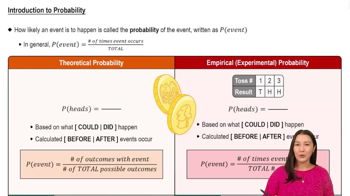
Introduction to Probability

Independent Events

Independent events are those where the occurrence of one event does not affect the probability of the other event. For independent events A and B, the joint probability is given by P(A and B) = P(A) · P(B), which is not applicable for dependent events.
Video consigliato:
Percorso guidato
05:54
Probability of Multiple Independent Events