
Ch. 3 - Probability
Larson - Elementary Statistics: Picturing the World 8th Edition
Larson8th EditionElementary Statistics: Picturing the WorldISBN: 9780137493470Non è quello che usi tu?Cambia libro di testo
Capitolo 3, Problema 3.1.37

Using the Fundamental Counting Principle In Exercises 37-40, use the Fundamental Counting Principle.
37. Menu A restaurant offers a \$15 dinner special that lets you choose from 6 appetizers, 12 entrées, and 8 desserts. How many different meals are available when you select an appetizer, an entrée, and a dessert?

Guida verificata passo dopo passo
1
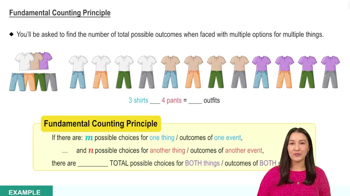
Step 1: Understand the Fundamental Counting Principle, which states that if there are multiple choices for different stages of a process, the total number of outcomes is the product of the number of choices at each stage.
Step 2: Identify the choices available for each stage in the problem. Here, the restaurant offers 6 appetizers, 12 entrées, and 8 desserts.
Step 3: Multiply the number of choices for appetizers, entrées, and desserts to find the total number of possible meal combinations. Use the formula: total=appetizers×entrées×desserts
Step 4: Substitute the values into the formula: total=6×12×8
Step 5: The result of the multiplication will give the total number of different meals available. Perform the calculation to find the final answer.

Risposta video verificata per un problema simile:

Questa soluzione video è stata consigliata dai nostri tutor come utile per risolvere questo problema.
Durata del video:
1m

Concetti chiave

Ecco i concetti essenziali che devi comprendere per rispondere correttamente alla domanda.

Fundamental Counting Principle

The Fundamental Counting Principle states that if there are 'n' ways to do one thing and 'm' ways to do another, then there are n × m ways to perform both actions. This principle is essential for calculating the total number of combinations in scenarios where multiple choices are involved, such as selecting items from a menu.
Video consigliato:
Percorso guidato
04:04
Fundamental Counting Principle

Combinations

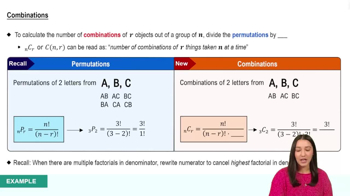
Combinations refer to the selection of items from a larger set where the order does not matter. In the context of the restaurant menu, each choice of appetizer, entrée, and dessert represents a combination of items that can be selected independently, contributing to the overall meal options.
Video consigliato:

Multiplicative Rule

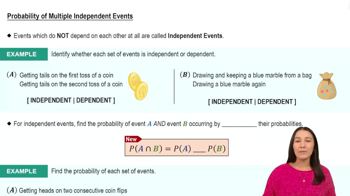
The Multiplicative Rule is a principle in probability and combinatorics that states the total number of outcomes for a series of independent events is the product of the number of outcomes for each event. In this case, the number of meal combinations is calculated by multiplying the number of choices for appetizers, entrées, and desserts.
Video consigliato:
Percorso guidato
05:54
Probability of Multiple Independent Events
Pratica correlata
Domanda del libro di testo

Odds The chances of winning are often written in terms of odds rather than probabilities. The odds of winning is the ratio of the number of successful outcomes to the number of unsuccessful outcomes. The odds of losing is the ratio of the number of unsuccessful outcomes to the number of successful outcomes. For example, when the number of successful outcomes is 2 and the number of unsuccessful outcomes is 3, the odds of winning are 2 : 3 (read "2 to 3"). In Exercises 91-96, use this information about odds.

94. A card is picked at random from a standard deck of 52 playing cards. Find the odds that it is a spade.

242
views
Domanda del libro di testo

Identifying the Sample Space of a Probability Experiment In Exercises 25-32, identify the sample space of the probability experiment and determine the number of outcomes in the sample space. Draw a tree diagram when appropriate.

32. Rolling a six-sided die, tossing two coins, and spinning the fair spinner shown

158
views
Domanda del libro di testo

Identifying the Sample Space of a Probability Experiment In Exercises 25-32, identify the sample space of the probability experiment and determine the number of outcomes in the sample space. Draw a tree diagram when appropriate.

31. Rolling a pair of six-sided dice

107
views
Domanda del libro di testo

Identifying the Sample Space of a Probability Experiment In Exercises 25-32, identify the sample space of the probability experiment and determine the number of outcomes in the sample space. Draw a tree diagram when appropriate.

28. Identifying a person's eye color (brown, blue, green, hazel, gray, other) and hair color (black, brown, blonde, red, other).

113
views
Domanda del libro di testo

In Exercises 7-14, perform the indicated calculation.

9.8C3

136
views
Domanda del libro di testo

"Classifying Events as Independent or Dependent In Exercises 9-14, determine whether the events are independent or dependent. Explain your reasoning.

10. A father having hazel eyes and a daughter having hazel eyes"

69
views