
Ch. 3 - Probability
Larson - Elementary Statistics: Picturing the World 8th Edition
Larson8th EditionElementary Statistics: Picturing the WorldISBN: 9780137493470Non è quello che usi tu?Cambia libro di testo
Capitolo 3, Problema 3.2.24c

"Using the Multiplication Rule In Exercises 19-32, use the Multiplication Rule.
24. Knowing a Person Who Was Murdered In a sample of 11,771 children ages 2 to 17, 8% have lost a friend or relative to murder. Four children are selected at random. (Adapted from University of New Hampshire)
c. Find the probability that at least one of the four has lost a friend or relative to murder."

Guida verificata passo dopo passo
1
Step 1: Understand the problem. We are tasked with finding the probability that at least one of the four randomly selected children has lost a friend or relative to murder. This is a complementary probability problem, where we first calculate the probability that none of the four children has lost a friend or relative to murder, and then subtract this value from 1.
Step 2: Define the probability of the complementary event. The probability that a single child has NOT lost a friend or relative to murder is 1 - 0.08 = 0.92 (since 8% of children have lost someone to murder).
Step 3: Use the Multiplication Rule to calculate the probability that none of the four children has lost a friend or relative to murder. Assuming the selections are independent, the probability that all four children have NOT lost someone is given by the product of their individual probabilities: \( P(\text{none}) = 0.92 \times 0.92 \times 0.92 \times 0.92 = 0.92^4 \).
Step 4: Calculate the probability of the event we are interested in (at least one child has lost a friend or relative to murder). This is the complement of the probability that none of the children has lost someone: \( P(\text{at least one}) = 1 - P(\text{none}) = 1 - 0.92^4 \).
Step 5: Conclude the solution. The final probability can be found by evaluating \( 1 - 0.92^4 \). This gives the probability that at least one of the four children has lost a friend or relative to murder.

Risposta video verificata per un problema simile:

Questa soluzione video è stata consigliata dai nostri tutor come utile per risolvere questo problema.
Durata del video:
4m

Concetti chiave

Ecco i concetti essenziali che devi comprendere per rispondere correttamente alla domanda.

Multiplication Rule

The Multiplication Rule in probability states that the probability of two independent events both occurring is the product of their individual probabilities. This rule is essential for calculating the likelihood of multiple events happening together, especially when dealing with random selections, as in this question.
Video consigliato:
Percorso guidato
05:17
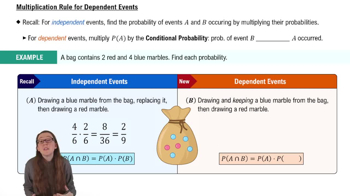
Multiplication Rule: Dependent Events

Complement Rule

The Complement Rule is a fundamental concept in probability that states the probability of an event occurring is equal to one minus the probability of it not occurring. In this context, to find the probability that at least one child has lost a friend or relative to murder, it is often easier to first calculate the probability that none have, and then subtract that from one.
Video consigliato:
Percorso guidato
03:53
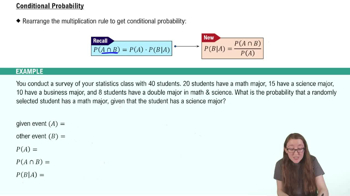
Conditional Probability Rule

Binomial Probability

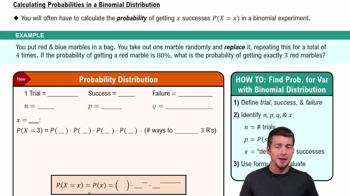
Binomial Probability refers to the probability of obtaining a fixed number of successes in a fixed number of independent Bernoulli trials, each with the same probability of success. In this scenario, selecting four children can be modeled as a binomial experiment where 'success' is defined as a child having lost a friend or relative to murder, allowing for the application of binomial probability formulas.
Video consigliato:
Percorso guidato
06:39
Calculating Probabilities in a Binomial Distribution
Pratica correlata
Domanda del libro di testo

Using the Multiplication Rule In Exercises 19-32, use the Multiplication Rule.

26. Worst President In a sample of 1500 adult U.S. citizens, 690 said that Donald Trump was the worst president in U.S. history. Three adult U.S. citizens are selected at random.

(Adapted from YouGov)

c. Find the probability that at most two of the three adult U.S. citizens say that Donald Trump was the worst president in U.S. history.

127
views
Domanda del libro di testo

"Using the Multiplication Rule In Exercises 19-32, use the Multiplication Rule.

23. Celebrities as Role Models In a sample of 1103 probable voters, three out of four say they would like entertainers to address social and political issues. Two probable voters are selected at random. (Source: The Hollywood Reporter)

c. Find the probability that at least one of the two probable voters would like entertainers to address social and political issues."

59
views
Domanda del libro di testo

Using the Multiplication Rule In Exercises 19-32, use the Multiplication Rule.

27. Blood Types The probability that a person of Asian descent in the United States has type O+ blood is 39%. At random, six people of Asian descent in the United States are selected. (Source: American National Red Cross)

c. Find the probability that at least one of the six has type O+ blood.

74
views
Domanda del libro di testo

81. Genetics A Punnett square is a diagram that shows all possible gene combinations in a cross of parents whose genes are known. When two pink snapdragon flowers (RW) are crossed, there are four equally likely possible outcomes for the genetic makeup of the offspring: red (RR), pink (RW), pink (WR), and white (WW), as shown in the Punnett square at the left. When two pink snapdragons are crossed, what is the probability that the offspring will be (c) white?

131
views
Domanda del libro di testo

17. Selecting a Card A card is selected at random from a standard deck of 52 playing cards. Find the probability of each event.

c. Randomly selecting a 9 or a face card

388
views
Domanda del libro di testo

23. Engineering Degrees The table shows the numbers of male and female students in the U.S. who received B.S. degrees in engineering in a recent year. A student earning a B.S. degree in engineering during that year is selected at random. Find the probability of each event.

(Source: National Center for Educational Statistics)

c. The student is not female or did not receive a mechanical engineering degree.

82
views